Implementing this policy, An Giang province is focusing on developing a number of social housing projects while proactively addressing difficulties arising during the implementation process.
Under Resolution No. 07/NQ-CP dated January 12, 2026 of the Government on assigning social housing development targets for the 2026-2030 period, An Giang has been assigned a target of building 6,010 units. This is a major task requiring the coordinated involvement of all levels, sectors, localities and the business community.
Contributing to changes in the urban landscape
To concretise the target, the provincial People’s Committee has assigned the Department of Construction to take the lead and coordinate with departments, sectors and the People’s Committees of communes, wards and special administrative zones to review and assess housing and rental housing needs among workers, labourers, officials, civil servants, public employees and people facing housing difficulties.
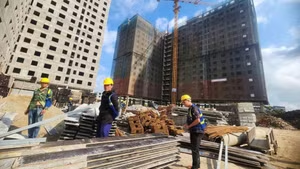
An Giang currently has seven social housing projects under construction, with a total scale of 6,579 units. Of these, 3,200 units were completed during the 2021-2025 period, while in 2026 the province aims to complete 1,116 units out of the target assigned by the Government.
Nguyen Van Hon, Deputy Director of the Department of Construction of An Giang province
On that basis, plans are being developed for 2026 and the 2026-2030 period, identifying targets, project lists, implementation roadmaps and resource requirements. According to Nguyen Van Hon, Deputy Director of the provincial Department of Construction, An Giang has seven social housing projects under construction, with a total scale of 6,579 units. Of these, 3,200 units were completed during the 2021-2025 period, while in 2026 the province aims to complete 1,116 units out of the target assigned by the Government.
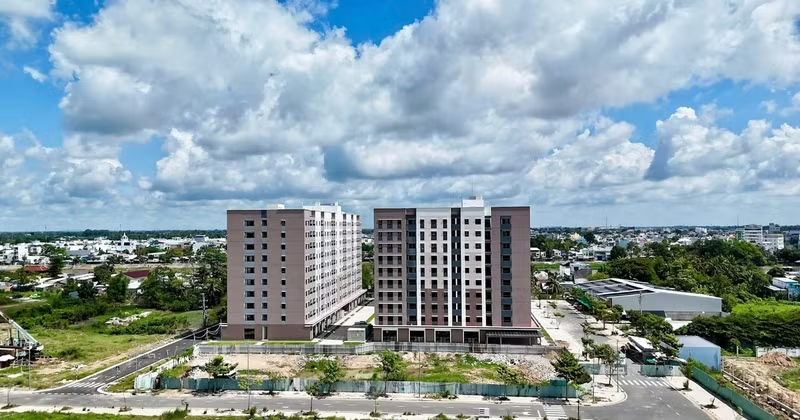
These social housing units not only increase the housing supply but also contribute to changing the appearance of urban areas, creating more favourable conditions for people to travel, work and study. In Long Xuyen ward, the social housing project in the Tay Dai Hoc residential area, developed by An Giang Construction One Member Company Limited, is located in what was previously a sparsely populated area and has now taken on a new appearance.
The project consists of four multi-storey apartment blocks with 446 units. When the State invested in and opened a major road, it connected the social housing complex with hospitals, schools, Long Xuyen Bus Station and important transport facilities, bringing new vitality to the residential area. The developer has now completed procedures to sell the remaining units and issue certificates of land use rights and ownership of assets attached to land to customers.
Under the roadmap, the province is expected to complete 1,116 units in 2026, 3,600 units during the 2027-2029 period and 1,300 units in 2030. Social housing projects are concentrated mainly in Rach Gia ward, Long Xuyen ward and Phu Quoc special administrative zone.
In Rach Gia ward, Phu Cuong Hoang Gia Joint Stock Company is the developer of the Phu Cuong Phu Quy Urban Area social housing project, with a total scale of 1,203 low-rise terraced housing units. In July 2026, in the first phase, the company organised a lottery for customers to select 751 units, with handover expected by the end of 2026. The project is located about 3 km from the central area and has connections to transport routes, residential areas and existing utility systems.
Addressing difficulties in mechanisms, procedures and resources
In July 2026, Pham Dung Tien was very happy when he moved into his social housing apartment in Long Xuyen ward, as he now had a home of his own and could feel secure in focusing on his work. With his current income, it would normally be very difficult for Mr Tien to purchase his own apartment. This is also a common concern for many people, particularly workers and labourers.
One gap that needs continued attention is social housing associated with industrial parks. At present, there are no social housing projects in industrial parks in the province serving low-income workers. The province has planned land reserves for developing worker housing associated with industrial parks, but it has encountered difficulties in attracting investment and no investor has yet registered to invest.
According to Nguyen Van Hon, the central authorities have introduced numerous preferential policies for social housing developers, expanded incentives for beneficiaries of social housing policies, removed difficulties and obstacles, and provided timely support to accelerate project implementation. However, alongside these favourable conditions, there are also difficulties, such as the targets assigned by the Ministry of Construction exceeding the actual construction capacity of projects in the province, meaning that the number of completed units has not yet met the assigned plan.
Some projects have encountered difficulties with legal procedures during implementation following conclusions issued by the Ministry of Construction’s Inspectorate, and therefore have not been able to ensure construction investment progress in accordance with regulations. Some projects under construction have faced difficulties with site clearance and challenges regarding product sales. At present, fluctuations in prices and shortages of construction materials are also affecting the construction investment progress of projects.
Huynh Thai Lel, General Director of Phu Cuong Hoang Gia Joint Stock Company, said that under the development orientation for the Phu Cuong Hoang Gia urban area, the company plans to develop around 3,000 social housing apartments, contributing to diversifying housing products and meeting the growing demand for stable housing in central Rach Gia. The development of apartment housing is planned in conjunction with the overall planning of the urban area, technical infrastructure, amenities and service spaces, with the aim of forming a modern and integrated residential community.
According to Huynh Thai Lel, the greatest advantage is that demand for social housing in Rach Gia ward and An Giang province is currently high. This is also an area receiving attention and direction from State management agencies. At the same time, social housing development faces difficulties, particularly in meeting requirements related to land reserves, investment procedures, planning, land, construction permits, capital and construction progress. In addition, the construction market is affected by fluctuations in raw material prices, shortages of construction materials at certain times and a shortage of construction workers, thereby affecting investment costs and project implementation progress.
At meetings related to social housing development, Chairman of the provincial People’s Committee Ho Van Muong affirmed that social housing is not only urban infrastructure but also a core pillar of social welfare. He also requested the Department of Construction, the Department of Planning and Investment and local authorities to take more decisive and coordinated action in reviewing and prioritising clean land reserves so that they are ready for social housing projects. In addition, investment attraction mechanisms need to be renewed, including strongly encouraging enterprises to invest through public-private partnerships (PPPs), and considering the reduction of complex administrative procedures so that investors can access projects as quickly as possible.
The province has proposed that the central authorities add preferential credit packages for people purchasing or renting homes. At the same time, it has assigned departments and sectors to closely coordinate with enterprises to properly assess housing demand among residents in each area, so as to develop realistic development plans and ensure that workers genuinely have opportunities to settle down and build their lives.






![[Video] Renewal and growth milestones of Ha Noi through the lens](https://en-cdn.nhandan.vn/images/1XgBTSIw0KyfD4abQsg-hd4ly6fBUHXC7_OAKyN4YwPfAhBw0Xs6rVX3rF0up9Tr6rLNn30Muc4bzp90E7yOqg/10-10-hanoi-cover.jpg.avif)