'Green lane' procedures: A breakthrough from mindset to action
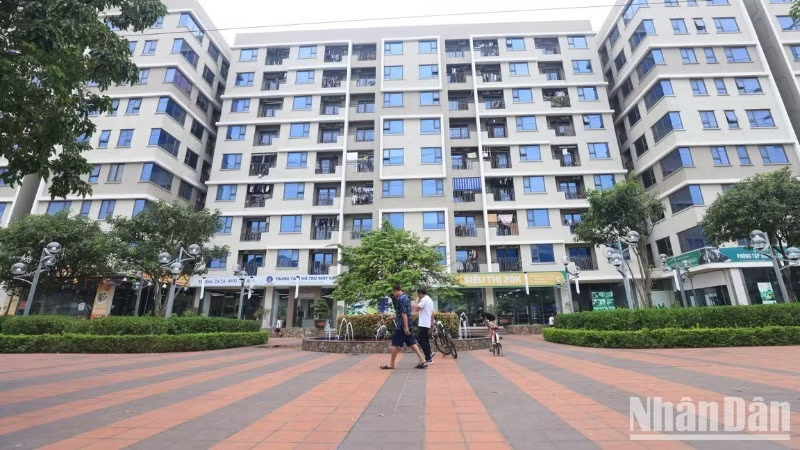
In its socio-economic development roadmap for the coming years, Ha Noi has identified social housing development not only as a key social welfare task but also as an important lever for achieving the double-digit economic growth target set by the Party Central Committee.
Under Directive No. 16 of the Ha Noi People's Committee, the city's 2026–2030 plan includes a portfolio of 236 social housing projects. To date, investment policy approval has been granted for 147 projects comprising around 132,000 apartments, with total investment exceeding 290.5 trillion VND.
Ha Noi has designated 2026 as a pivotal year, aiming to complete at least 18,700 social housing units in line with the target assigned by the Government, while striving to bring between 25,000 and 27,000 units to the market. To achieve this goal, the city is determined to commence construction on 114 projects during the final six months of 2026, regarding this as a priority task to ensure adequate housing supply and accelerate investment disbursement.
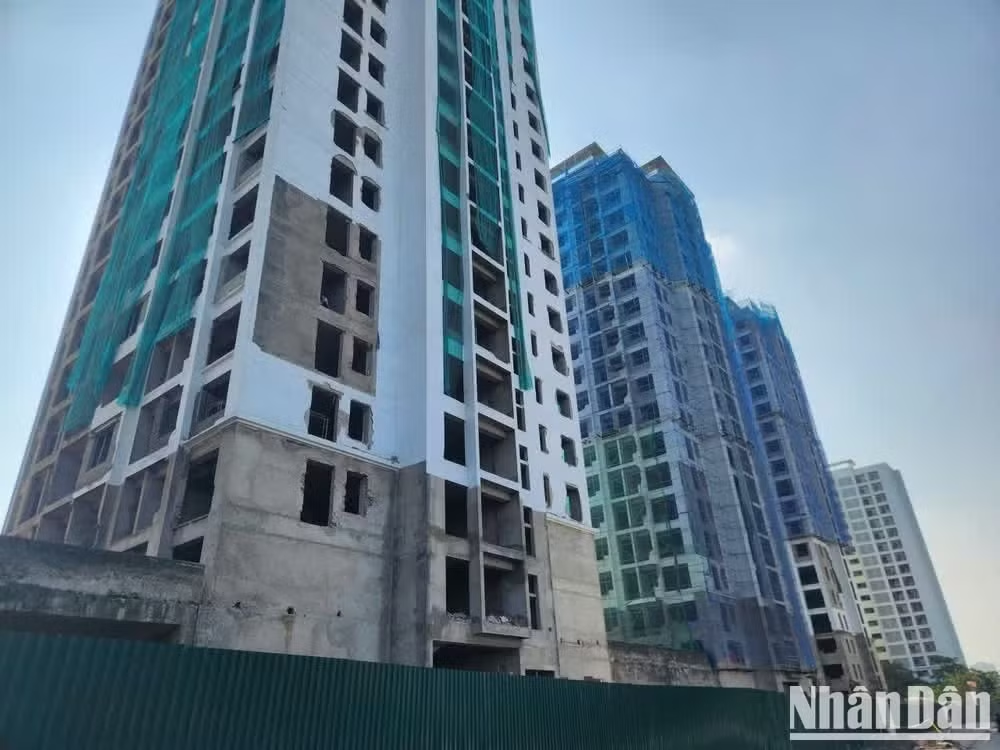
To realise these objectives, Ha Noi has identified administrative reform as the key breakthrough. The city has instructed authorities to reduce processing times for administrative procedures by at least 50%, while introducing the "green lane" mechanism for planning, land administration, and construction procedures.
Speaking on the issue, Luyen Van Phuong, Deputy Director of the Ha Noi Department of Construction, said: "Substantially reducing the time required to process administrative procedures is not only a factor in meeting deadlines but also an important step in administrative reform. If implemented effectively, the 'green lane' mechanism will eliminate unnecessary intermediary procedures, enabling businesses to commence projects sooner and bring products to the market more quickly."
The Department of Construction has already reduced the time required for construction appraisal and permit issuance to a maximum of 10 working days.
The Viet Nam Institute for Economic and Real Estate Research also noted that while the target of breaking ground on 114 projects demonstrates strong determination, the real challenge lies in implementation. Halving administrative processing times is necessary, but this must be accompanied by effective coordination across planning, land administration, and construction licensing. It also recommended establishing a transparent project-by-project monitoring mechanism to prevent delays in implementation despite early registration.
Practical review with emphasis on feasibility
Another notable feature of Ha Noi's approach is its emphasis on discipline and practicality rather than pursuing numbers alone. Under Decision No. 3602/QD-UBND, the city has thoroughly reviewed and updated its project portfolio, removing 22 projects that were no longer suitable or whose investors lacked sufficient capacity — including several large-scale developments in Soc Son and Tay Tuu.
Instead, the city is focusing on highly feasible projects in key areas such as Nam Tu Liem, Bac Tu Liem, Dan Phuong, and Soc Son.
A major highlight of the city's latest social housing strategy is its focus on rental housing. Three flagship outstanding social housing projects, with combined investment of more than 34 trillion VND, are intended to diversify housing options that are affordable to workers. Among them, the 36-hectare project developed by Him Lam Joint Stock Company in Long Bien Ward is expected to provide more than 2,000 rental apartments and is regarded as a highlight development for the 2026–2031 period.
Alongside support mechanisms, Ha Noi has openly acknowledged persistent bottlenecks in site clearance and the determination of financial obligations. To address these issues, the Ha Noi People's Committee has granted greater authority to commune- and ward-level authorities in appraising 1:500 detailed planning schemes, while reducing site clearance timelines to between 60 and 90 days, depending on the scale of each social housing project.
However, support measures will be accompanied by stricter enforcement. The Ha Noi Department of Construction has tightened accountability requirements for project developers, while the Ha Noi People's Committee has required all investors to commit to specific implementation schedules. Developers that fail to meet their commitments without legitimate reasons will face strict penalties, including possible project revocation in cases of prolonged delays or serious violations.