The lingering pain
On August 10, 1961, the first US military flights began spraying chemical agents over southern Viet Nam, initiating an Agent Orange tragedy that has spanned multiple generations. Statistics indicated that approximately 4.8 million Vietnamese people have been exposed to Agent Orange/dioxin; hundreds of thousands have passed away, while millions more continue to liv
e with the lasting consequences. The effects of Agent Orange/dioxin have persisted into the third and fourth generations, resulting in congenital disabilities, severe illnesses, and the loss of the ability to work.
These figures cannot fully capture the suffering endured by families like that of Diu. Following the war, he and his wife had 15 children; today, only three remain alive, and of those, only one has developed normally.
Do Thi Hang is Diu’s second daughter. At birth, she was immobile and partially paralysed. Her life has been defined by hospital corridors and eight separate surgeries, spanning from her childhood into adulthood.
Her first operation took place after doctors diagnosed her with hydrocephalus. Less than a month later, Hang underwent three additional surgeries to address spina bifida—a congenital spinal defect. Surgeons had to carefully connect and realign her vertebrae, hoping to enable her to stand on her own two feet. Yet, the tragedy did not end there. As an adult, Hang has faced bouts of excruciating pain that have repeatedly necessitated emergency hospitalisations.
Doctors discovered that she had developed complications from uterine fibroids, necessitating the removal of both her uterus and ovaries. “Agent Orange stole half my life. It robbed me of the chance to pursue an education, to experience love, and to become a mother”, Hang shared, her voice choking with emotion.
For more than a decade that followed, Diu and his wife traveled tirelessly from one hospital to another. They sold their entire flock of chickens and ducks, and even mortgaged their land deed and pension documents to secure loans—all in a desperate fight to save their daughter’s life.
“The Colour of Hope”
As a second-generation victim of Agent Orange, Do Ha Cu (from Hung Yen Province) has been almost entirely immobile since birth, with only the index finger on his right hand capable of movement. At the age of ten, while watching television and seeing visually impaired people learning to read Braille, Cu asked his mother, “I have eyes that can see—why can’t I learn to read?”
That question sparked a long, persistent journey for his mother, Nguyen Thi Kim Son, as she taught her son how to read and write. It took two years of unwavering perseverance before Cu was finally able to read his first lines of text.
Do Ha Cu gradually rediscovered the meaning of his life, and in 2015, he founded a library called “Hope Reading Space”. To date, this small library has welcomed tens of thousands of readers and served as the inspiration for the establishment of over 30 similar reading spaces for people with disabilities across the country.
With only one finger capable of movement, Cu spent six years completing his autobiography, “The Colour of Hope”, a volume spanning nearly 400 pages. The book chronicles a journey through one’s own personal darkness—recounting the physical pain and moments of utter despair experienced by a young man who once felt like giving up.
At the same time, it portrays the boundless love of a mother who persevered in teaching him, letter by letter, and gave wings to dreams that once seemed impossible to realise.
Embracing arms of compassion
The miraculous recovery of Do Thi Hang stemmed not only from her own resilience and the love of her parents, but also from the support of those who reached out with compassionate, embracing arms. In 2000, Hang was welcomed into the Viet Nam Friendship Village in Ha Noi, where she received care and upbringing.
Having been a part of this community for over 20 years, the Village has served as a home and a pillar of strength, helping Hang overcome her hardships. Today, she is more resilient; she crafts handmade flowers and greeting cards, and dreams of opening an online shop to help support her family.
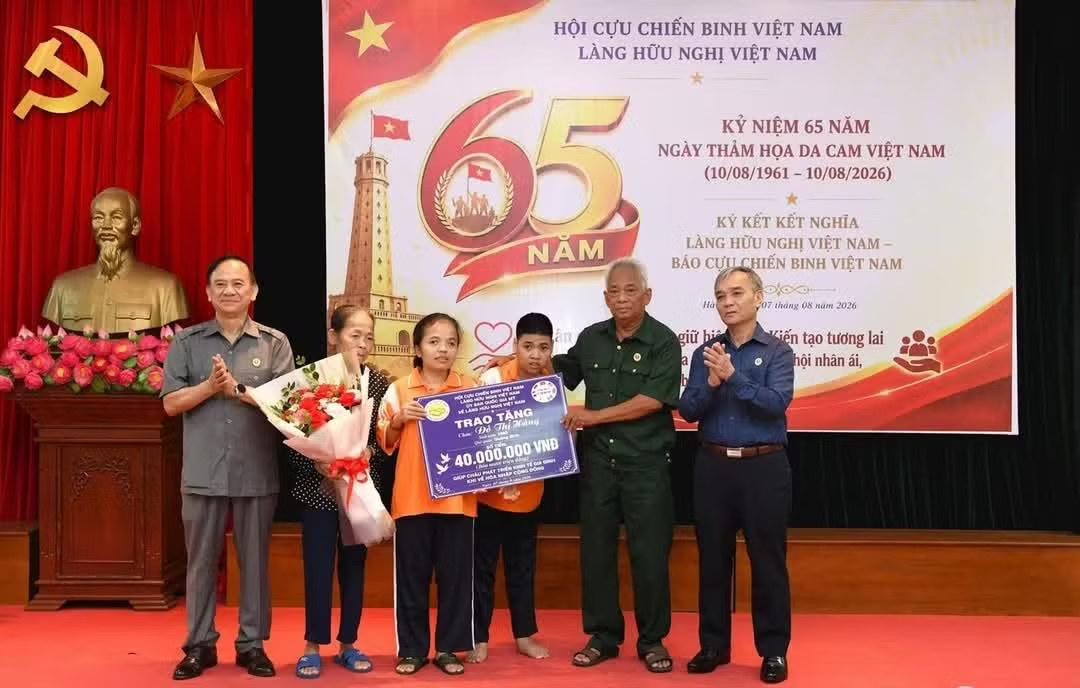
On August 7, Hang and her family returned to visit the Viet Nam Friendship Village. During a ceremony marking the 65th anniversary of the Agent Orange catastrophe, she shared with deep emotion: “Without the love and care of the staff here at the Viet Nam Friendship Village, it would have been nearly impossible for me to endure the cruel twists and turns of my life.”
At the event, the Village’s leaders gifted Hang 40 million VND in startup capital to help her pursue her dream of running an online business and gradually achieving independence. Previously, Tecapro (a company under the Ministry of National Defence) also provided Hang with 20 million VND and a computer, while also granting 20 million VND to Do Ha Cu to support his project aimed at promoting a culture of reading.
Despite bearing the physical scars of war and the lasting effects of Agent Orange, Ho Quoc Minh—from Tan Hung Commune, Tay Ninh Province—remains steadfast in his perspective: “I am still luckier than many of my comrades, as I survived and was able to return home to my family.” Deeply empathetic toward the suffering of other victims, this wounded veteran has long been a pioneer in local humanitarian efforts.
In 2023, upon learning of the difficult circumstances faced by the family of Ho Thi Suong—the widow of a fallen soldier whose child suffers from the lasting effects of Agent Orange—he donated 100 square meters of his own residential land for the construction of a “gratitude house”.
Furthermore, drawing from his monthly disability pension, he contributed 60 million VND toward home repairs for two other families entitled to state welfare policies, and he frequently provides gifts to impoverished households and victims of Agent Orange during holidays and the Tet (Lunar New Year) festival.
No one is left behind
Throughout their journey to overcome the suffering caused by Agent Orange, millions of victims have been steadfastly supported by the Viet Nam Association for Victims of Agent Orange/Dioxin (VAVA).
For over 20 years, the Association has served as a bridge between those facing such profound misfortune and the broader community, while also acting as an organisation that protects the legal rights and interests of Agent Orange victims in Viet Nam.
Between 2021 and 2025, the Association mobilised over 2.424 trillion VND. Of this amount, nearly 2.314 trillion VND was dedicated to building and repairing homes, distributing gifts, providing capital for production, creating livelihoods, and offering care and support for victims.
In recent years, support efforts have increasingly shifted toward long-term solutions—such as providing loans, supplying production tools, offering vocational training, and creating employment opportunities—to help victims and their families gradually achieve self-reliance and integrate into the community.
Nevertheless, there remain individuals affected by Agent Orange who do not yet have full access to support policies. This includes those who served in areas where dioxin persisted after 1975, residents living in regions once sprayed with chemical agents, and victims belonging to the third and fourth generations.
The review and amendment of policies, the expansion of the range of beneficiaries, and the enhancement of opportunities for education, employment, and livelihoods for victims of Agent Orange must continue—ensuring that no one is left to suffer the disadvantages caused by the legacy of war.