Leading the way towards shared development
Dak Nhau Commune, in Dong Nai City, lies at the end of the Truong Son mountain range, at the junction between the Central Highlands and the Southeast region. This remote area is home to 26 ethnic groups, with ethnic minorities accounting for about 51.7% of the population. Grassroots Party members, particularly those from ethnic minority groups, take the lead in restructuring crops and livestock, applying scientific and technical advances to production, and helping residents develop livelihoods and achieve sustainable poverty reduction.
Taking us to visit the gardens of Party members who excel in production and actively participate in social activities, Pham Dinh Phung, Standing Deputy Secretary of the Dak Nhau Commune Party Committee, said: “As a remote commune with a large ethnic minority population, Dak Nhau still faces many difficulties. However, it is changing day by day thanks to investment and attention from the Party, the State, and Dong Nai City.
Higher-level funding is prioritised for the development of synchronised infrastructure, while local resources are used to reduce poverty and improve people’s material and spiritual lives. Grassroots Party members lead local residents in developing household economies and building a cultured lifestyle in residential areas. Examples include Party members Dieu Tan and Dieu Trem in Dak La Hamlet, Dieu Pyon in Dak Nung Hamlet, and Chu Thi Dung in Dak Wi Hamlet.”
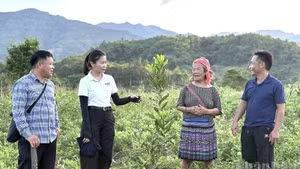
At the home of Party member Dieu Pyong, who belongs to the Stieng ethnic group, it was already late morning, but he was still diligently showing local households how to care for durian trees and use plant protection products as the trees prepared to flower.
According to Vo Quynh Thanh Truc, Chairwoman of the commune’s Farmers’ Association, Dieu Pyong consistently sets an example, boldly embraces new ways of thinking and working, and proactively applies suitable production methods to develop his household economy, gradually increasing income and improving living standards.
He also raises awareness among local residents and encourages them to change their production methods and restructure crops and livestock in ways that are effective and suited to local conditions. Through these practical efforts, he has spread the spirit of emulation in labour and production, inspired ethnic minority communities to strive for a better life, and encouraged them to join hands in developing their homeland of Dak Nhau.
Dieu Pyong said: “In the past, poor households accounted for a high proportion of the population in Dak Nung Hamlet, partly because people had limited understanding of household economic development, while some relied on others rather than making their own efforts.
Since 2010, after gaining access to cultivation knowledge and receiving support from local authorities in the form of seedlings, I have boldly cleared gardens of low-yielding trees to grow durian, intercropping coffee to generate short-term income while waiting for longer-term returns. As a result, my family now earns 200–300 million VND a year.”
He added: “I was the first ethnic minority resident in Dak Nung Hamlet to change crops and develop a model of growing coffee beneath durian trees. After seeing the results, I encouraged other households to restructure their crops and shared my experience of growing and caring for the trees. Many households followed suit and now enjoy better living standards, including Party members Dieu Ma and Thi Doan, each of whom earns around 200 million VND a year.”
Household economies provide foundation for stability
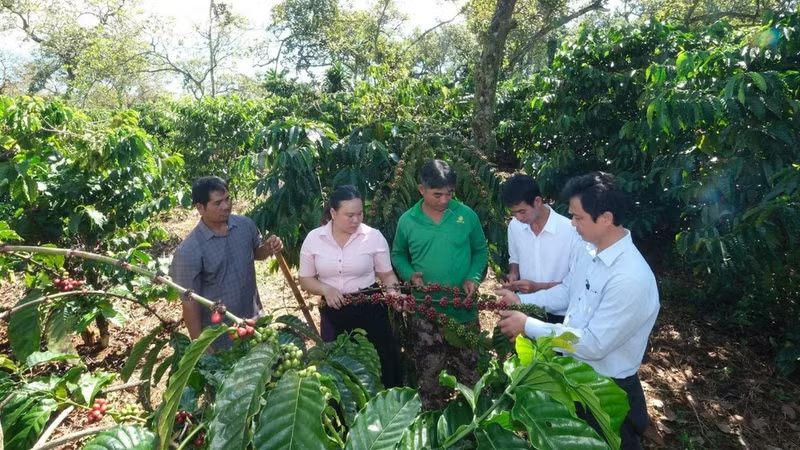
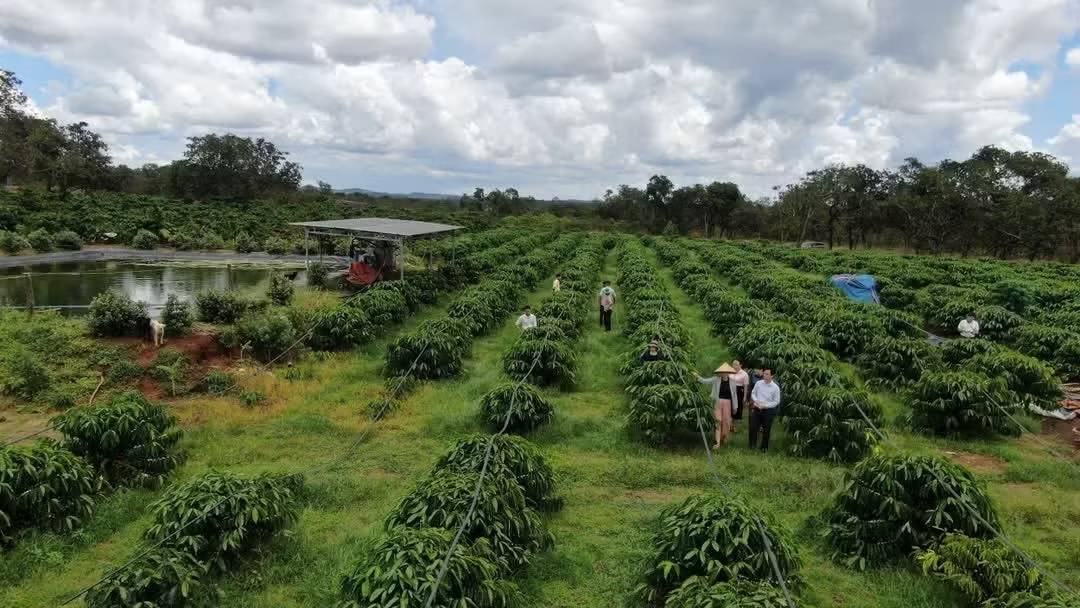
Dak Wi Hamlet in Dak Nhau Commune, where the Tay and Nung ethnic groups make up most of the population, presents a vivid picture of rural development. Roads paved with asphalt and concrete wind through vast expanses of coffee, durian, and rubber plantations. Adding to this colourful landscape are spacious, well-built houses worth billions of dong. During a visit to the garden of Party member Chu Thi Dung, head of the hamlet’s Fatherland Front affairs committee, we were struck by the lush coffee plantation stretching as far as the eye could see.
Dung said: “My family moved here from Northern Viet Nam several decades ago. Dak Nhau offers favourable natural conditions and a welcoming community, so we have put down roots here, developed our household economy, and contributed to making this new homeland prosperous and beautiful. With agricultural commodity prices having been high in recent years, my family now earns around one billion VND a year and creates many jobs for local workers.”
Dung also actively encouraged women in Dak Wi Hamlet to establish an arts troupe. She said: “After a hard day’s work, the women gather to practise dancing and singing, and to perform folk dances. These gatherings help them relax, strengthen neighbourly ties, and enrich local cultural life. At festivals and events organised by the hamlet and commune, the troupe puts on lively performances, creating a cheerful and united atmosphere in the community.”
The border commune of Tan Tien in Dong Nai City is home to 20 ethnic groups, with ethnic minorities accounting for 29.4% of the population. The Tan Tien Commune Party Committee currently has 725 members, including 144 ethnic minority members.
Ho Ba Toan, Standing Deputy Secretary of the commune’s Party Committee, said: “We believe that in border areas, national defence and security are not only key and ongoing political tasks but also prerequisites and a solid foundation for socio-economic development. Territorial protection depends not only on national defence and security capabilities, but also on close ties among ethnic groups, consensus within the community, and the people’s trust in the Party, the State, Party committees, and local authorities.”
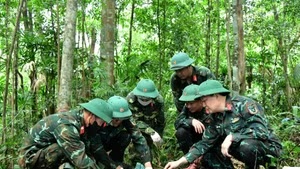
At 72, with 42 years of Party membership, Dieu Pa No, a resident of Tan Loc Hamlet and a former People’s Public Security officer, continues to uphold the qualities of a Party member and actively contribute to the community. He encourages local residents to join Border Guard forces in patrols to protect the border line and markers. His sustained, practical efforts help strengthen great national unity and build a peaceful, friendly, and cooperative Viet Nam–Cambodia border that continues to develop.
Dieu Pa No said: “As a Party member and a respected person in the community, I actively develop my household economy and strive to achieve legitimate prosperity. I also raise awareness among residents and encourage them to comply with border regulations, work with the competent forces to firmly safeguard national sovereignty, maintain security and public order, and contribute to the development of border areas.”