Therefore, the emergence of highly replicable economic models is of great significance in addressing the challenge of enabling ethnic minority people to “leave farming without leaving their homeland.”
Bringing water hyacinth weaving to the commune
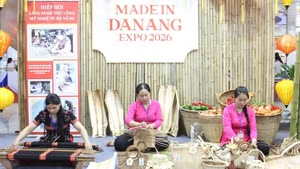
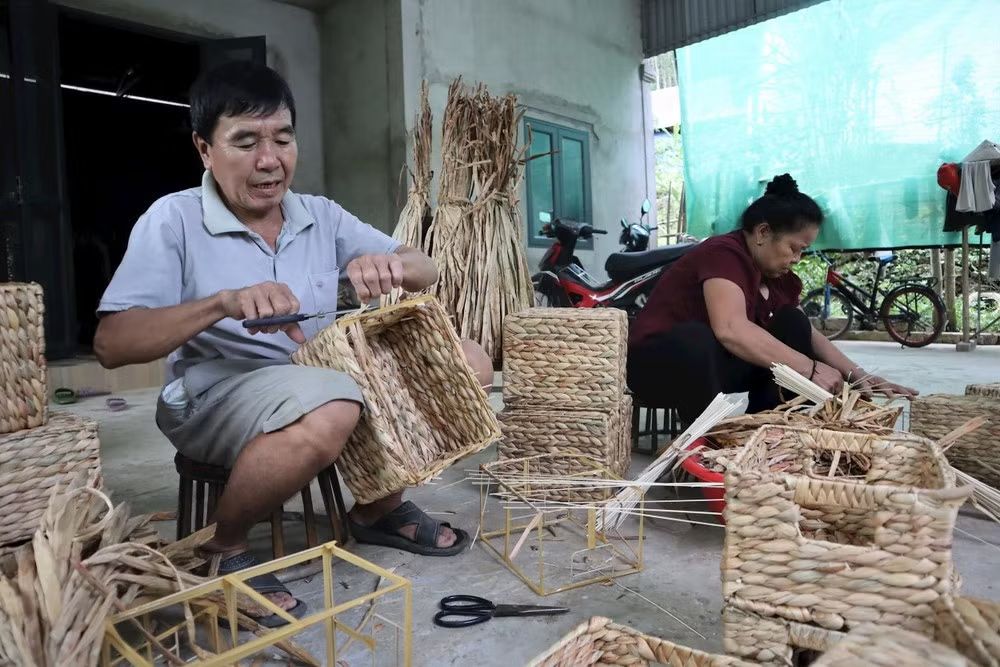
From the border commune of Na Ngoi, we travelled on to Yen Tinh Village, Yen Na Commune. Dusk was already falling, but Luong Van Toan (60), a Thai ethnic minority man, and his wife were still taking advantage of the remaining daylight to weave a few more baskets at their home. Their nimble hands quickly filled one side after another of the steel frames with strands of dried water hyacinth. “The good thing about this job is that you can do it whenever you have free time. You can weave while watching television or sitting around, and even if you cannot sleep at night, you can get up and weave. Each one earns 10,000 VND. My wife and I can weave 12 to 15 a day, and some months we can earn up to 4 million VND. There is no limit to the number we can make; the only concern is whether we have enough strength to do it,” Toan said happily.
Ethnic minority people in Nghe An account for more than 14% of the province’s total population and live mainly in communes in the western part of the province.
Vi Thi Lan (48), Toan’s neighbour, said that in addition to weaving according to orders from the company, she also teaches the craft to people in the village and at affiliated facilities. Yen Tinh Village currently has 11 water hyacinth weaving groups. According to the agreed schedule, the company transports raw materials and steel frames from Ninh Binh to deliver to locals and collects the finished products. “The person who deserves the greatest credit for bringing this craft to the villagers is official Hoe,” Lan said.
The person Lan referred to is Nguyen Van Hoe, Vice Chairman of the People’s Committee of Yen Na Commune. When the two-tier local government model was implemented, Hoe, formerly Chief of the Office of the People’s Council and People’s Committee of the former Tuong Duong District, took up his new post in Yen Na Commune. After arriving in the area, he was concerned about the situation in which young workers had to leave home to seek work elsewhere, “leaving” their children in the care of their parents. Elderly grandparents were in poor health and productive land was limited, so they had to go into the forest to collect bamboo shoots and bo bo fruit, while young children were not properly cared for or supervised, leading to numerous consequences. In reality, a number of heartbreaking incidents have occurred.
Having a long-standing acquaintance who worked at a company specialising in the production and export of handicrafts to the European market, Hoe proposed bringing the weaving craft to the local residents. After being persuaded several times, the company agreed on the condition that the locality could provide sufficient labour and output. The requirement sounded simple at first, but it proved to be a difficult challenge because the locals were not accustomed to commodity-oriented production, while labour discipline remained “flexible” — “working when they felt like it and taking a break when they did not.”
Hoe said: “In July 2025, the first training course was organised in Na Bon Village. Commune leaders patiently explained to residents that the work was not too strenuous and that they would receive cash payment promptly — every item they completed would bring them money. However, all those efforts failed to produce the desired results because people were not focused, and the ‘quick gains’ mindset had yet to be overcome. We then ‘made a difficult request’ to the company to move the training course to Canh Toong Village (now Xop Pu Village). At that time, Mac Dinh Tang, Chairman of the commune’s Veterans Association, had just retired under the applicable policy. He volunteered to accommodate the company’s trainers at his home, turning his house into a weaving training centre and encouraging local people to attend. At first, there were only a few participants, but as they saw the effectiveness of the work, the number gradually increased.”
To date, four villages in Yen Na have taken up water hyacinth weaving, with more than 200 local residents participating regularly and delivering approximately 10,000 products of various types to the company each month. The Vice Chairman of the People’s Committee of Yen Na Commune stated that this was a model with a high degree of social stability, and that the commune was developing a training plan with the aim of bringing the weaving craft to all seven villages. The planting of water hyacinth in the reservoir of the Ban Ve Hydropower Plant to provide their own raw materials has also been considered by the Yen Na Commune authorities.
Villages developing community-based tourism
If Hoe is the person who brought the water hyacinth craft to local villagers, Vu Tong Po (born in 1970, a H’Mong ethnic minority man) in Muong Long 1 Village is regarded as a pioneer in tourism development in the Muong Long Valley. As tourists began coming here to see the clouds and take photographs but could not find places to stay, he began to consider opening an accommodation facility. Po went online to read articles and watch videos about tourism. At the same time, local authorities organised training courses and took residents to visit community-based tourism models in other localities, helping him acquire his initial knowledge of tourism development.
In 2021, after a period of preparation, Po took the bold step of building a traditional H’Mong wooden house to use as a homestay. “If you go up there, stay at Mr Po’s house” — one person told another, while local residents were always enthusiastic about pointing visitors in the right direction whenever anyone asked. In this way, Po’s homestay gradually became well known. During peak months, his homestay welcomes hundreds of visitors for sightseeing and relaxation.
Located at an altitude of nearly 1,500 metres, with clouds drifting around the mountain peaks and a consistently cool climate, Muong Long welcomes thousands of visitors each year for sightseeing and relaxation. Lau Y Denh said that initially, she renovated the simple wooden house, adding bathrooms and a communal living space. She happily teaches visitors how to make traditional cakes and weave linen, and she welcomes them with rustic dishes featuring the flavours of the mountains and forests. Recently, she boldly invested in three additional rooms and other amenities. The family’s homestay can now accommodate and serve 35 to 40 guests at the same time.
Nguyen Huu Luong, Secretary of the Party Committee of Muong Long Commune, said that Muong Long welcomed more than 1,500 visitors in 2025, while nearly 1,200 visitors came for sightseeing and relaxation in the first six months of 2026. “In addition to medicinal plants and livestock farming, tourism has been identified as an important pillar for increasing people’s incomes and reducing poverty. However, the biggest obstacle at present is difficult transportation, particularly to the four villages, which can only be reached by car during the dry season, while one cluster of villages does not yet have access to the national power grid.
“If these limitations can be addressed promptly, it will add more appeal to Muong Long’s tourism, thereby creating more jobs for local residents,” Secretary Nguyen Huu Luong emphasised.
Statistics from the Nghe An Department of Culture, Sports and Tourism show that western Nghe An currently has 24 villages and hamlets with 81 households operating homestays, providing regular employment for more than 300 local workers. The community-based tourism model has contributed to creating many local jobs and increasing incomes for people in mountainous areas. Many local residents who were previously familiar only with farming on hillsides and raising cattle and chickens have now shifted to tourism-related activities.
According to Tran Xuan Cuong, Deputy Director of the Nghe An Department of Culture, Sports and Tourism, in July 2020, with the aim to promote tourism development, the Nghe An Provincial People’s Council issued Resolution No. 07/2020/NQ-HD on policies to support the development of community-based tourism for the 2021-2025 period. The resolution provided support for residents to invest in and upgrade facilities in order to improve the quality of tourism services. However, due to limited resources (with total allocated and disbursed funding of nearly 9.3 billion VND), the resolution has so far served only as an initial incentive, creating momentum to get projects off the ground rather than producing a breakthrough.
To further develop community-based tourism and create local employment, the sector is advising the Nghe An Provincial People’s Committee to formulate sufficiently strong specific policies, focusing resources on key tourism destinations with regional connectivity, while proactively integrating national target programmes and prioritising resources to support localities with tourism potential and those performing tourism-related tasks effectively.