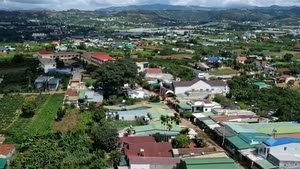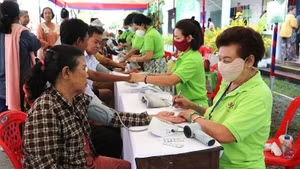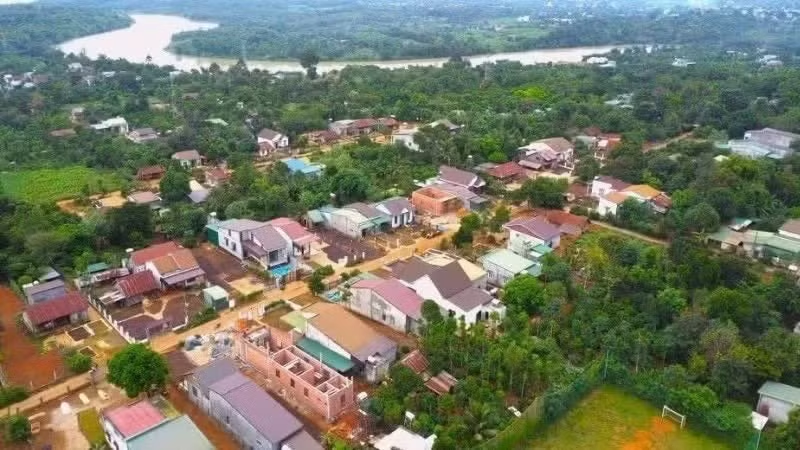
The Central Highlands was at the peak of the dry season in May, yet the lush green of forests, coffee plantations and fruit trees seemed to dispel the oppressive heat. In Bu Dar Village in the border commune of Quang Truc, rows of newly built houses stood as vivid evidence of the special attention paid by the Party, the State, the military and local authorities to the western border region of Lam Dong.
This residential area adjacent to a border militia post consists of 60 houses, together with a community hall, football pitch, internal roads and a lighting system, forming the appearance of a modern new village.
“Most residents here are M’Nong people. For many years, we dreamed of having solid homes so we could settle down, stay on the border and develop our economy. Now that dream has become reality, we are truly delighted,” said Dieu Lot enthusiastically.
Construction of the residential area began in early February 2026, with total investment of 12.5 billion VND (474,000 USD). Of this amount, Military Region 7 contributed 6.5 billion VND (247,000 USD), while the remainder was funded by Lam Dong Province. Built on nearly 2ha of land close to the border marker, the residential area was developed in a synchronised manner, with each house covering almost 50m2 and fully equipped with basic facilities.
Luu Van Trung, Deputy Secretary of the Provincial Party Committee and Chairman of the People’s Council of Lam Dong Province, stressed: “This residential area holds strategic significance in combining socio-economic development with strengthening national defence and security, while building a strong all-people national defence posture associated with the people’s security posture from the grassroots level.”
The Dam Ron area was once known as the “poverty centre” of the former Dam Rong District. Sitting inside a traditional house, village elder Cil Neu in Dam Rong 4 Commune proudly said: “Those stories of poverty belong to the past. Today, people only talk about economic development and ensuring their children can go to school. Villages are now more spacious, roads are wider, and people have food and savings.”
Lo Mu Ha Poh, Permanent Deputy Secretary of the Party Committee of Dam Rong 4 Commune, said that thanks to the participation of the entire political system and local communities in building new-style rural areas, sustainable poverty reduction had achieved notable results. The commune now has only 255 poor households, accounting for 8.36%, down 2.28% compared with 2024. Local livelihoods have improved significantly.
Many effective production models have emerged in the commune, including mulberry cultivation combined with silkworm raising, fruit farming and sturgeon farming — developments that would once have been considered unusual in ethnic minority areas.
Senior monk Thuong Xuan Huu shared that over recent years, thanks to the attention of authorities at all levels, Cham villages in Lien Huong Commune had benefited from synchronised investment in essential infrastructure and facilities, alongside policies specifically designed for Cham communities. As a result, the appearance of the villages has changed markedly, and both the material and spiritual lives of residents have improved.
According to Dang Thien Vien, Vice Chairman of the People’s Committee of Lien Huong Commune, the commune has two villages inhabited entirely by Cham people, with more than 1,900 households. Thanks to socio-economic development programmes and policies for ethnic minority areas, the appearance of these Cham villages has undergone remarkable transformation.
Lam Dong is the largest province in the country by natural area, with a population of more than 3.87 million people, of whom ethnic minorities account for around 17.6%. The province has 2,311 out of 2,772 villages, hamlets and residential quarters, as well as 100 out of 124 communes, wards and special administrative zones located in ethnic minority and mountainous areas.
During the 2021-2025 period, Lam Dong allocated more than 3.28 trillion VND (124 million USD) to programmes and projects aimed at socio-economic development in ethnic minority regions. As a result, the poverty rate fell to 8.75%. By the end of 2025, 16 out of 19 communes in Zone 3 and 138 out of 236 villages had been removed from the list of especially disadvantaged areas.
Lam Dong aims to eliminate all especially disadvantaged communes and villages by 2030. More than 40% of communes in ethnic minority and mountainous areas are expected to meet new-style rural standards, while the poverty rate among ethnic minority households is targeted to decrease by 2-3% annually. Average per capita income in ethnic minority areas is expected to reach more than 70% of the provincial average.
Nguyen Ngoc Phuc, Vice Chairman of the People’s Committee of Lam Dong Province, emphasised: “Comprehensive and sustainable development in ethnic minority areas has always been identified by the province as a long-term strategic mission. Lam Dong is continuing to concentrate resources on effectively implementing national target programmes, prioritising infrastructure development, livelihood support, vocational training, improving human resource quality and preserving traditional culture.”