A foundation for a new phase of development
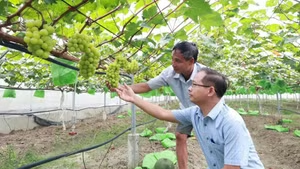
Lam Dong currently has more than 107,000 hectares of high-tech agricultural production, accounting for 11% of its cultivated area, 1,200 hectares of which are smart agriculture. The province has 16 high-tech agricultural production zones covering more than 16,000 hectares as well as seven high-tech agricultural enterprises operating effectively.
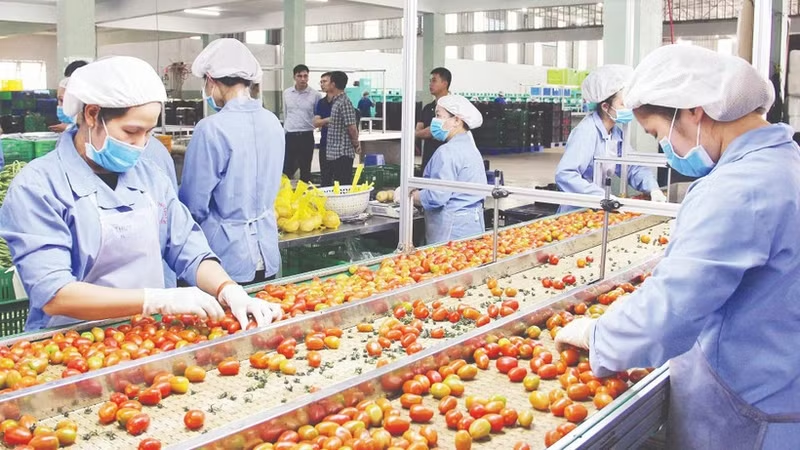
The province has nearly 150,000 hectares of agricultural production meeting safety and sustainability standards such as VietGAP, GlobalGAP, and organic standards; 952 export planting area codes covering more than 39,000 hectares and 341 packing facilities meeting international standards; and 416 linkage chains, more than 1,150 cooperatives, and 914 OCOP products.
Lam Dong’s agricultural products have entered major markets including China, the US, Japan, the Republic of Korea, the EU, and Australia. The locality has a number of key agricultural products produced on a large scale, such as vegetables (about 101,000 hectares, with output reaching 3.5 million tonnes per year), flowers (nearly 12,000 hectares, accounting for about 30% of the country’s flower production area, with output of 4.8 billion stems per year and export turnover exceeding 70 million USD), coffee, durian, avocado, pepper, macadamia, and dragon fruit.
Lam Dong’s agricultural products have entered major markets including China, the US, Japan, the Republic of Korea, the EU, and Australia. The locality has a number of key agricultural products produced on a large scale, such as vegetables (about 101,000 hectares, with output reaching 3.5 million tonnes per year), flowers (nearly 12,000 hectares, accounting for about 30% of the country’s flower production area, with output of 4.8 billion stems per year and export turnover exceeding 70 million USD), coffee, durian, avocado, pepper, macadamia, and dragon fruit.
The average agricultural production value reaches 197 million VND per hectare per year, while high-tech agriculture exceeds 450 million VND per hectare, vegetables generate between 500 million and 1 billion VND per hectare, and flowers reach 5 billion VND per hectare.
According to Assoc Prof, Dr Nguyen Dinh Tho from the Institute of Strategy and Policy on Agriculture and Environment, Lam Dong has outstanding advantages in natural conditions and has formed agricultural production zones, helping its key products establish strong brands in international markets. The development of biotechnology is also a key highlight.
Each year, tissue culture facilities in Lam Dong supply more than 50 million seedlings, more than 35 million of which are exported, generating revenue of around 10 million USD. “Lam Dong’s biotechnology sector is ranked among the leading in Southeast Asia by international partners,” said Ho Anh Dung, Director of F1 Biotechnology Co., Ltd.
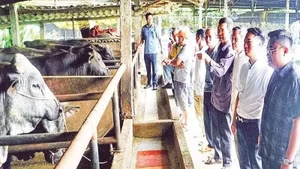
In Lam Dong, many modern production models have demonstrated effectiveness in recent years. A notable example is Langbiang Farm, which operates a closed production ecosystem on nearly 30 hectares in line with VietGAP and GlobalGAP standards, with strong application of Internet of Things (IoT), environmental sensors, and QR code-based traceability. Each year, the enterprise exports more than 100 containers of agricultural products to Asian markets.
Founder of Langbiang Farm Tran Huy Duong affirmed: “Digitalisation is now the trend. Only genuine innovation and real value can lead to success.” Vu Dinh Cuong, Deputy Director of the Lam Dong Department of Agriculture and Environment, emphasised: “The success of Lam Dong’s agriculture comes from utilising the right approach: taking enterprises as the core, science and technology as the foundation, and farmers as the centre, thereby strongly promoting the transition from traditional to modern production.”
Towards green agriculture
Lam Dong’s agricultural export turnover remains above 1.2 billion USD per year, accounting for more than 40% of the province’s total export value. Building on this foundation, the Resolution of the Lam Dong Provincial Party Congress for the 2025–2030 term identifies the development of modern, ecological, high-tech agriculture, alongside the building of agricultural value chains linked with e-commerce, to fully tap into and promote local potential and advantages.
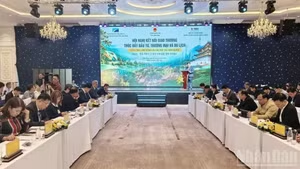
Ho Van Muoi, Party Central Committee member and Chairman of the Lam Dong People’s Committee, stressed that agriculture is a “pillar” of the local economy, with high-tech agriculture identified as a strategic direction towards building a modern, green, and sustainable agricultural sector. Based on this orientation, Lam Dong is strongly shifting towards an agricultural economy mindset, focusing on added value, branding, and markets; developing logistics and services in key agricultural areas; integrating e-commerce; and forming concentrated production zones linked with deep processing.
In the 2026–2030 period, the province aims to raise the proportion of processed agricultural products to 70%. By 2030, the area of high-tech agriculture is expected to exceed 150,000 hectares, with an average production value of more than 250 million VND per hectare per year.
“The agricultural sector is working to complete a digital data system serving management, forecasting, and product traceability. It is also building development strategies for key products such as vegetables, flowers, specialty coffee, fruit trees, and high-quality seafood,” said Vu Dinh Cuong.