The direction provided by the general secretary and president also outlines requirements that demand the concerted effort and unity of the entire political system to successfully fulfil tasks in the new era.
Leveraging the advantages of regional linkages
Regional development linkage is a major policy of the Party regarding national construction and defence. The Platform for National Construction in the Period of Transition to Socialism (supplemented and developed in 2011) has affirmed the need to ensure harmonious development across regions, promote rapid growth in key economic zones, and simultaneously create conditions for the development of disadvantaged areas.
During the 2020–2025 term, the Political Bureau issued six resolutions on socio-economic development and the assurance of national defence and security for the country’s six economic regions. Adhering closely to these resolutions, Party committees and organisations in provinces and cities have formulated practical action programs and plans, implemented them rigorously, and achieved many positive results.
In the Northern Midlands and Mountains region, following the reorganisation of administrative boundaries, the regional Gross Regional Domestic Product (GRDP) growth rate for 2025 is estimated to reach 8.53%. Phu Tho Province stands out with an estimated GRDP growth rate of 10.5%, leading the entire region.
In the Red River Delta region, localities such as Ha Noi, Hai Phong, and Quang Ninh have continued to achieve high economic growth, driven significantly by exports, tourism, and FDI attraction. Hai Phong and Quang Ninh in particular have consistently recorded double-digit growth rates.
Despite facing numerous challenges, the Mekong Delta region has strengthened linkages in transport infrastructure, telecommunications, tourism, and the fisheries sector, creating breakthroughs in socio-economic development and social welfare.
Poverty reduction efforts stand out as a highlight; statistics show that the poverty rate (based on the 2022–2025 multidimensional poverty standard) dropped from 2.26% in 2022 to 1.0% in 2024 — lower than the national average of 1.93% and ranking only behind the Red River Delta and Southeast regions.
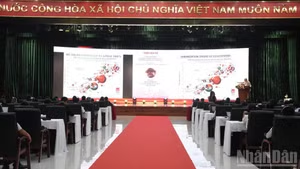
At the conference reviewing the three-year implementation of the Political Bureau’s six resolutions on regional development, Nguyen Si Hiep, Deputy Head of the Central Commission for Policy and Strategy, assessed that inter-locality cooperation has been vigorously implemented. Regional infrastructure, especially strategic infrastructure, has received investment and been put into operation.
Socio-cultural aspects of the regions have seen positive shifts: living standards have improved, the multidimensional poverty rate is trending downward, and healthcare services have markedly improved. National defence, security, and social order have been maintained, while external relations and international integration have expanded.
Innovating mindset and action
Despite achieving significant results, the implementation of the Politburo's six regional development resolutions still reveals shortcomings in many localities. Specifically, economic growth has not yet achieved a true breakthrough, and labour quality and productivity remain low.
The quality of planning and infrastructure — spanning transport, digital systems, and disaster response — fundamentally falls short of requirements. High-quality human resources do not yet meet the demands of new development needs. Living standards across residential areas remain uneven, and environmental protection poses significant challenges.
Fully aligning with the directive of the General Secretary and President — that “spatial and development resource management must transcend administrative boundaries, sectoral silos, and tenure-based limitations” — many Party committees and localities recognise the need to innovate their thinking and adjust their approaches regarding regional development.
The Ha Noi Party Committee is spearheading innovation in the formulation of the Ha Noi Capital Master Plan (with a 100-year vision), clearly emphasising a model of open, interconnected spatial development. Ha Noi is set to expand through linkages with six provinces and cities — Thai Nguyen, Bac Ninh, Hai Phong, Quang Ninh, Hung Yen, and Ninh Binh — across various sectors.
Under the plan, Ha Noi is designated as the central hub and driving force, playing a pivotal role in radiating development across economic, social, scientific, educational, and healthcare sectors. Surrounding localities will serve as satellite urban areas, collaborating and sharing resources.
However, many economic regions lack sufficient resources, prompting local Party committees and authorities to call for specific policies and mechanisms to drive progress. In practice, some localities struggle to determine the appropriate authority for resolving existing bottlenecks.
Nguyen Tuan Anh, Deputy Secretary of the Can Tho City Party Committee, urged the central government to accelerate the decentralisation of authority — coupled with local accountability — regarding investment, planning, and land management.
He also called for the early finalisation of the legal framework to implement breakthrough models, such as free trade zones and regional hubs for the production, processing, and distribution of agricultural products.
Regarding infrastructure, he proposed prioritising resources to complete key regional expressway networks. Concerning the reform of regional coordination mechanisms, he emphasised the need to clearly define the authority of coordination bodies in making decisions on inter-regional projects.
Accelerating digital transformation in regional integration is a recommendation shared by many local Party committees. Nguyen Anh Tuan, Chairman of the People’s Committee of Binh My Commune (Ho Chi Minh City), noted that shared database systems across various sectors and administrative levels remain incomplete, hindering the real-time processing and utilisation of information.
Across many levels and sectors, the fragmentation and lack of seamless, synchronised connectivity in database development remain widespread issues that directly impact regional integration.
Therefore, accelerating the completion, interconnection, and effective utilisation of national, specialised, and regional databases will facilitate the unified and synchronised implementation of goals and tasks across both intra-regional and inter-regional localities.
Rapid digital transformation will enable localities to enhance coordination in fully leveraging their respective potentials and strengths, thus ensuring the effective use of local resources for the benefit of both regional integration and the nation as a whole.