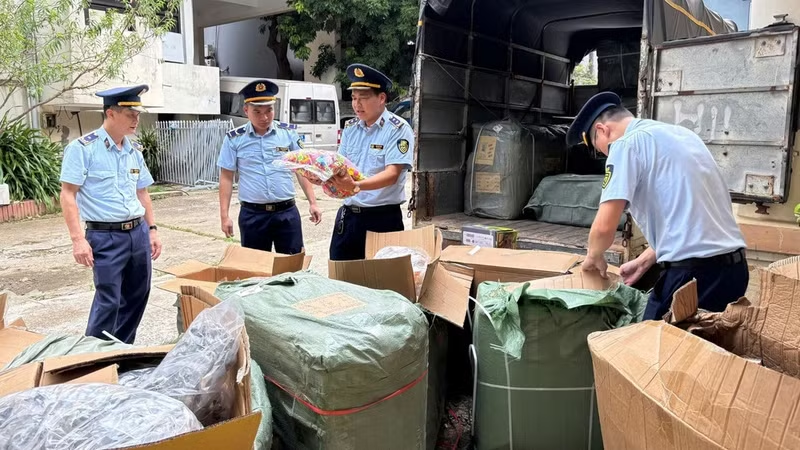
This reality highlights the need to reform market surveillance methods. Rather than simply detecting and handling individual cases, authorities must trace the sources of goods, establish the responsibilities of the parties involved, and prevent violations from recurring in the digital environment.
From an online shop to a counterfeit manufacturing facility
In June 2026, following reports of suspected sales of counterfeit branded food products on an e-commerce platform, market surveillance force in Ha Noi reviewed the information, conducted verification, and coordinated with An Khanh Commune Police in Ha Noi to inspect a facility producing counterfeit Acecook-branded powdered soup.
At the facility, the authorities found 125 cartons of finished products, equivalent to approximately 250,000 sachets of powdered soup, along with 300 fully packaged sachets. The facility also contained raw materials, packaging pre-printed with the brand's identifying marks, and machinery used in production. Representatives of Acecook Viet Nam confirmed that the products showed signs of infringing a trademark protected in Viet Nam.
What is noteworthy is not merely the quantity of goods discovered but also how the case was brought to light: information from online trading activities provided a lead that enabled the authorities to investigate and trace the products back to their manufacturing site. Had action stopped at removing a product listing from an online shop, the goods already manufactured and the associated parties might have remained beyond the reach of the authorities.
This case illustrates how e-commerce has expanded the scope of commercial activity, enabled goods to reach consumers more quickly, reduced distribution costs, and created additional opportunities for businesses.
However, these same advantages can also be exploited to introduce counterfeit, imitation, and goods of unknown origin into the market. Consumers see products on their screens, while the manufacturing sites, storage facilities, and true identities of sellers can remain difficult to verify.
Tran Huu Linh, Director General of the Domestic Market Surveillance and Development Agency under the Ministry of Industry and Trade, has previously identified the greatest challenge of market surveillance as not simply detecting a product suspected of violating regulations but tracing the entire journey of the goods.

According to Linh, a product may be advertised on social media, sold through an e-commerce platform, stored in a warehouse at an address different from the one registered by the seller, and delivered to the buyer by a logistics provider. These stages may be handled by different parties, making it more complicated to identify those responsible and collect evidence.
In addition, the anonymity associated with e-commerce makes it difficult for consumers to establish sellers' identities, determine the origins of goods, and locate storage facilities. Consequently, efforts to trace products and verify information when violations occur are more complicated than in businesses operating from fixed premises. There is therefore an urgent need to improve the legal framework and sanctions as well as strengthen the effectiveness of law enforcement.
Statistics show that in 2025, market surveillance forces nationwide handled more than 23,000 cases involving counterfeit goods, goods of unknown origin, and violations in the e-commerce environment. The amount collected and remitted to the state budget was nearly 372 billion VND, while the total value of infringing goods approached 290 billion VND. These figures reflect the considerable efforts made by the authorities, while also demonstrating the enormous scale of the task ahead.
However, the number of cases handled cannot be the sole measure of the effectiveness of anti-counterfeiting efforts. More important questions are how far back the source of the goods has been traced after each case, whether the associated parties have been prevented from continuing their activities, and whether violators can easily return to the market using another account. This is also what distinguishes traditional market surveillance from market surveillance in the digital environment.
Preventing counterfeit goods from returning to the market
Whereas authorities previously relied mainly on geographical areas, business facilities, and tangible traces of goods, they must now also draw on transaction data, account information, advertising activities, and delivery records. If action is taken only against the point of sale where a violation is detected, without clarifying the source of supply, the same violations may continue in another form.
One of the key requirements, therefore, is to strengthen the accountability of e-commerce platforms and social media networks. Receiving reports and removing infringing content are necessary, but they remain insufficient if sellers can quickly open new accounts, use different information, or switch to other sales channels.
Removing an online shop cannot be regarded as the final outcome of anti-counterfeiting efforts. Genuine effectiveness must be measured by the ability to stop the supply of infringing goods, correctly identify the parties conducting the business, and reduce the risk of repeat offences.
Platforms must also fulfil their responsibilities through concrete measures, including verifying sellers' information, retaining data for inspection purposes, and cooperating in handling suspected violations in accordance with the law.
On the part of the authorities, the Domestic Market Surveillance and Development Agency must continue to fulfil its role in advising on policy, providing guidance, and organising law enforcement, while promoting digital transformation in inspection and surveillance activities.
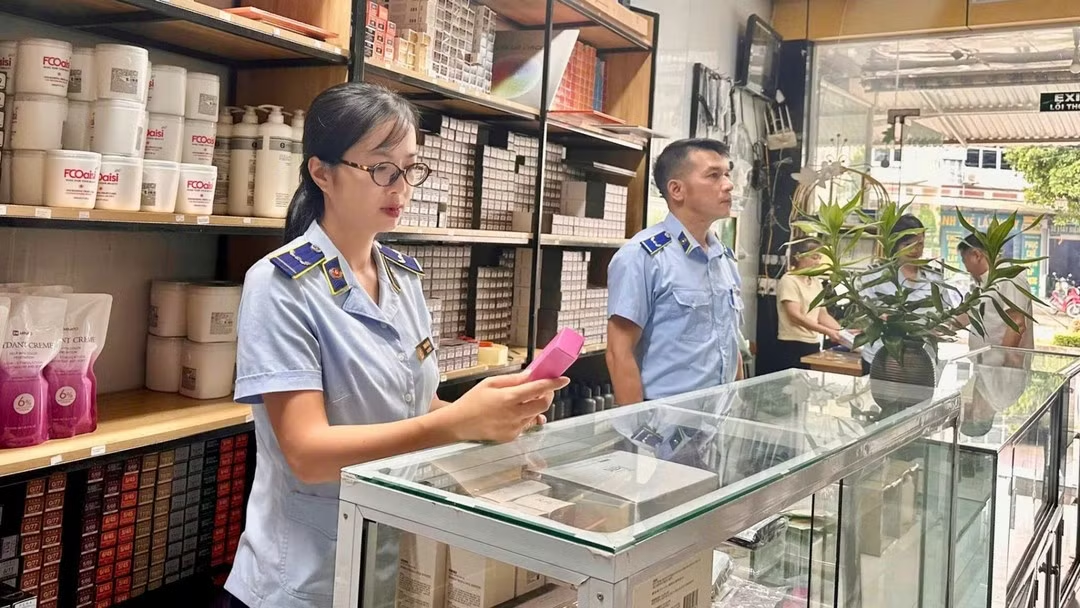
Data from cases already handled should be analysed to identify methods of infringement, high-risk product categories, locations used for stockpiling goods, and links between different seller accounts. By connecting this information, the authorities will be better placed to move beyond handling individual cases and towards the early detection of systematic violations.
At the same time, coordination should be strengthened among market surveillance forces, the police, tax authorities, customs, and other relevant agencies. Each agency holds different information about goods, business operators, financial flows, or transportation activities.
Coordinating and sharing data within their respective legal mandates will help shorten verification processes, establish accountability and deal with cases showing signs of criminal activity. In large-scale counterfeit manufacturing and distribution networks, efforts should focus on identifying suppliers and the organisations behind them rather than simply stopping at the final point of sale.
Businesses, for their part, need to take a more proactive approach to trademark protection by monitoring online sales channels, providing information to help identify genuine products, cooperating in product verification, and promptly reporting suspected infringements.
Consumers should be cautious of goods priced unusually low, sellers who provide insufficient or unclear information, and advertisements making unsubstantiated claims. They should also retain transaction records and report any suspected counterfeit goods.
Combating counterfeiting in the digital environment cannot depend solely on intensive inspection campaigns, as methods of infringement may change more quickly than inspection cycles. What is needed is a continuous, data-driven market surveillance mechanism involving coordination among state authorities, commercial platforms, businesses, and consumers.
The ultimate goal is not merely to reduce the number of infringing online shops detected but to make it increasingly difficult for counterfeit goods to enter the market, protect legitimate businesses, and give consumers greater confidence when shopping online.