A strategic planning breakthrough
To realise this ambition, the adjustment of the National Airport System Master Plan and the approval of Gia Binh International Airport serve as particularly significant milestones. Under the plan, by 2030, Viet Nam will have 36 airports, including 19 international airports.
The development of the Capital Region airport system through the combined operation of Noi Bai International Airport and Gia Binh International Airport will create new opportunities for growth, serving to ease congestion at existing airports, improve operational efficiency, and shorten cargo transport times from key industrial zones in northern Viet Nam. Meanwhile, the development of Long Thanh International Airport in the south and Chu Lai Airport in central Viet Nam as air logistics hubs will forge a balanced, multi-centre logistics network across the country.
In reality, Viet Nam’s air logistics industry has navigated a period of considerable volatility while also demonstrating remarkable resilience. Cargo throughput fell sharply from 1,516,098.87 tonnes in 2019 to 1,267,427.85 tonnes in 2020 as a result of the COVID-19 pandemic and geopolitical disruptions, before reaching a low of 1,243,360.89 tonnes in 2023.
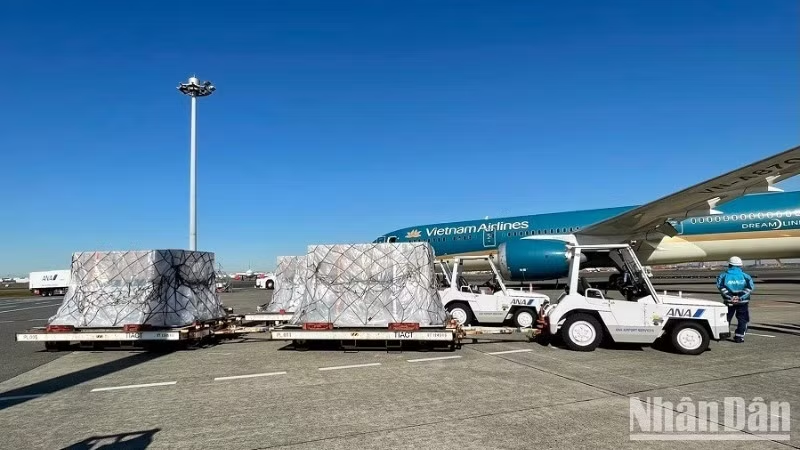
However, owing to its strong adaptability, the market recovered rapidly. In 2024, cargo throughput reached 1,523,756.47 tonnes, officially surpassing pre-pandemic levels. The following year marked a historic milestone, with a record 1,773,452.24 tonnes of cargo processed through Viet Nam’s airports, of which international freight accounted for the dominant share of 74.7%, equivalent to 1,325,331.17 tonnes.
Growth continued into the first six months of 2026, with total cargo throughput across the airport network reaching 920,919.00 tonnes. These figures clearly evidence the robust recovery of supply chains while also underscoring Viet Nam’s growing appeal to foreign investors, particularly in high-tech industries and manufacturing.
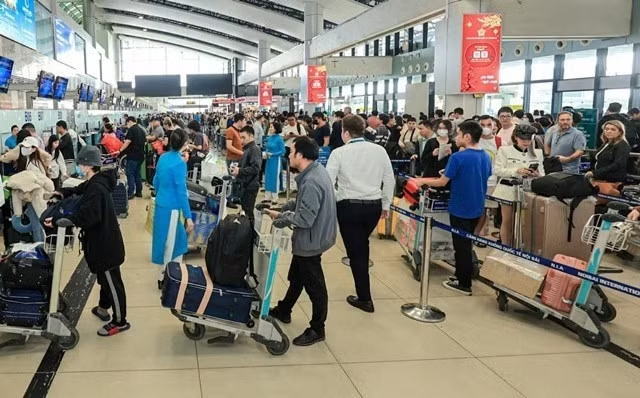
Noi Bai International Airport, in particular, has emerged as the country’s leading air logistics gateway. In 2025, cargo throughput at the airport surpassed one million tonnes for the first time, reaching 1,015,845.94 tonnes, a substantial increase from 695,324.91 tonnes in 2019.
In the first half of 2026 alone, cargo throughput at Noi Bai reached 550,388.64 tonnes, accounting for nearly 60% of the national total and almost 65% of international air freight. Beyond its dominant volume, the airport serves as a key transport hub for high-value goods, including electronic components and technology products manufactured by multinational corporations operating in Bac Ninh, Thai Nguyen, and Hai Phong.
Although air transport accounts for only a small proportion of freight volume, it generates an average of 30% of Viet Nam’s total import–export turnover, underscoring its critical role in global value chains.
Transforming the vision of a regional logistics hub into reality
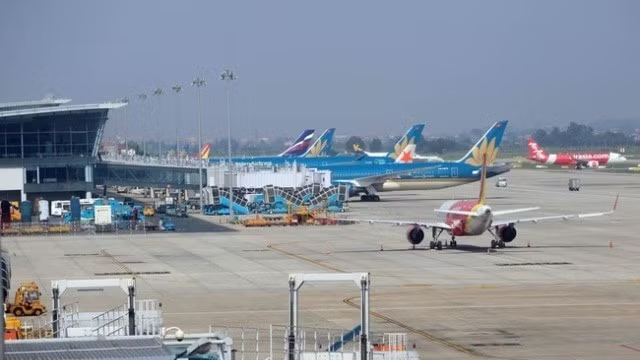
Despite these positive achievements, the air logistics sector continues to confront a number of challenges. Congestion in landside infrastructure at major gateway airports such as Noi Bai and Tan Son Nhat during peak periods remains an issue that demands urgent attention.
Another significant bottleneck is the heavy reliance on foreign airlines, which currently account for more than 80% of Viet Nam’s international air cargo market, while the country still lacks dedicated cargo airlines of sufficient scale and competitiveness.
To achieve the goal of handling approximately 4.35 million tonnes of air freight annually by 2030, the Government and the Ministry of Construction have directed relevant agencies to execute a comprehensive package of coordinated measures.
Director General of the Civil Aviation Authority of Viet Nam (CAAV) Uong Viet Dung stated that the authority is actively collaborating with ministries and relevant agencies to refine mechanisms and policies aimed at attracting investment into logistics centres, modernising warehousing systems, and accelerating digital transformation across the aviation sector.
At the same time, expediting the establishment of Vietnamese cargo airlines and strengthening multimodal transport links between road, rail, and seaports have been designated as key priorities for the coming years.
“With increasingly modern infrastructure, a progressively more favourable policy environment, and a dynamic market, Viet Nam is optimally positioned to serve as an important link in global supply chains and steadily realise its ambition of becoming a regional air logistics hub,” Director General Uong Viet Dung affirmed.