Ha Noi and Can Tho forge a new strategic cooperation axis
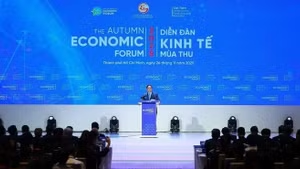
At a conference on promoting trade and investment cooperation between Ha Noi and Can Tho held in early June, the Chairman of the Can Tho People’s Committee noted that following its merger with Hau Giang and Soc Trang, Can Tho now covers approximately 6,360 sq km, comprising 103 communes and wards, with a population of around 4.2 million.
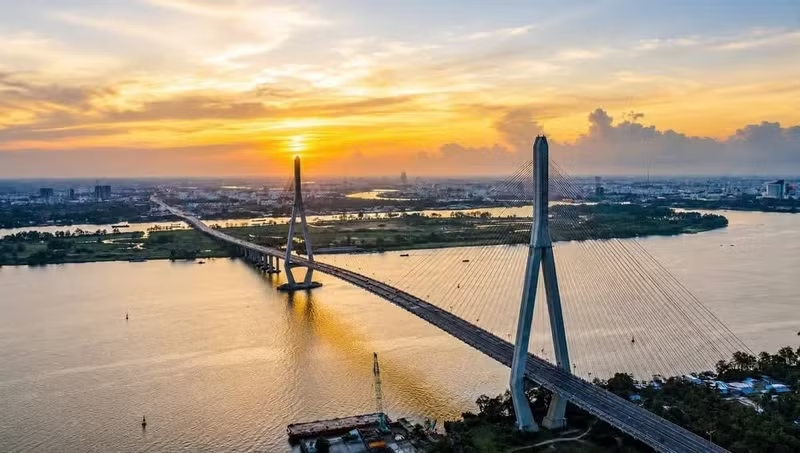
With its dense river network, central location within the Mekong Delta, and an increasingly integrated transport system, Can Tho is well-positioned to develop logistics, manufacturing, trade, and services.
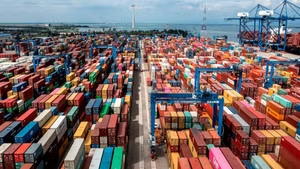
In particular, the expanded maritime and coastal space created through the merger has unlocked substantial opportunities for the marine economy, seaport logistics, renewable energy, and aquaculture and fisheries.
On this basis, the city has approved an integrated post-merger development plan targeting average annual economic growth of more than 10%. By 2030, per capita GDP is anticipated to reach approximately 8,500 USD, while the digital economy is projected to account for at least 30% of total economic output. By 2050, the city aims to become a modern, distinctive riverine metropolis in Southeast Asia.
Under its development strategy, Can Tho plans to establish the Can Tho Economic Zone linked to seaport infrastructure, develop large-scale industrial parks, explore establishing a free trade zone, and build an integrated industrial, logistics, and science-and-technology complex anchored to Can Tho International Airport, as well as strategic economic corridors linking the wider region.
Drawing on the strengths and potential of both localities, the Can Tho Chairman proposed four key areas of cooperation with Ha Noi: trade promotion and agricultural market linkages; investment promotion in industrial parks, economic zones, and logistics infrastructure; bilateral tourism promotion; and cooperation in healthcare, education, and technology transfer. Notably, Can Tho proposed that Ha Noi consider supporting the construction of a public hospital in the city, further strengthening the partnership between the two cities in the next phase of development.
Le Quang Tung, Secretary of the Can Tho Party Committee, said that following the merger, the city’s development space had expanded significantly, creating favourable conditions for a new stage of development characterised by greater opportunities and higher ambitions.
As a centrally governed city and the hub of the Mekong Delta, Can Tho is focusing on strengthening its role as a regional growth engine in trade, services, logistics, processing industries, high-tech agriculture, healthcare, education, science and technology, and innovation.
The critical factor: reforming regional governance mechanisms
The effort to strengthen cooperation between Ha Noi and Can Tho transcends the interests of the two localities themselves, serving to deepen linkages between the Red River Delta and the Mekong Delta and harness the complementary strengths of two of the country’s most important growth poles.
This cooperation model should be encouraged nationwide. According to many experts, localism continues to exert a strong influence, leading provinces and cities to pursue development strategies independently rather than within a unified regional framework. The consequences are evident in both productive efficiency and competitiveness. Although the Mekong Delta remains the country’s largest agricultural production region, its output advantages have not translated proportionately into market gains.
At the macroeconomic level, fragmented development planning has scattered investment resources and undermined overall effectiveness. While numerous major infrastructure projects have been implemented, connectivity remains incomplete, and leading economic corridors capable of driving regional growth have yet to emerge. This underscores the need for governance to shift from an administrative-boundary approach to one based on regional development space.
Overcoming the Mekong Delta’s development bottlenecks requires not only additional resources but, more importantly, institutional reform and restructuring development space based on substantive regional linkages.
Can Tho has therefore proposed that the central government continue to expand decentralisation and delegate authority, alongside strengthening local accountability in investment, planning, and land management, giving localities greater flexibility in steering their own development.
At the same time, the legal framework must be promptly strengthened to facilitate innovative models such as free trade zones and regional centres for agricultural production, processing, and distribution. These initiatives would help establish leading value-chain hubs and enhance regional competitiveness.
An Giang Province also proposed that the central government promptly introduce special mechanisms and policies for developing the marine economy, alongside preferential policies for border-gate economic zones, to attract investment while integrating economic development with national defence, security, and poverty reduction objectives in border areas.
Prioritising investment in dual-use transport infrastructure, serving both economic development and defence objectives, has likewise been identified as a key measure to enhance regional connectivity and resilience.
The Mekong Delta requires comprehensively restructuring its development space along integrated, well-coordinated lines. This is not simply a matter of policy adjustment; it represents a redefinition of the region’s entire growth model.
The Mekong Delta Regional Plan for 2021–2030, with a vision to 2050, has already set the direction for developing economic corridors, growth centres, and interconnected infrastructure systems. Growth targets have been set at around 7.7% annually, rising to around 9.5% in the following period, supported by the accelerated construction of expressways, seaports, and logistics networks.
At the coordination level, reforming regional governance mechanisms by moving from loose coordination to effective governance through the Regional Coordination Council is regarded as a critical prerequisite. This would require clearly defining the Council’s authority in approving inter-regional projects and developing a unified regional data system on a shared digital platform accessible to all localities.
A sufficiently empowered institution, capable of allocating resources, guiding planning, and steering investment, will be essential to transforming regional connectivity into a genuine driver of development.