To achieve this goal, authorities at all levels and sectors of the city are demonstrating strong determination and decisive action from the very beginning of the year.
At the end of 2025, the Can Tho City People’s Council adopted a resolution adjusting Can Tho City’s master plan for the 2021–2030 period, with a vision to 2050, providing a foundation for accelerating development in the new phase. The plan concretises the resolutions of the central agencies and the Resolution of the 1st City Party Congress for the 2025–2030 term, enabling early, decisive, and synchronous implementation to promote focused and key development following administrative merger and consolidation, and the implementation of the two-tier local government model from the start of the term.
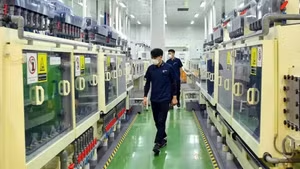
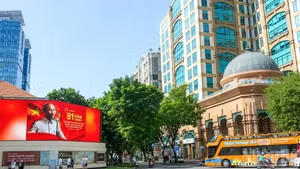
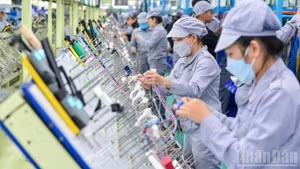
According to the plan, Can Tho City will become a national growth pole and the central driving hub of the Mekong Delta by 2030, playing a core role in linking and coordinating development of the entire region. The economic structure will shift towards modernity, becoming a centre for services, trade, tourism, logistics, processing industries, strategic technologies, digital technologies, high-tech agriculture, education and training, specialised healthcare, start-ups, science and technology, and culture and sports in the region.
The master plan of Can Tho divides the city into five economic development zones and six development corridors. These economic zones are based on advantages in available infrastructure and human resources as well as potential for development of industry, commerce, service, tourism, smart urban, industrial parks, and high-tech agriculture along strategic infrastructure corridors, including expressways, national highways, airports, seaports, and economic zones. The division of economic zones aims to maximise the effectiveness of available infrastructure and investment, thereby promoting rapid economic growth of the city in the coming period.
According to Vo Nhut Quang, Deputy Director of the Can Tho City Department of Finance, this integrated master plan opens new development space, strengthens connectivity among economic zones and development corridors, and links them with the core urban areas and smart urban areas, towards the goal of making Can Tho a regional centre in many fields.
The plan closely aligns with the objectives and targets set out by the Resolution of the 1st City Party Congress for the 2025–2030 period, aiming for a gross regional domestic product (GRDP) growth rate of 10–10.5% per year or higher, state budget revenue of 57 trillion VND, and GRDP per capita of 215 million VND by 2030. The plan is considered highly feasible as it is consistent with practical conditions and the synchronous and development and breakthrough strategy during Can Tho’s expansion phase.
Following administrative merger and consolidation, Can Tho City’s area and population have tripled compared with the past. This opens new space with diverse resources for development.
However, to develop Can Tho City in a rapid and sustainable manner, and to become a growth pole which is capable of spreading and leading the entire region, the city must address long-standing bottlenecks, particularly the lack of synchronised transport infrastructure, which remains the most significant constraint.
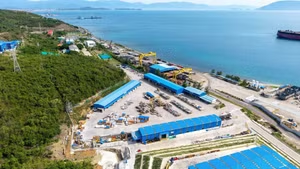
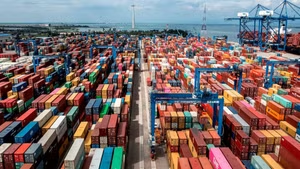
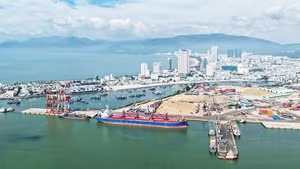
Although Can Tho City has the Cai Cui Port cluster (the central port cluster of the Mekong Delta), Can Tho International Airport, and national highways and expressways, connectivity remains inadequate and slow, especially in waterway transport. For many years, Cai Cui Port has been unable to receive large-tonnage vessels due to sedimentation along shipping channels into the Hau River.
As a result, more than 80% of the region’s goods must be transported and consumed by road, leading to high logistics costs and reduced competitiveness of regional goods.
In addition, the quality of human resources fails to meet requirements; a segment of officials, including some leaders, lack decisiveness, are reluctant to act, and tend to avoid responsibility. Science, technology, innovation, and digital transformation have not truly become leading driving forces for breakthrough development, while climate change continues to negatively affect production and people’s livelihoods.
In order to achieve objectives in the new period, the human factor is decisive. In terms of human resources and capacity, Can Tho City has many strengths, however, socio-economic development in recent years has not been dynamic nor created breakthroughs due to a lack of synchronous coordination, determination, and decisiveness, with officials remaining risk-averse and fearful of responsibility. Therefore, leaders at all levels and of sectors must address and remove the prevailing psychological barriers among officials. Leaders of agencies and units must create trust, set examples in both work and life, dare to think, dare to act, and dare to take responsibility for the common benefits in order to lead their collectives forward.
Pham Thanh Van
Former Standing Deputy Secretary of the Can Tho City Party Committee
Pham Thanh Van, Former Standing Deputy Secretary of the Can Tho City Party Committee, also emphasised that in order to achieve objectives in the new period, the human factor is decisive. In terms of human resources and capacity, Can Tho City has many strengths, however, socio-economic development in recent years has not been dynamic nor created breakthroughs due to a lack of synchronous coordination, determination, and decisiveness, with officials remaining risk-averse and fearful of responsibility. Therefore, leaders at all levels and of sectors must address and remove the prevailing psychological barriers among officials. Leaders of agencies and units must create trust, set examples in both work and life, dare to think, dare to act, and dare to take responsibility for the common benefits in order to lead their collectives forward.
Can Tho City has identified science and technology, innovation, and digital transformation as core driving forces to improve competitiveness and promote rapid and sustainable socio-economic development, towards taking a locomotive role in leading the entire region.
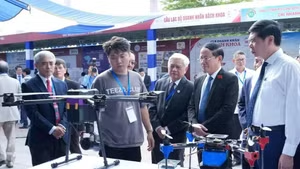
According to Ngo Anh Tin, Director of the Can Tho Department of Science and Technology, high-tech products currently account for more than 33% of the city’s total output. In 2025, the city established the Start-up and Innovation Centre as a focal point to connect and mobilise resources from within and outside the city for start-up and innovation activities, building and developing the start-up and innovation ecosystem of Can Tho City and the Mekong Delta region in sectors based on local and regional strengths. The centre has received strong support from city leaders and the Ministry of Science and Technology to develop at a regional scale and has become a core hub in connecting the entire region.
In addition, the project to establish the Can Tho City Fund for Science, Technology, and Innovation Development has been approved in principle by the Standing Board of the City Party Committee, providing a basis for implementation in the next phase, and contributing to creating a momentum for the city’s development in this field.
Standing Deputy Secretary of the City Party Committee and Chairman of the City People’s Council Dong Van Thanh affirmed that to address difficulties and challenges in socio-economic development and move towards becoming a new growth pole, Can Tho City needs to focus on completing key transport infrastructure.
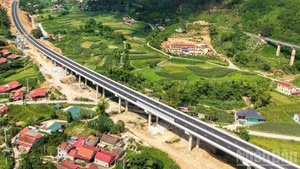
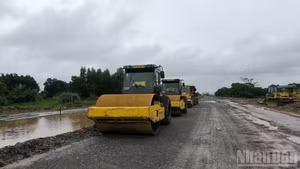
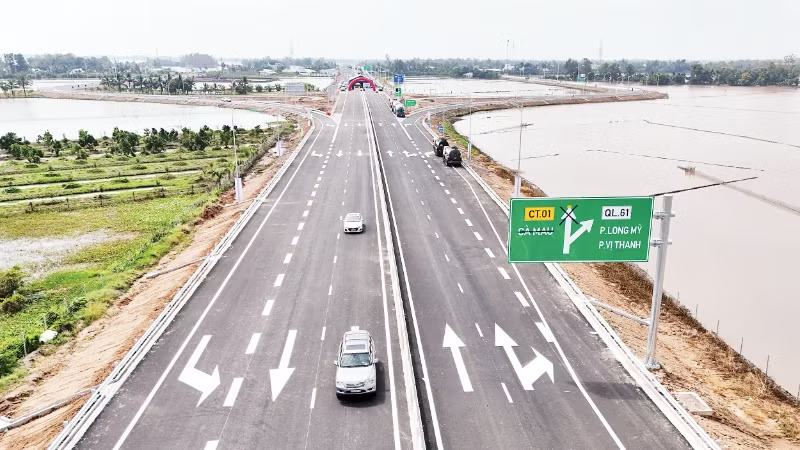
Accordingly, functional agencies need to accelerate the construction progress of the Chau Doc–Can Tho–Soc Trang Expressway, National Highway 91, and the western ring road to strengthen connectivity with 16 industrial parks and clusters, linked with the development of the marine economic zone, logistics services, and Tran De Port (covering an area of 40,000 hectares) into a deep-water seaport serving as a trade gateway for Can Tho City and the Mekong Delta region.
In addition to policies to attract and utilise talents, the Can Tho City Party Committee is focusing on training and fostering skills and capabilities of cadres at all levels, especially leaders, to meet the requirements of the new phase.