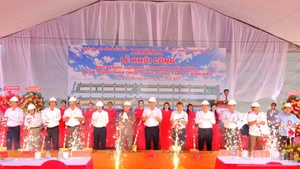
Public investment in 2025 concluded with many notable highlights. The total public investment capital plan assigned exceeded 902 trillion VND. Including local budget balances and carried-over funds from previous years, the total amount requiring disbursement surpassed 1.16 quadrillion VND. Nationwide disbursement exceeded 755 trillion VND, reaching 83.7% of the plan assigned by the Prime Minister. The remaining more than 146 trillion VND continued to be prioritised by ministries, sectors, and localities for completion before January 31, 2026.
Disbursement breakthrough
These figures reflect not only significant pressure on the administrative apparatus but also a clear shift in implementation mindset. For the first time in many years, public investment disbursement has become a yardstick for governance capacity and accountability at every level and across every sector.
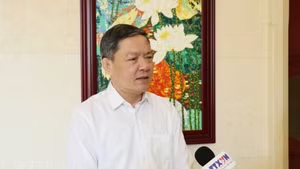
Nguyen Van Lam, Standing Member of the National Assembly’s Finance and Budget Committee, noted that the most noteworthy change lies in the shift in approach. “When the responsibility of the head is directly linked to disbursement progress and results, positive pressure creates implementation discipline. However, the most important factor remains the ultimate effectiveness of each project,” he emphasised.
In 2026, state budget public investment capital assigned to ministries and central agencies exceeded 995 trillion VND, including a 5% saving from investment expenditure to supplement the Lao Cai–Ha Noi–Hai Phong high-speed railway project. This scale presents unprecedented organisational requirements while also opening up strong growth opportunities.
Pham Van Hoa, National Assembly deputy from Dong Thap Province, said the large capital scale requires more flexible discipline in allocation and capital reallocation. Projects with good implementation and effective disbursement should be prioritised, while slow or inefficient ones should be boldly adjusted.
Within the broader picture, Ninh Binh Province emerged as a bright spot in 2025, achieving a disbursement rate of 144% with nearly 76 trillion VND in assigned capital. This success stemmed from methodical preparation from the investment planning stage.
The province established a site clearance steering committee, identifying this as the “bottleneck of all bottlenecks”. Resettlement arrangements and land-use conversion were implemented flexibly in phases to avoid prolonged delays. During project preparation, careful selection of financially capable and experienced consultants and contractors minimised potential risks.
Project management experts observed that Ninh Binh’s experience shows that high disbursement originates from thorough preparation and clear decentralisation. Once land clearance and materials are secured, construction progress is effectively “unlocked”.
Another lesson is proactive material supply. When local sand and fill sources proved insufficient, Ninh Binh worked early with Thanh Hoa and Hoa Binh provinces to secure alternatives, preventing infrastructure projects from being disrupted due to material shortages.
The province also maintained weekly and monthly progress meetings, promptly resolving issues within its authority and flexibly reallocating capital from slow projects to those with stronger disbursement capacity. Entering 2026, the first year of the 2026–2030 five-year socio-economic development plan, Ninh Binh has committed to disbursing 100% of assigned capital.
Ha Noi demonstrated the strength of flexible governance mechanisms in a special urban area. In 2025, with a capital plan exceeding 103 trillion VND, the city surpassed the Prime Minister’s assigned disbursement target, reaching over 106%.
The city identified public investment as a central political task and a key driver of GRDP growth. The introduction of a “green lane” mechanism for public investment procedures for key projects was regarded as a notable administrative reform, shortening processing time and reducing delays.
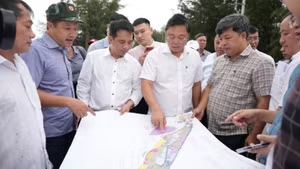
At the ministerial level, with 83.057 trillion VND in public investment in 2025, the Ministry of Construction determined to proactively remove bottlenecks as they arise. Working groups closely monitored construction sites, and leaders directly oversaw projects to address obstacles in a timely manner.
Le Thang, Director of Project Management Unit 2 under the Ministry of Construction, said the most important lesson is early completion of legal procedures, detailed planning for each component, and linking construction progress with disbursement commitments. Round-the-clock construction and acceptance based on actual completed volumes have helped avoid the year-end payment backlog that had persisted for years. “In previous years, disbursing 10 trillion VND was already a major effort. Accelerating progress must follow proper procedures, so units need to support one another to resolve issues,” he noted.
Tran Quoc Phuong, Deputy Minister of Finance, frankly acknowledged that despite completing the 2021–2025 term, persistent shortcomings remain in public investment. Without comprehensive procedural reform, public investment risks falling into a repetitive cycle of “obstruction — resolution — renewed obstruction”, reducing long-term efficiency.
Economic experts believe that under the two-tier local government model, Ha Noi’s deeper decentralisation to communes and wards is an important governance test. When approval processes are shortened and authority is aligned with responsibility, sustainable improvements in disbursement efficiency become achievable.
From figures to growth confidence
In 2026, the Ministry of Construction has been assigned more than 133 trillion VND, a sharp increase from the previous year. All capital has been allocated to investors, accompanied by a directive requiring 100% disbursement within the year. This represents both significant pressure and an opportunity to affirm its leading role in national infrastructure development.
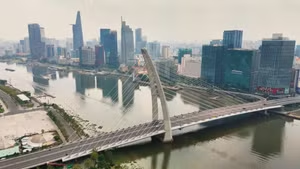
The distinct feature of 2026 lies not only in capital scale but also in investment structure. While previous years focused heavily on expressways, attention is now shifting towards large-scale railway and urban infrastructure projects.
The target of completing 5,000 km of expressways by 2030 continues, alongside the launch of a 2,362 km railway network, notably the North–South high-speed railway project with total investment of around 1.7 quadrillion VND. Infrastructure experts assess this as a strategic shift, as railway and metro investment can generate stronger spillover effects on economic restructuring and sustainable urban development.
According to forecasts by MB Securities Company, public investment disbursement in 2026 could reach a record 930 trillion VND, up around 20% year-on-year. This reflects a shift from a “preparation phase” to one of “decisive implementation”.
At the same time, the revised Land Law and revised Law on Public Investment are being put into practice, addressing obstacles related to land pricing frameworks, compensation and site clearance, and approval authority. Institutional experts believe that once the legal foundation is strengthened, public investment will serve not merely as a short-term stimulus but as a medium-term growth pillar for the 2026–2030 period.
With substantial resources and strong political determination, 2026 is expected to mark a pivotal year in a new development cycle. When resources are transformed into completed projects, projects generate growth, and growth in turn benefits the people, public investment will truly fulfil its leading role and reinforce Viet Nam’s economic position in the 2026–2030 period.