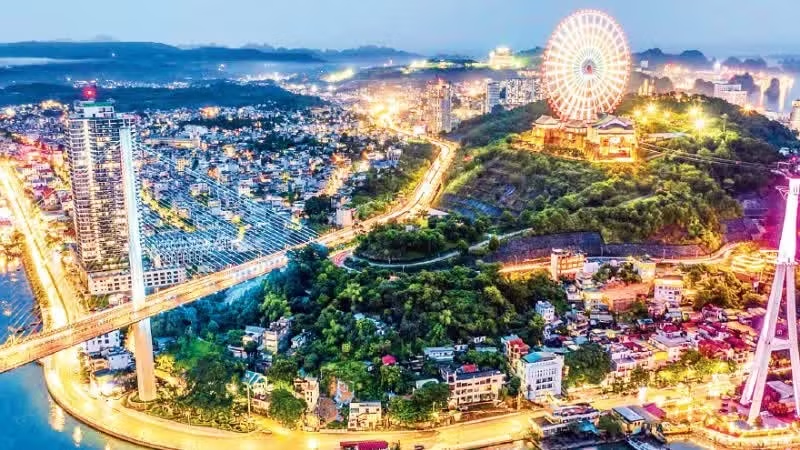
Quang Ninh’s advantage lies in its diverse and integrated transport system, which provides an important foundation and strategic breakthrough for a new development phase based on a smart and model urban framework.
Planning first, transport paving the way
With the Van Don-Mong Cai Expressway, Quang Ninh has become the only locality in the country possessing a nearly 200km-long expressway network directly connected to Ha Noi and major northern economic centres. Alongside this, a series of key infrastructure projects — including the Cua Luc Bridge, the Ha Long-Cam Pha coastal road, Van Don International Airport, and seaport and logistics systems — have helped reshape the province’s development landscape, shorten geographical distances, strengthen regional connectivity and open up new development opportunities.
Recently, Quang Ninh Province and Vingroup, in coordination with Ha Noi, Hai Phong and Bac Ninh, commenced construction of the Ha Noi-Quang Ninh high-speed railway project. The project has a total investment of more than 147 trillion VND (approximately 5.6 billion USD) and is expected to pass through four localities over a length of 120.2km, with a maximum speed of up to 350km/h. The railway is scheduled for completion and commercial operation in 2028, reducing travel time between Ha Noi and Quang Ninh from more than two hours to around 30 minutes.
Entering a new development phase, Quang Ninh has identified the principle that “planning must go first, transport must pave the way”. The province is therefore focusing on improving planning quality in an integrated, synchronised and long-term manner, aligned with trends in green urban development, smart cities and transit-oriented urban models.
At the same time, the province is accelerating digital transformation in the planning sector, building synchronised and unified databases, strengthening both regional and intra-regional connectivity, and developing spatial organisation under the two-tier local government model in a streamlined and efficient direction. Planning is designed to ensure consistency with national, regional and sectoral plans while maximising the unique advantages of a coastal-border-heritage urban area. It also aims to promote green, smart and sustainable urban development that adapts to climate change and balances economic growth with environmental protection and improved quality of life.
Director of the Quang Ninh Department of Construction Do Xuan Diep said: “Through planning, Quang Ninh will comprehensively restructure its development space, rationally organise urban, industrial, service, tourism and rural areas, while developing modern and synchronised technical and social infrastructure systems. This will provide an important foundation for the province to realise its goal of becoming a centrally governed city and a dynamic growth pole of the northern region.”
Through planning, Quang Ninh will comprehensively restructure its development space, rationally organise urban, industrial, service, tourism and rural areas, while developing modern and synchronised technical and social infrastructure systems. This will provide an important foundation for the province to realise its goal of becoming a centrally governed city and a dynamic growth pole of the northern region.
Director of the Quang Ninh Department of Construction Do Xuan Diep
With regional connectivity, international integration and sustainable development as central orientations, during the 2026-2030 period Quang Ninh will continue prioritising resources for key multimodal transport infrastructure projects. The province’s transport system is being comprehensively planned and synchronised across roads, railways, seaports, airports, inland waterways and coastal routes, creating an open transport network that strongly promotes trade, tourism and logistics.
At the same time, Quang Ninh will continue expanding growth space and creating breakthroughs driven by science and technology and digital transformation. The province will also promote the coordinated development of the green economy, heritage economy, marine economy, border economy, night-time economy and cultural industries. Major investments will continue in road infrastructure, high-speed railways, airports, seaports and smart urban infrastructure connecting major urban centres.
Improving quality of life
In the coming period, Quang Ninh will strive to ensure harmonious and balanced development among communes, wards and special administrative zones, while protecting the environment and preserving cultural identity. The province also aims to strengthen institutional reform, innovate governance and build a development-oriented, transparent, disciplined and effective administration, thereby improving people’s quality of life.
Since late 2025, hundreds of roads, urban infrastructure projects and residential areas have been upgraded and renovated, creating a more modern and attractive urban appearance while significantly improving the living environment. In many localities, residents have actively donated land and dismantled structures to facilitate road expansion and urban beautification. Thousands of households have contributed tens of thousands of square metres of land, helping accelerate infrastructure projects and visibly transform urban landscapes.
Dang Van Mai, a resident of Cam Pha Ward, said: “I am very pleased to witness the province’s rapid and sustainable development. In addition to investing in modern and synchronised infrastructure and attracting investment resources, the province has also paid close attention to improving people’s livelihoods. Quang Ninh becoming a centrally governed city is entirely consistent with the locality’s development aspirations and the wishes of the people, while also opening a new development chapter for Quang Ninh in the country’s new era.”
With its modern infrastructure foundation, impressive economic growth and strategic location, Quang Ninh is expected to form a new “growth triangle” together with Ha Noi and Hai Phong once it becomes a centrally governed city, helping drive growth across northern Viet Nam. Achieving centrally governed city status will not only create a “new institutional framework”, but also position Quang Ninh as a growth pole capable of making strong breakthroughs and spreading development on a broader scale.
Becoming a centrally governed city represents the province’s greatest opportunity to leverage special mechanisms, maximise its existing potential and advantages, and realise the core objective of building Quang Ninh into a leading city of the country in every respect — a prosperous, civilised and modern model city where people’s quality of life continues to improve.
Quang Minh Cuong, Secretary of the Quang Ninh Provincial Party Committee
Quang Minh Cuong, Secretary of the Quang Ninh Provincial Party Committee, affirmed: “Becoming a centrally governed city represents the province’s greatest opportunity to leverage special mechanisms, maximise its existing potential and advantages, and realise the core objective of building Quang Ninh into a leading city of the country in every respect — a prosperous, civilised and modern model city where people’s quality of life continues to improve.”