Clearing bottlenecks to development
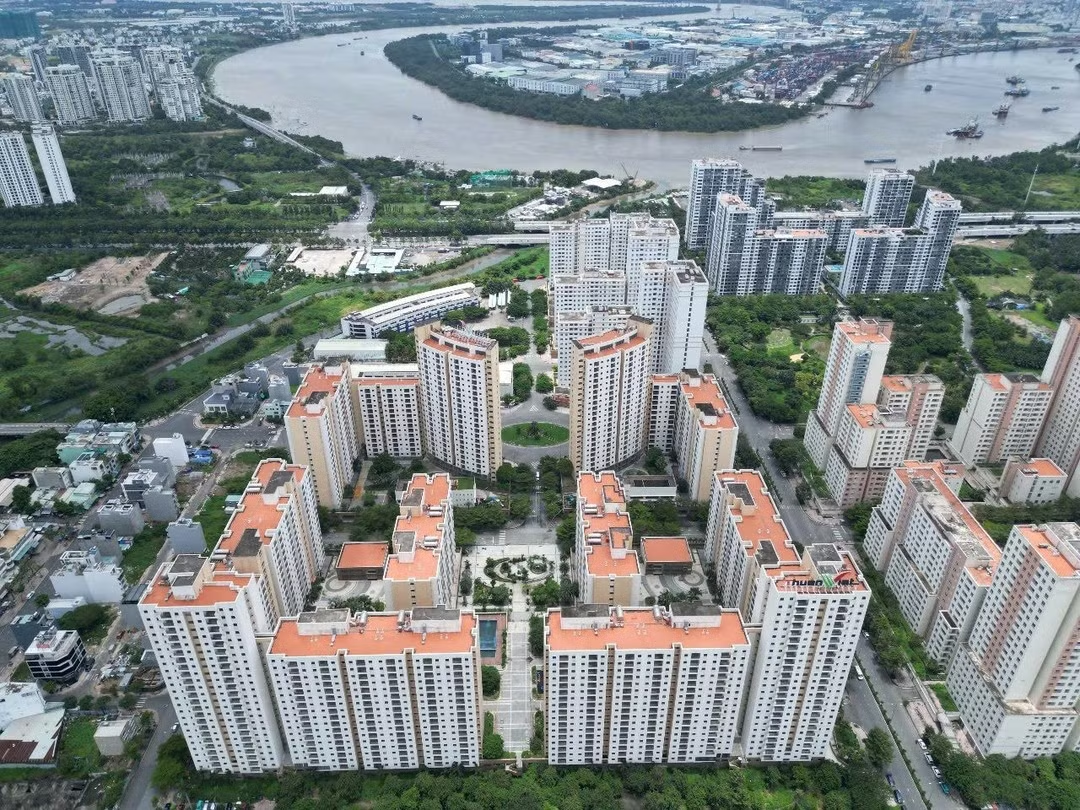
Between 2013 and 2025, Ho Chi Minh City built 12,500 apartments to resettle about 16,000 households affected by the Thu Thiem New Urban Area project in An Khanh Ward.
But most residents chose to take financial compensation and find their own housing, leaving many resettlement apartments vacant.
To address the problem, the city has repeatedly drawn up plans since 2018 to auction the apartments and convert them from resettlement to commercial housing.
Yet large auction packages, high starting prices, legal obstacles to the conversion and financial pressures have left investors wary of bidding.
A similar situation exists at the 30.9-hectare Vinh Loc B resettlement area in Tan Vinh Loc Commune. The development, with 1,939 apartments and 529 residential land plots, has been in use since 2010 but remains sparsely occupied, and many of its facilities are in disrepair. The result is a paradox: the city has housing available, yet people who need homes cannot get them.
The Urban Development Law offers a way to address these bottlenecks. It authorises the city to convert housing between commercial, social and resettlement categories, so that properties can be used flexibly to meet residents’ real needs.
The city is also empowered to change the use of public housing under its management when needed.
Dr Pham Viet Thuan, Director of the Ho Chi Minh City Institute of Natural Resources and Environmental Economics, said the city should make full use of the Urban Development Law to review completed resettlement projects that are no longer needed for their original purposes.
The review should clarify current demand for resettlement housing, the legal status of the properties and their value, so that suitable conversion options can be chosen for each project.
A new approach to implementation
The Urban Development Law covers a broad range of issues, including administrative organisation and decentralisation, urban planning and development, finance and budgeting, and new and special economic models.
It gives the city broader authority to issue special regulations suited to a major metropolis, allows controlled regulatory sandboxes of up to five years, sets a legal framework for planning underground and above-ground spaces and protects officials who show initiative and take bold action.
Putting the law into practice should let the city take the initiative in pursuing development policies and tackling long-standing bottlenecks.
In the first month since the Urban Development Law took effect, the city People’s Council has adopted 24 resolutions on planning, infrastructure, key projects and policies affecting social welfare and quality of life.
Mai Huu Tin, Chairman of the Ho Chi Minh City Union of Business Associations (HUBA), said the union has received 46 draft resolutions affecting businesses, including those on infrastructure, underground spaces, the transformation of industrial parks and export processing zones, and new development models.
He said early access to the drafts and the chance to comment have helped businesses better understand policy direction, prepare and act on new policies faster.
The Ho Chi Minh City People’s Committee said each resolution and decision must specify the lead agency, coordinating agencies, individuals in charge, deadlines, required resources and criteria for evaluating outcomes.
In the initial phase, the city is testing how the new mechanisms work in practice across various sectors so that any that prove unsuitable can be adjusted quickly.
Tran Luu Quang, Secretary of the Ho Chi Minh City Party Committee, said the city must turn the law’s advantages into concrete mechanisms that unlock resources and deliver results.
He said delays that prevent residents and businesses from benefiting promptly from the new policies would mean the mechanisms had failed to deliver their intended benefits.
Quang added that practical decisions, effectively carried out, would generate momentum for rapid and sustainable development and improve residents’ quality of life.
Le Nhu Thach, Vice Chairman of HUBA, proposed that the city introduce tax and service incentives and investment mechanisms to encourage the development of underground spaces.
He suggested that underground spaces should house not only car parks but also shopping centres, service facilities and entertainment venues, adding value to the city.
At public parks, many businesses have also suggested building commercial and service facilities underground while preserving green spaces above. This would use urban space more efficiently and offer residents and tourists more services.
Speaking to officials in Tan Thoi Hiep Ward after the law took effect, Nguyen Huu Hiep, Chairman of the ward People’s Committee, said specialised agencies should study the law closely, review their responsibilities and propose measures suited to local conditions.
Vu Thi Yen, a resident of Phuoc Long Ward, said: “Ho Chi Minh City is a dynamic and innovative place. I hope the city will implement the Urban Development Law effectively to meet its major goals, improve people’s living standards and achieve sustainable economic development.”