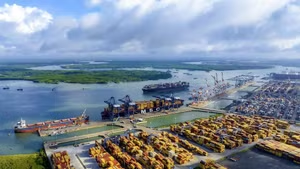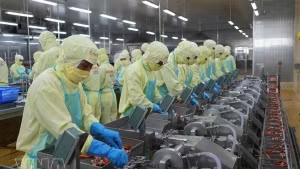
In the spirit of three Central Committee resolutions — Resolution No. 68-NQ/TW on the development of the private sector, Resolution No. 79-NQ/TW on the development of the state sector, and Resolution No. 10-NQ/TW on the development of the foreign-invested sector — it is clear that the coexistence of three economic sectors, centred on state-owned enterprises, private enterprises, and foreign direct investment (FDI) firms, is inevitable. These sectors are not mutually exclusive.
Three parallel lines
These enterprises are the principal economic actors contributing to achieving Viet Nam’s ambitious national goals for 2030–2045 and its vision for 2130, as set out in Resolution No. 19-NQ/TW on renewing Viet Nam’s development model in the new era. Enterprises in each economic sector may perform different functions, but they must share one core principle: three economic sectors, one national capacity.
This means that businesses in different economic sectors should not be viewed as separate segments, but as three groups of actors jointly forming an ecosystem that underpins national competitiveness. From this perspective, greater emphasis must be placed on linkages between enterprises to enhance the quality and efficiency of the entire system. In other words, the focus should be on the business sector as a collective force. Within Viet Nam’s business community, economic groups play a pivotal role, linking small and medium-sized enterprises (SMEs) to form domestic production chains and networks.
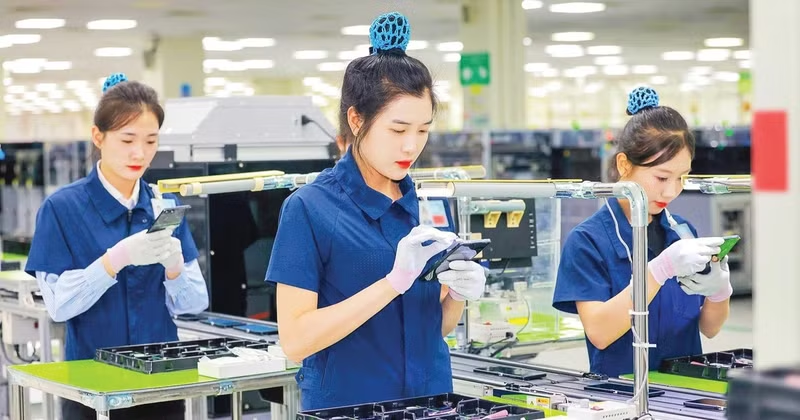
Several models demonstrating effective linkages between different types of enterprises are already operating in Viet Nam. One notable example is the State–Samsung Group–private enterprise model implemented during 2015–2025, which aimed to help local businesses improve production processes and develop their supplier base. Under this model, the Ministry of Industry and Trade and the Bac Ninh Provincial People’s Committee introduced policies to support training and business connections. Samsung established technological and management standards and provided orders, while private enterprises focused on raising productivity, upgrading technology, and joining supply chains.
The model trained 207 Vietnamese consultants, supported production improvements at 144 domestic enterprises in Samsung’s supply chain, and increased the number of Tier 1 suppliers from 35 to 50 and Tier 2 suppliers from 157 to 203.
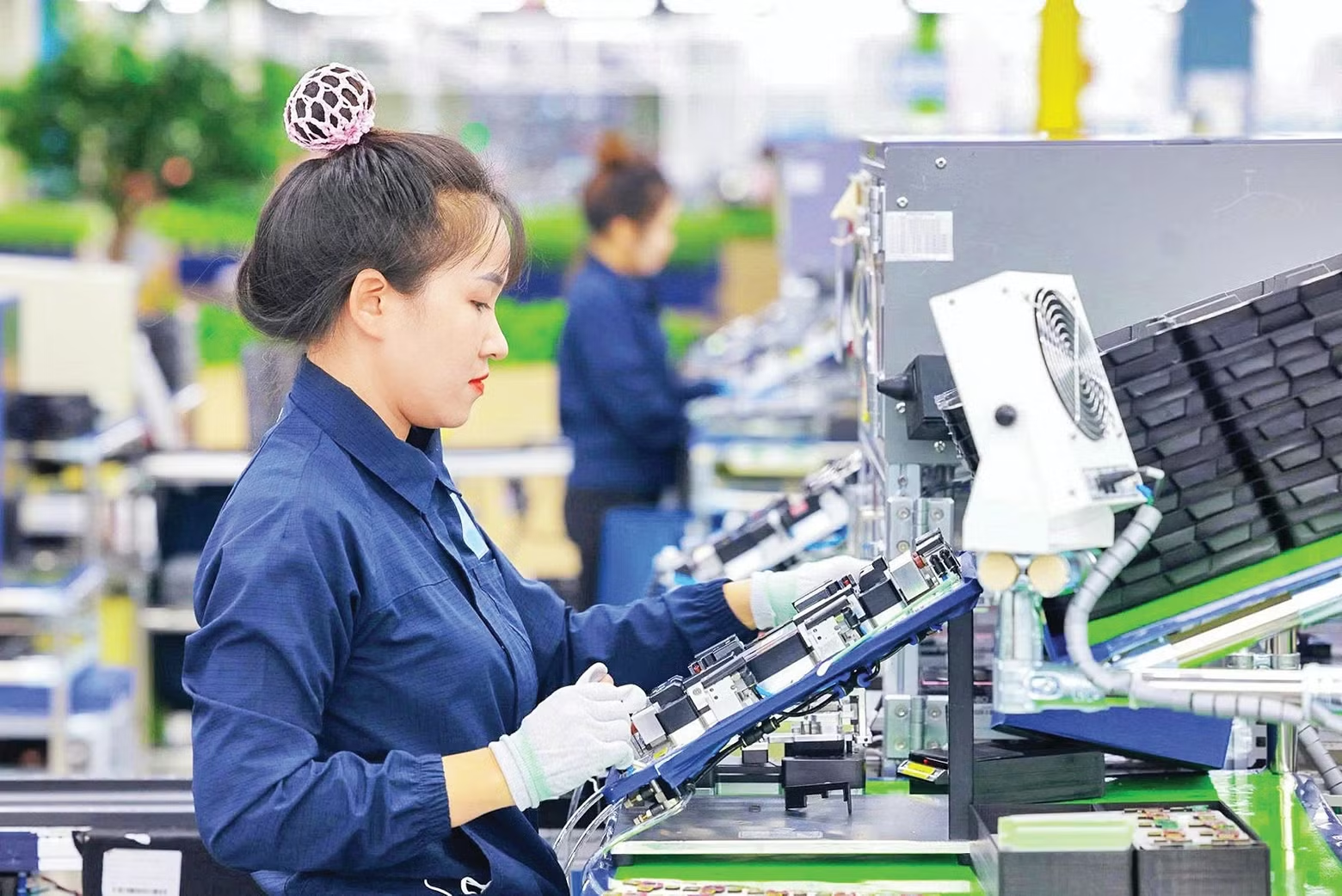
The cooperation project to develop smart factories has also achieved encouraging results through a similar linkage model. Under this arrangement, the State provides the institutional and financial framework and connects Samsung with domestic enterprises. Samsung, in turn, supplies technology, standards, experts, and management models to support private businesses. Private enterprises then adopt, apply, and refine these approaches while innovating their operations.
The programme has helped boost productivity, accelerate digital transformation, and strengthen the competitiveness of domestic businesses. It provides a compelling example of how links between the three economic sectors can become a driving force for private-sector development.
However, such models remain limited in scale. In practice, enterprises in Viet Nam’s three economic sectors still operate largely in isolation, creating what amounts to “three economies within one economy.” State-owned enterprises control infrastructure, energy, minerals, and other strategic national resources, yet have not fully realised their role as a foundation for the growth of domestic private businesses.
FDI enterprises make a substantial contribution to exports but operate within their own global supply chains, with limited technology transfer or spillover benefits for domestic firms. This has created two parallel tracks: FDI enterprises move directly towards international markets, while local private businesses remain confined to a relatively underdeveloped domestic market.
Building linkages through “spillover effect”
This situation underscores the need to strengthen links between enterprises across the economic sectors, to develop a model based on the “spillover effect.” Under this approach, enterprises from different sectors establish economic partnerships on the principles of voluntary participation, mutual benefit, and compatibility with each party’s capabilities. The benefits of greater efficiency and organisational maturity flow downwards, from large corporations and major enterprises to smaller businesses, creating a sustainable system.
Under this model, large corporations and leading enterprises, often referred to as flagship companies, act as growth engines and amplify their spillover effects. These economic entities can lead markets, create business networks, and establish value chains, enabling other members of the business community to identify opportunities, determine how to participate, and secure their place within the system.
SMEs serve as reliable partners for major corporations and leading firms. They provide products and services to meet the procurement needs of large private economic groups, while also acting as important markets that directly purchase or distribute products supplied by larger businesses.
Within this model, large corporations and major enterprises focus on market engagement and product commercialisation, while research and development, product development, and the roll-out of commercialised solutions can be undertaken by SMEs through cooperation between the two sides. Mutually beneficial partnerships between large corporations and other businesses generate growth from which enterprises, society, and the public all stand to benefit.
Business cooperation can create enterprises that are stronger both financially and in scale. Only by doing so can Vietnamese businesses compete with foreign conglomerates, expand into global markets, and build value chains.
Mutually beneficial partnerships between large corporations and other businesses generate growth from which enterprises, society, and the public all stand to benefit. Business cooperation can create enterprises that are stronger both financially and in scale. Only by doing so can Vietnamese businesses compete with foreign conglomerates, expand into global markets, and build value chains.
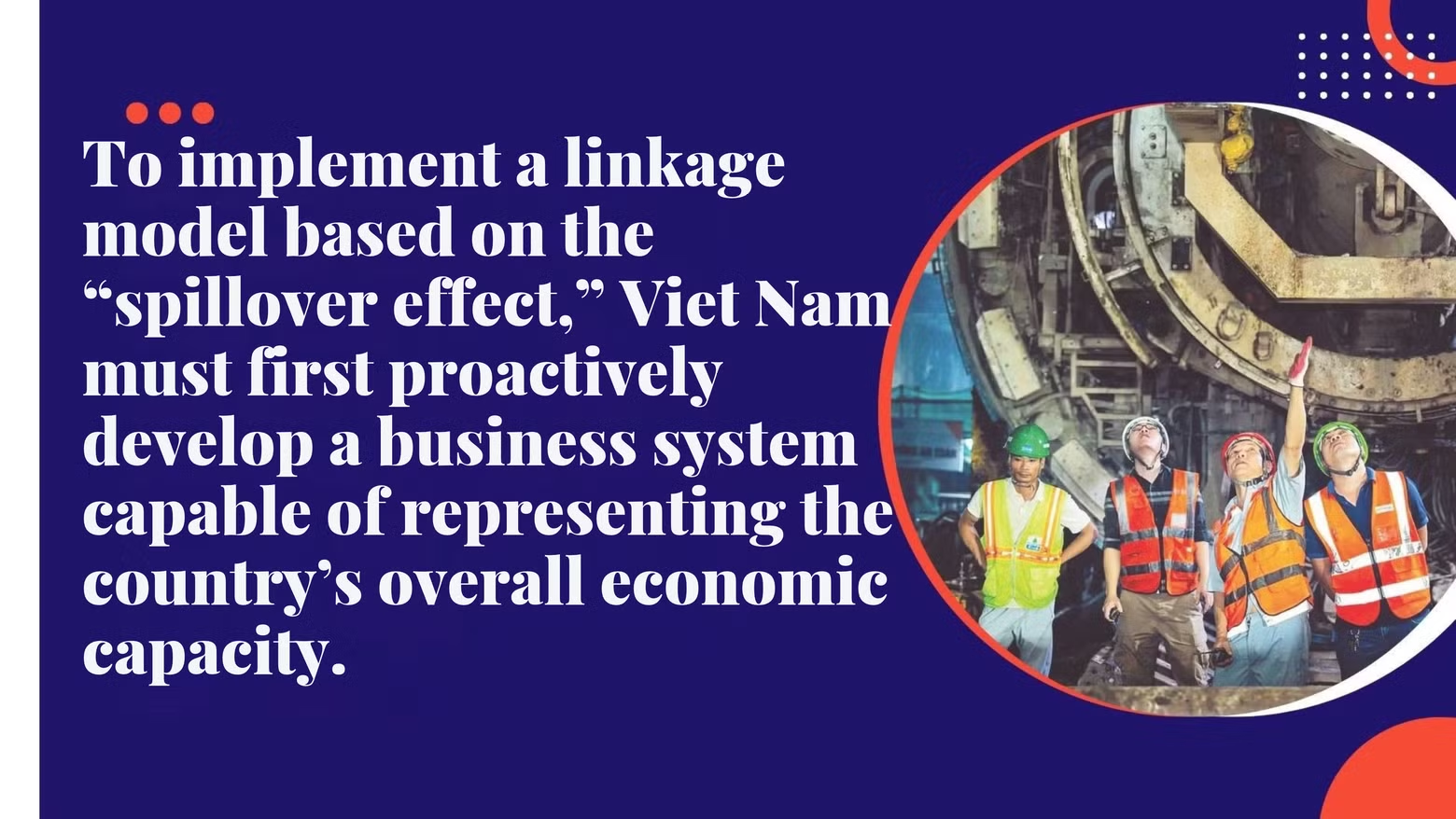
To implement a linkage model based on the “spillover effect,” Viet Nam must first proactively develop a business system capable of representing the country’s overall economic capacity.
Specifically, the country needs to establish and develop more large economic groups with strong financial resources and the capacity to compete regionally and internationally. This can be achieved through tax policies, financial support, and access to preferential funding suited to corporate research, innovation, and technological modernisation. The number of medium-sized enterprises should also be expanded, while encouraging capital accumulation through internal resources and mechanisms such as mergers and acquisitions as well as equity investment.
Support must also be provided to ease the difficulties faced by small and micro-enterprises. Measures could include tax policies and the amendment, supplementation, or removal of regulations governing business licensing, import and export activities, and market management. The aim should be to make development resources as accessible as possible to smaller businesses.
At the same time, Viet Nam needs to build and develop production networks controlled by dometic enterprises, enabling them to take the initiative, innovate in manufacturing, and bring large, medium-sized, and small businesses together as a cohesive force. Within this system, the different components would support one another and develop through competition. Otherwise, as experience in recent years has demonstrated, Vietnamese enterprises will struggle to grow, expand only slowly, and fail to mature sufficiently to compete internationally.
Another crucial condition is upgrading industry through deeper integration with FDI.
Accordingly, Viet Nam should focus on attracting multinational corporations with advanced, clean technologies and high value-added activities, particularly in sectors such as semiconductors, artificial intelligence, and automation. FDI enterprises should be encouraged to invest in research and development, technology transfer, and the adoption of Industry 4.0 solutions. Modern and sustainable industrial park infrastructure must also be developed.
Another essential requirement is to shift the approach to FDI linkages so that it becomes more proactive and generates greater spillover benefits. Viet Nam needs to move from simply “attracting investment” towards “investment promotion on the ground.” In practical terms, this means helping major existing FDI enterprises, such as Samsung, Canon, Foxconn, and Amkor, expand their production operations while encouraging their supporting suppliers to establish or scale up alongside them.
Domestic enterprises must also be connected with FDI businesses, while private companies should be encouraged to invest systematically in modern management and strengthen their production capabilities. This would enable them to become reliable partners for major foreign-invested corporations and enhance the competitiveness of local businesses.
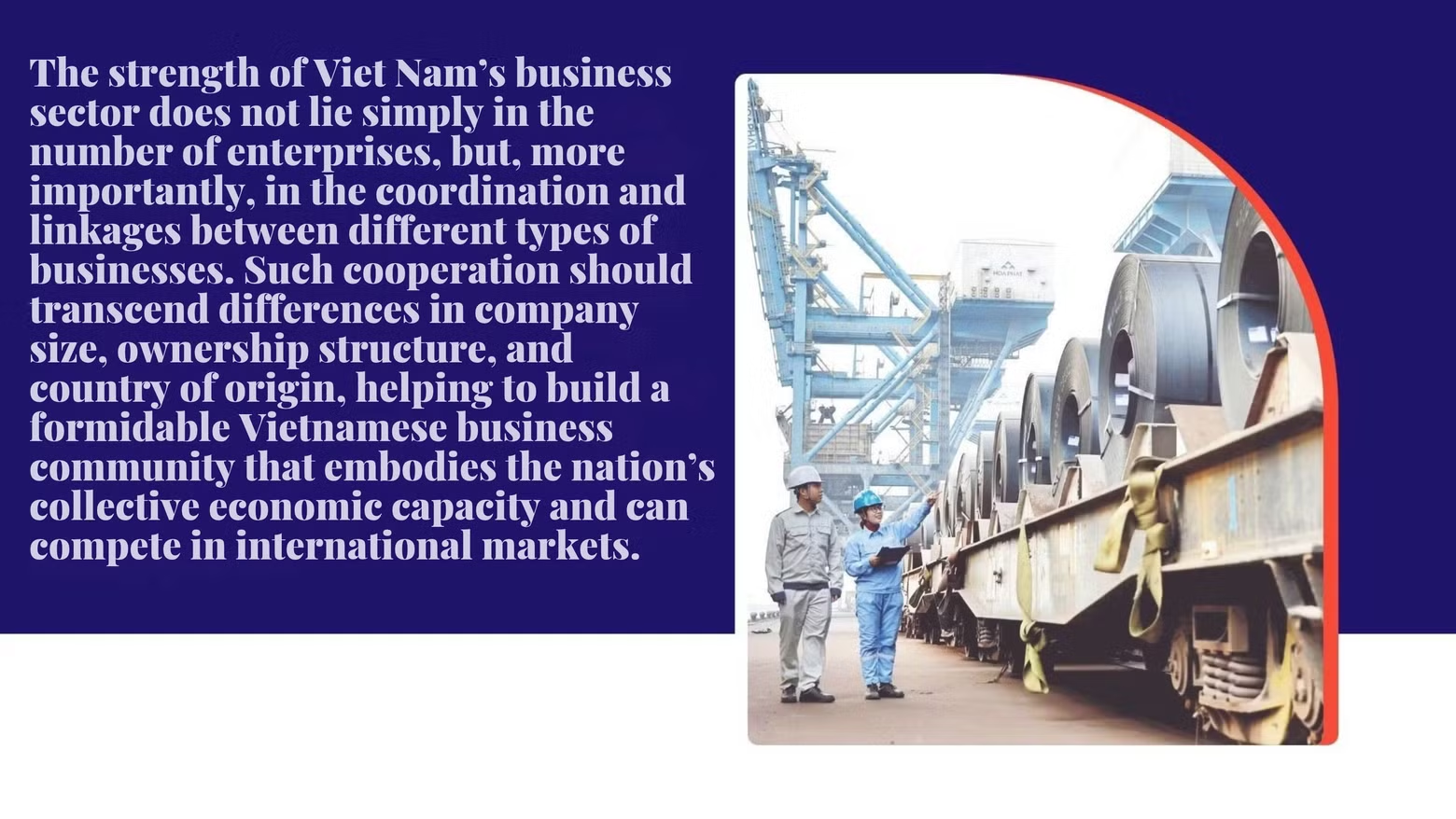
In conclusion, the strength of Viet Nam’s business sector does not lie simply in the number of enterprises, but, more importantly, in the coordination and linkages between different types of businesses. Such cooperation should transcend differences in company size, ownership structure, and country of origin, helping to build a formidable Vietnamese business community that embodies the nation’s collective economic capacity and can compete in international markets.