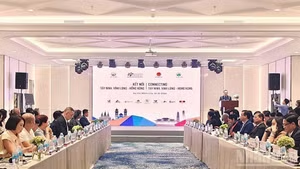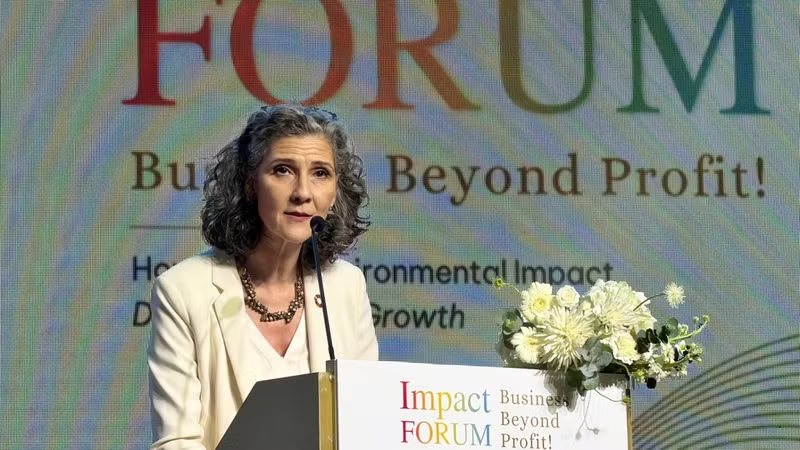
This was the key message at the Impact Forum “Business for Community Benefit: Social and Environmental Impacts Driving Business Growth”, held on the afternoon of August 20 as part of InnoEx 2026 in Ho Chi Minh City.
The forum brought together social impact businesses, investors, business leaders, Government representatives and ecosystem partners from Viet Nam and Canada to discuss how businesses can turn social and environmental impacts into opportunities for growth, market expansion and investment attraction.
The event also showed that the social impact business ecosystem in Viet Nam is continuing to develop. Through cooperation with the Government of Canada and the former Ministry of Planning and Investment, the United Nations Development Programme’s (UNDP) ISEE COVID project supported more than 400 social impact businesses, contributing to the creation of nearly 15,000 jobs. About 60% of these businesses are led by women, with many creating livelihoods and opportunities for ethnic minority communities and people with disabilities.
One year after the project ended, many of the supported businesses continued to grow, expand their operations and markets, establish new partnerships, while also attracting additional businesses and investors. Their experience demonstrates the importance of a supportive ecosystem that helps businesses adapt and grow beyond the period of support provided by programmes.
The programme showed that social and environmental impacts are not separate from business performance. There is growing evidence that positive impacts can create business value. Businesses that reduce waste can simultaneously reduce costs; manufacturers working with farmers to adopt more sustainable practices can build more resilient supply chains. Businesses that meet higher environmental and social standards can also gain access to new buyers, investors and international markets.
“This is not about choosing between profit and impact objectives. What matters is understanding how the two can reinforce each other. Strategic partnerships play an essential role in taking positive impacts created at the local level to a larger scale and reaching global markets,” said UNDP Resident Representative in Viet Nam Ramla Khalidi.
She highlighted the complementary strengths of Canada and Viet Nam, noting that Canada has extensive experience in green innovation, sustainable business models and international markets, while Viet Nam has a dynamic business ecosystem and strong innovation capabilities. She said the two countries have significant potential to combine their strengths in areas such as climate-resilient forestry, sustainable agriculture and food, clean technology, digital innovation and artificial intelligence (AI), life sciences and the marine economy.
These are all areas in which social and environmental impact solutions can simultaneously create commercial value and new growth opportunities.
The forum encouraged businesses, buyers and investors to view SIBs not only as beneficiaries of development programmes, but also as potential suppliers, partners and businesses for investment.
The Impact Forum is part of SIB Connect under InnoEx 2026, providing a space for SIBs to showcase their solutions, connect with potential partners and investors, and strengthen engagement with the broader business community.
As the business environment in Viet Nam continues to change, the experience of SIBs shows that integrating social and environmental impacts into business models can help enhance resilience, expand markets and create long-term value for businesses and communities.