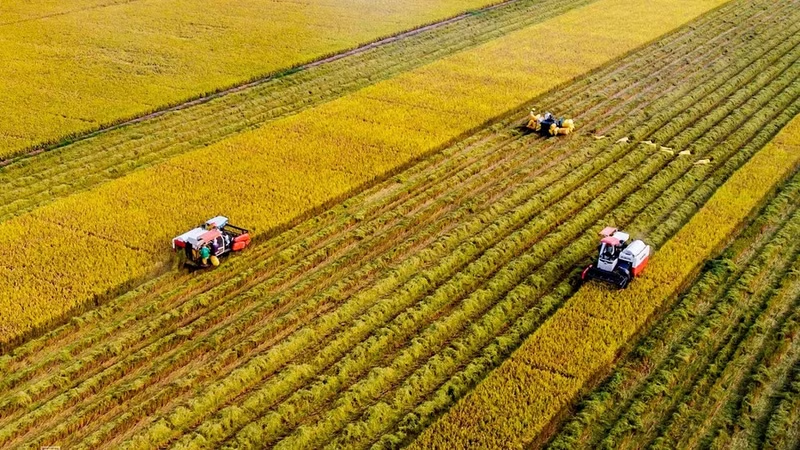
Stable production, accelerating exports
Data from the National Statistics Office show that, in the first nine months of 2026, many agricultural product groups, including rice, fruit, livestock and fisheries, maintained high productivity and output, meeting domestic demand and generating supplies for export.
Specifically, fruit and vegetable exports reached nearly 7.35 billion USD, up 19.9%; seafood exports totalled 9.17 billion USD, up 12.3%; livestock product exports reached 564.4 million USD, up 24.6%; cashew nut exports stood at 3.85 billion USD, up 2%; and pepper exports reached 1.4 billion USD, up 10.2%.
However, export performance varied across product groups, with coffee and rice showing downward trends. In the first nine months of the year, coffee exports reached 1.4 million tonnes, worth 6.54 billion USD, representing a 15.4% increase in volume but a 7.3% decline in value. Rice exports totalled 6.4 million tonnes, valued at 3.11 billion USD, down 6.1% and 10.9%, respectively, compared with the same period in 2025.
The main reason was falling export prices. The average coffee export price in the first nine months was estimated at 4,537.3 USD per tonne, down 19.7%, while the average rice export price was estimated at 484.8 USD per tonne, down 5.1%. For rice, pressure also came from a key consumer market. In the first eight months of the year, the value of rice exports to the Philippines fell by 16.8% year on year. This highlights the increasingly significant impact of price movements and purchasing power in individual markets on export performance.
As a sector that recorded strong growth over the first three quarters and is targeting 10 billion USD in export turnover for the year, the fruit and vegetable industry has benefited from the expansion of the Chinese market, according to Nguyen Thanh Binh, Chairman of the Viet Nam Fruit and Vegetable Association. The number of approved growing area codes and packing facility codes has increased considerably, helping drive exports. China accounted for 63% of Viet Nam’s fruit and vegetable export market in the first eight months of 2026, with export value to the market rising 38.8% year on year.
To further standardise product quality and traceability for domestic goods destined for export, the agricultural sector is stepping up the development of data infrastructure and strengthening its capacity to monitor and verify product information. According to Deputy Minister of Agriculture and Environment Dang Ngoc Diep, as of September 20, 2026, a total of 820,723 agricultural products from 3,030 farming households and 208 businesses across 28 of Viet Nam’s 34 provinces and cities had been registered on the agricultural traceability system. Of these, 158,796 products from 48 farming households and 20 businesses in 16 provinces had completed the traceability process, enabling verification and cross-checking throughout the supply chain.
Retaining markets and diversifying supply
In the first nine months of 2026, China remained Viet Nam’s largest export market for agricultural, forestry and fishery products, accounting for 24.4% of total exports, followed by the US at 19.8% and Japan at 7.4%. To increase export turnover, industries need to consolidate their position in markets with strong purchasing demand while proactively securing supplies to fulfil existing contracts and stand ready to take on new orders.
Regarding the key Chinese market, Ngo Tuong Vy, General Director of Chanh Thu Fruit Export-Import Group Joint Stock Company, said the company had proactively conducted in-depth surveys across different regions of China, observing purchasing practices first-hand and studying actual demand, consumer preferences and buying behaviour. Based on these findings, it adjusted its production, preliminary processing and packaging procedures and developed products better suited to the market.
China has a well-developed network of sorting and processing centres, where imported products can undergo further processing to suit consumers’ tastes and demand for convenience. To attract customers and move further up the value chain, Vietnamese businesses therefore need to develop convenient products, including those that are ready to eat or use.
For some other product groups, solutions are needed not only to secure markets but also to ensure adequate supplies. Le Hang, Deputy Secretary-General of the Viet Nam Association of Seafood Exporters and Producers (VASEP), said seafood exports were expected to lose momentum in the fourth quarter following a strong acceleration in the third quarter. Many orders for year-end consumption had already been imported and delivered early, making it difficult for additional purchasing demand to remain as strong as in recent months.
Shrimp, tra fish and tilapia are all facing shortages of raw materials, while exports of wild-caught seafood are also difficult to expand due to a lack of suitable raw materials and limited capacity to meet origin-traceability requirements. “Therefore, even when some markets continue to show demand, the ability to fulfil orders may still be constrained,” Le Hang stressed.
A similar situation has emerged in the cashew industry, where export value has risen despite a decline in volume, partly due to pressure on domestic supplies of processing materials. Major raw material suppliers are stepping up local processing, leaving less product available for export. This requires Vietnamese businesses to take early action to secure raw material growing areas that meet the required standards.
The fourth quarter is the final sprint of the year and a peak period for industries to boost exports, making a significant contribution to overall growth targets. To capitalise on these opportunities, production needs to be organised more effectively in raw material growing areas to ensure adequate supplies. At the same time, strict quality control is essential to help products command higher prices in the market.