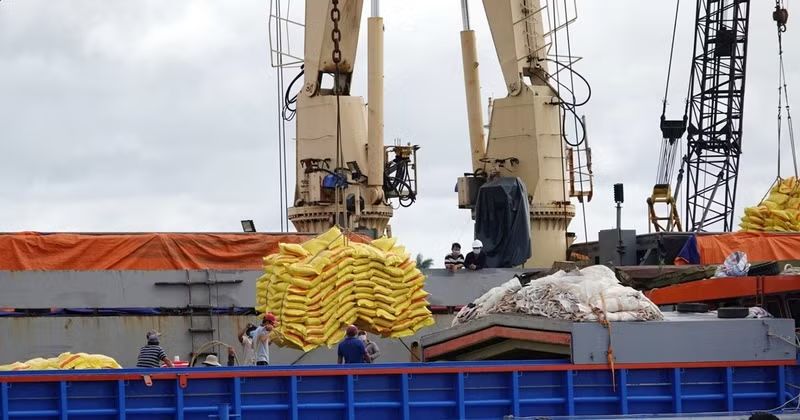
Burden of cost
According to the Viet Nam Association of Seafood Exporters and Producers (VASEP), container freight rates from Asia to North America and Europe remained high in July 2026. Compiled data show that freight rates from the Far East to the US West Coast stood at around 7,072 USD per 40-foot equivalent unit (FEU), up 66.6% from the previous month, while rates from the Far East to Northern Europe were approximately 5,457 USD/FEU, up 42.6%.
For frozen seafood, logistics costs directly affect price competitiveness, delivery schedules, and companies’ profit margins. Rising transport costs make it difficult for businesses to maintain quoted prices and compete with countries that have large-scale production advantages or more favourable logistics locations.
For fresh fruit, the pressure is even greater because of its short shelf life. Nguyen Dinh Tung, General Director of Vina T&T Group, said refrigerated container freight rates to the US had at times reached as high as 7,800 USD/FEU. Moreover, when geopolitical tensions intensify, transport times can rise to nearly double that of in normal conditions. To ensure product quality and meet delivery schedules, many consignments have to be switched to air freight, which is considerably more expensive. These factors have significantly reduced businesses’ profits.
In addition to international transport, businesses also incur logistics costs on domestic routes. Nguyen Van Muoi, Deputy Secretary-General of the Viet Nam Fruit and Vegetable Association, said around 80% of agricultural products currently depend on road transport, while inland waterways and railways — lower-cost modes of transport — have yet to be used effectively. In concentrated production areas such as the Mekong Delta and the Central Highlands, connectivity infrastructure linking production zones remains limited. Many local roads and bridges are unable to accommodate container trucks, forcing goods to be transferred several times before reaching ports.
In addition, major trading hubs still lack large-scale agricultural logistics centres. Services such as preliminary processing, packaging, cold storage, plant quarantine, and irradiation are scattered across different locations, forcing businesses to move goods through multiple stages, resulting in extended transit times and increased costs.
“According to our calculations, transport currently accounts for around 30% of the cost of many fruit and vegetable products, while domestic logistics alone accounts for approximately 17%,” Muoi stressed.
Optimising entire supply chain
When costs arise throughout both domestic and international logistics chains, the competitiveness of Vietnamese agricultural products is eroded. Addressing this bottleneck requires optimisation of the entire supply chain through coordinated investment in logistics infrastructure, data infrastructure, and transport capacity.
When costs arise throughout both domestic and international logistics chains, the competitiveness of Vietnamese agricultural products is eroded. Addressing this bottleneck requires optimisation of the entire supply chain through coordinated investment in logistics infrastructure, data infrastructure, and transport capacity.
Tran Chi Dung, a standing committee member of the Viet Nam Logistics Business Association (VLA) in charge of agricultural logistics, said countries were now competing on the basis of verified data infrastructure. Without an interconnected system linking growing areas, logistics, quarantine, carbon certification, and customs, businesses would continue to face a situation in which “every gateway requires a separate dossier”, slowing their access to markets. It is therefore necessary to reduce the time required to process procedures and documents and accelerate the movement of large consignments. The VLA has proposed developing infrastructure for authenticating agricultural export data and recommended that the Ministry of Agriculture and Environment submit to the government, at an early date, a mechanism recognising the legal validity of authenticated digital data in international supply chains.
Alongside data infrastructure, shortening customs clearance times is another important solution for reducing logistics costs. Meanwhile, new EU policies such as the Carbon Border Adjustment Mechanism (CBAM), the EU Deforestation Regulation (EUDR), and environmental, social and governance (ESG) criteria are also imposing higher requirements for emissions reduction and data transparency as goods enter the market. Businesses therefore need to move towards green logistics, backed by evidence covering everything from production areas and logistics journeys to carbon footprints.
From a transport perspective, VASEP Secretary-General Nguyen Hoai Nam called on the government to introduce a programme to develop Viet Nam’s fleet of container and refrigerated container ships, gradually increasing the country’s autonomy in transporting exports, reducing dependence on foreign shipping lines, and strengthening its ability to respond when the shipping market fluctuates.
In addition, amid a global supply chain that is increasingly vulnerable to geopolitical conflicts and natural disasters, businesses also need to adapt flexibly to maintain logistics capacity. Recent developments in the Middle Eastern market provide a clear illustration.
While the Strait of Hormuz remains potentially unstable, businesses should proactively develop flexible transport options rather than depend on a single fixed route. In the UAE, for example, businesses could consider using ports outside the Strait of Hormuz, such as Fujairah or Khor Fakkan, to maintain the flow of goods. Although this may incur additional transport costs, the approach can reduce the risk of supply chain disruptions and help ensure on-time delivery.
Truong Xuan Trung,
Head of Viet Nam's Trade Office in the UAE
According to Truong Xuan Trung, who is in charge of the Viet Nam Trade Office in the United Arab Emirates (UAE), while the Strait of Hormuz remains potentially unstable, businesses should proactively develop flexible transport options rather than depend on a single fixed route. In the UAE, for example, businesses could consider using ports outside the Strait of Hormuz, such as Fujairah or Khor Fakkan, to maintain the flow of goods. Although this may incur additional transport costs, the approach can reduce the risk of supply chain disruptions and help ensure on-time delivery.
The disruptions affecting global supply chains show that investment in logistics is becoming an important component of the competitiveness of Vietnamese agricultural products. It also opens new room for growth in agricultural production and exports in the period ahead.