A solid foundation for growth
At a recent meeting reviewing Hue’s nine-month socio-economic performance and outlining fourth-quarter priorities, Le Tri Thanh, Chairman of the Hue City People's Committee, asked departments, sectors, and localities to comprehensively assess the implementation of socio-economic targets, particularly the growth rate, the ability to achieve the set targets, and difficulties requiring focused action.
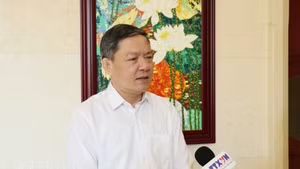
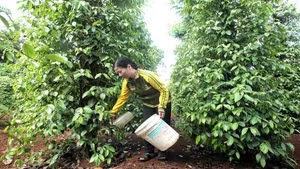
Presenting the report, La Phuc Thanh, Director of the city's Department of Finance, said that in the first nine months of the year, the city sustained its economic momentum. GRDP is estimated to have increased by 9–9.5%; of this, the services sector grew by 8.7–9.2%, accounting for 51–52% of the economic structure; industry and construction grew by 11–12%; while agriculture, forestry, and fisheries grew by 4–4.5%.
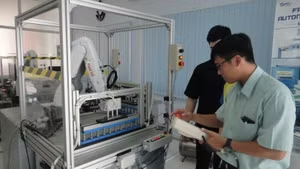
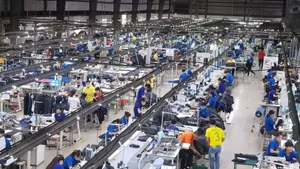
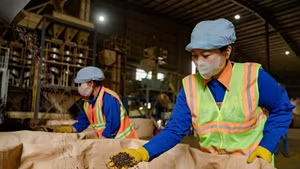
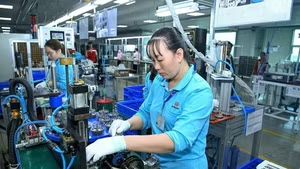
Indicators for production, trade, and services continued to demonstrate the economy's resilience and momentum. Export turnover is estimated at 1,326.6 billion USD, up 19.4%; while total retail sales of goods and consumer service revenue reached 57,665 billion VND, up 19.2%. The industrial production index increased by around 11%, with several key products such as cement, gloves, automobiles and various types of yarn recording robust growth.
Tourism continued to be a particularly bright spot. In the first nine months, the city welcomed more than 6.4 million visitors, up 29% year on year; tourism revenue was estimated at 15,400 billion VND, up 60%. Activities under the Hue Festival, including the Hue Wonderverse Fest 2026, helped bolster the destination’s appeal. Earlier, the city's eight-month report recorded around 5.817 million visitors and tourism revenue of 13,790 billion VND, showing that the services sector has maintained robust growth momentum.
According to Thanh, investment activities also posted positive shifts. Total realised investment capital in the city is estimated at 28,516 billion VND, up 12.4%. The city granted investment registration to 41 new projects with total registered capital of more than 24,520 billion VND, including six FDI projects with registered capital of 158.9 million USD.
State budget revenue in the first nine months is estimated at 12,354 billion VND, equivalent to 77.2% of the estimate and up 16% year on year. The city has successfully cleared 26 out of 177 backlogged projects and terminated the operations of six projects.
These results provide an important foundation for Hue to continue pursuing its 2026 growth target. However, as city leaders have acknowledged, considerable development potential remains untapped, and the exploitation of available resources has fallen short. This is also a direct challenge for leadership and administration during the final three months of the year.
Clearing bottlenecks, particularly in public investment
Notably, while the GRDP growth rate was respectable, it fell short of expectations; several industrial projects are behind schedule and have not created new growth drivers. PrBusiness conditions remain challenging, with 733 enterprises temporarily suspending operations and 308 enterprises dissolving during the first nine months.
Crucially, the disbursement of public investment capital remains slow. By the time of the report, the city had disbursed only 2,856.9 billion VND, equivalent to 45.7% of the capital plan assigned by the Prime Minister. This remains a priority bottleneck the city must clear if it is to create additional momentum for growth in the final months of the year.
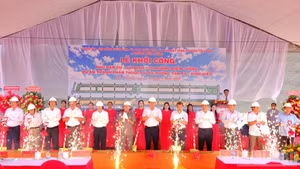
In practice, the obstacles are not confined to a single stage. Site clearance, compensation, resettlement support, land issues, sources of construction materials, and investment procedures continue to affect the progress of many projects. Several key projects, such as Nguyen Hoang Road and the bridge over the Huong River, Ring Road 3, and the bridge over Con Hen, still have issues that need to be resolved.
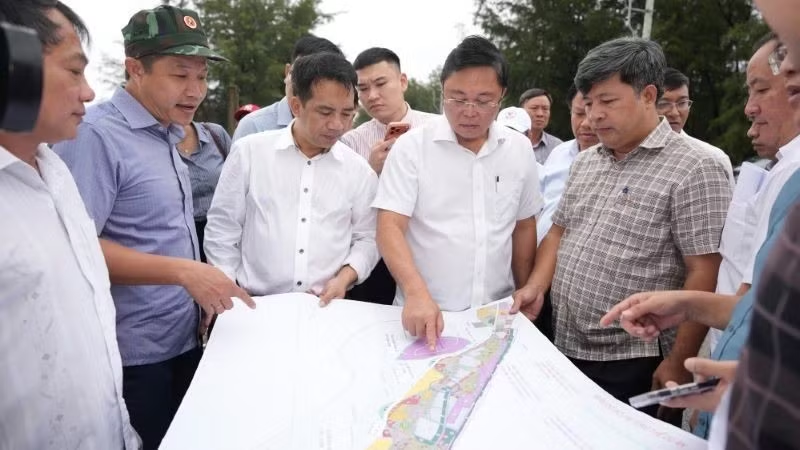
Ahead of the meeting, leaders of the Hue City People's Committee held a series of working sessions on these issues, including reviewing the progress of Con Hen Bridge and the roads at both ends of the bridge; inspecting delayed and unfinished projects in the An Van Duong Urban Area; and evaluating progress and hurdles in public investment projects and projects using non-budgetary capital. This shows that efforts to address bottlenecks are moving from an overall assessment to individual projects, localities and specific causes.
At the meeting, Chairman of the Hue City People's Committee Le Tri Thanh asked departments, sectors, and localities to rigorously evaluate the feasibility of hitting each target, particularly growth, budget revenue, and public investment disbursement. They must also clearly distinguish between obstacles that are localised and those that are widespread so that appropriate solutions can be adopted.
For backlogged projects, the directive is clear: each project must have a specific plan and roadmap, with responsibility for implementation clearly assigned, and prolonged delays must not be allowed to continue. Regarding public investment, the city needs to focus on removing bottlenecks related to construction materials, site clearance, and resettlement land funds, while proactively carrying out acceptance procedures and determining completed volumes for payment, avoiding situations in which capital has been allocated but implementation remains slow.
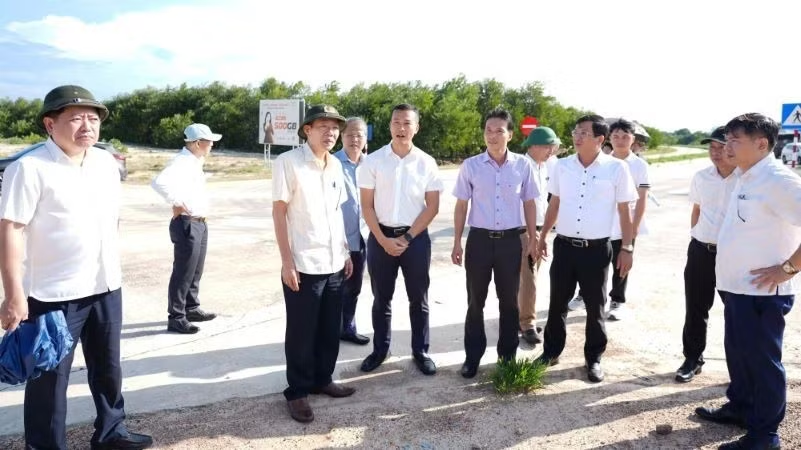
With the rainy and flood season approaching, this requirement has become even more urgent. Investors and contractors must proactively develop construction plans suited to weather conditions, make the most of favourable periods, and ensure both project safety and disbursement progress.
Accelerating efforts through each task and each month
The final three months of 2026 have been identified as a sprint to the finish, with a large volume of work to be completed. Chairman of the Hue City People's Committee Le Tri Thanh asked directors of departments and sectors and leaders of communes and wards to review all assigned tasks and targets; clearly identify areas that are behind schedule or have not met targets; analyse the causes; and develop targeted solutions.
The priority is first and foremost on sectors that still have room to generate growth. While industry and construction are expected to continue making important contributions, agricultural production is entering a period affected by rain and flooding, while tourism tends to enter its low season. Therefore, implementation must be closely tailored to each sector and locality rather than applying a one-size-fits-all approach.
For public investment, the city has requested regular updates on site-clearance progress, proactive preparation of land funds and resettlement plans, the resolution of bottlenecks related to construction materials, and stronger coordination among departments, sectors, and localities. Planning work must also be accelerated to ensure consistency during the adjustment of the General Urban Plan for Hue City to 2045, with a vision to 2065.
At the same time, the city will continue to address difficulties for enterprises, resolve legitimate requests from investors, and attract new projects. The accelerated publication of a digital map for investors is expected to make it easier for businesses to access information on locations, land funds, and investment opportunities.
Budget revenue is also a key task. The tax sector has been asked to coordinate with localities to implement measures to prevent revenue losses and recover tax arrears, while nurturing revenue sources by supporting businesses in maintaining and expanding production and business activities. Regarding land-related revenue, efforts should focus on resolving obstacles at projects capable of generating revenue in the final months of the year, particularly amounts expected to arise in October.
Another requirement is to continue reviewing and handling surplus public assets, categorising individual cases, identifying causes, and determining solutions to ensure that public assets are managed and used legally and to maximum effect.
In the field of digital transformation, Project 06, healthcare, and education, heads of agencies, units, and localities must directly monitor and review progress and promptly coordinate to resolve delayed tasks. This is also intended to improve administrative efficiency as the city operates the urban government model with 40 commune-level administrative units.
Based on the results of the first nine months and the issues that have emerged, Hue's task in the fourth quarter is not merely to maintain its growth momentum, but, more importantly, to turn available potential into concrete results. Every project that is unblocked, every construction project whose progress is accelerated, every source of revenue exploited in line with its potential, and every difficulty faced by enterprises that is resolved promptly will contribute additional momentum to the economy.
Therefore, a spirit of decisive management needs to be reflected in measurable progress, outputs, and results. In the final months of the year, the requirement for each department, sector, and locality is to act faster, coordinate more closely, and take clearer responsibility, thereby creating substantive changes in the implementation of the socio-economic targets and tasks for 2026.