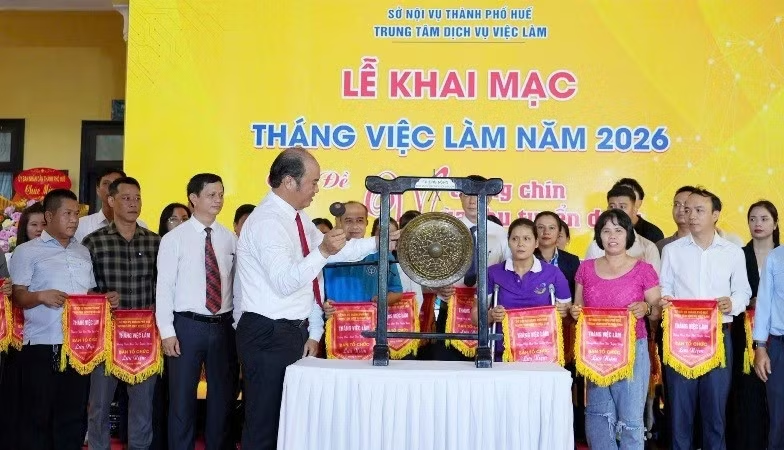
At the Employment Service Centre under the Hue City Department of Home Affairs, the 2026 Employment Month has officially opened under the theme “September – Autumn Recruitment Season”. The programme attracted 34 participating organisations, registering 8,725 recruitment and enrolment quotas while creating an additional direct channel connecting workers, businesses, and vocational education institutions.
Attending the programme was Nguyen Van Manh, Vice Chairman of the Hue City People’s Committee, along with leaders of departments, agencies, and sectors, representatives of businesses and training institutions, as well as a large number of pupils, students, and workers in the city.
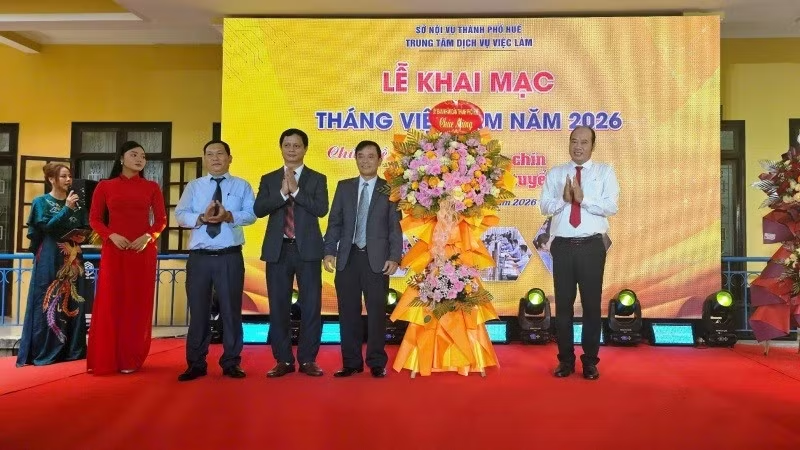
In addition to concentrated recruitment activities, the 2026 Employment Month in Hue is also part of a broader requirement: developing the labour market in a flexible, modern, and sustainable direction, gradually meeting the requirements of socio-economic development and the city’s investment attraction process.
Making labour supply-demand connections increasingly substantive
Hue City currently has more than 650,000 workers. Each year, around 10,000 new workers enter the labour market, including graduating pupils and students, discharged military personnel, and workers moving due to organisational restructuring. At the same time, around 9,000 people need support with vocational training, job changes, or unemployment benefits.
The large labour supply, while the structure of occupations and recruitment requirements are constantly changing, poses the challenge of organising a more flexible labour market. Therefore, employment is no longer viewed simply in terms of numbers but increasingly requires attention to suitability, stability, income, and development opportunities for workers.

Director of the Hue City Employment Service Centre Nguyen Duy Thong said that in recent times, the centre had maintained regular job transaction sessions while also organising programmes such as “Spring Employment Connections” and “September – Autumn Recruitment Season”. Through these activities, connections between businesses, training institutions, and workers have gradually become more structured.
Notably, digital transformation is expanding the space for connections. Online job transaction platforms, the “Hue Jobs” platform and the website vieclamhue.vn are helping recruitment information reach workers more quickly and transparently, while also making it easier for people with disabilities and disadvantaged groups of workers to access employment opportunities.
At the opening programme of the 2026 Employment Month, 34 organisations registered a total of 8,725 recruitment and enrolment quotas. Of these, businesses are seeking to recruit 3,216 workers for domestic employment, mainly in sectors such as garments, mechanical engineering, construction materials, tourism and services, technology, and manufacturing, with common monthly incomes ranging from 6 million to 15 million VND. The demand for workers to work abroad stands at 3,739 people in markets including Japan, the Republic of Korea, Germany, and Taiwan (China), with many positions offering incomes of more than 20 million VND per month.

According to Nguyen Duy Thong, alongside recruitment, vocational education institutions have registered more than 1,770 enrolment quotas, focusing on occupations linked to the actual needs of the labour market.
These figures show that Hue’s labour market is becoming increasingly open, not only in terms of local employment but also opportunities to work in international markets. However, behind the strong demand for recruitment lies increasingly high requirements for workers’ quality, skills, and adaptability.
Speaking at the programme, Vice Chairman Nguyen Van Manh acknowledged these results and praised the proactive efforts of the Employment Service Centre and the support provided by businesses and vocational training institutions in the city.

Nguyen Van Manh said that labour and employment are pillars of social security, as well as important factors in sustainable development. Ensuring a balance between labour supply and demand is not simply an economic goal but also a socio-political task, requiring coordinated engagement from the entire political system.
This view shows that employment work is being placed within a broader requirement: not only addressing immediate employment needs but also building a labour market capable of meeting the city’s long-term development process.
Training to meet demand, creating sustainable employment
According to Vice Chairman Nguyen Van Manh, Hue is stepping up investment attraction and developing industry, services, tourism, and new fields; therefore, the workforce challenge needs to be addressed at an early stage. Businesses may invest in factories and expand production, however, for projects to operate effectively, the decisive factor remains a workforce capable of meeting requirements for skills and labour discipline.

Therefore, at this year’s Employment Month, the vice chairman of the City People’s Committee called on agencies, organisations, and localities to strengthen inter-sectoral coordination, improve the capacity to survey and forecast labour supply and demand, link training with recruitment needs, and prepare human resources in both quantity and quality to anticipate major projects.
This is also an area where a major shift is needed in the way employment issues are addressed: training must stay one step ahead of market demand rather than only being provided after businesses have already developed recruitment needs.
At the same time, city leaders called on businesses to expand production while paying attention to wage, welfare, and social security policies; and to build civilised, safe, and stable working environments in order to attract and retain workers.
It is necessary for the Employment Service Centre to continue closely monitoring market developments, improve the quality of employment counselling and placement services, bring job transaction sessions and employment fairs closer to residents in wards and communes, step up digital transformation and regional linkages, and connect with the National Employment Service Centre.

Hue City aims to contribute to creating employment for 18,000 workers and send 2,500 workers abroad for employment by the end of this year. To realise this target, activities during the Employment Month need to be extended through specific solutions following each job transaction session, each interview, and each counselling programme.
More importantly, efforts should focus on establishing a sufficiently reliable labour market database that can be jointly used by authorities, training institutions, and businesses. When it is known what businesses need, what skills workers possess, and which occupations are facing labour shortages, then training, counselling, and employment connection activities will become more proactive, thereby helping to limit the situation in which there are labour shortages while some people are still unable to find suitable jobs.
From the “September – Autumn Recruitment Season”, the city expects Employment Month not to stop at thousands of recruitment quotas being introduced but to result in substantive connections that are established and maintained after the programme. Every worker who finds a suitable job, every trainee who receives training in the right occupation, and every business that recruits personnel who meet its requirements will contribute to making the labour market operate more effectively.

From a monthly activity, Employment Month aims to gradually become a regular means of connection, with a wider reach across individual localities and groups of workers. When supply and demand are connected transparently, training closely follows the market, and businesses proactively improve the quality of employment, then human resources will not merely be beneficiaries of policies but will become a direct driving force for Hue’s growth and sustainable development.