Greening the production chain
In practice, many agricultural models prioritise the efficient use of resources, environmental protection, and the creation of sustainable livelihoods for local people from the outset of production.
Sinh Duoc Cooperative in Ninh Binh Province is one such example. It has chosen indigenous medicinal plants as the foundation for building a production chain linked to processing, services, and ecotourism. Vu Trung Duc, Director of Sinh Duoc Cooperative, said that medicinal plants harvested from growing areas were collected, preliminarily processed, extracted, blended, and turned into products such as foot-soaking salts, various essential oils, bath soaps, shampoos, and peaceful bodhi leaf paintings.
A key feature of the model is its value chain, which comprises raw material growing areas, satellite processing workshops, and a centralised packaging facility. Its aim is to produce a full range of convenient, naturally derived products that are chemical-free and environmentally friendly. The cooperative also seeks to develop an ecotourism space incorporating traditional folk-art performances and healthcare services based on traditional methods. This approach extends the value chain of medicinal plants. The model's effectiveness is also reflected in the livelihoods of those directly involved in production.
“With an income of around 7 million VND per month, we can feel secure in our jobs. The cooperative operates on a green, ecological basis, so workers also enjoy a friendly, clean working environment,” said Bui Thi Thom, a cooperative member.
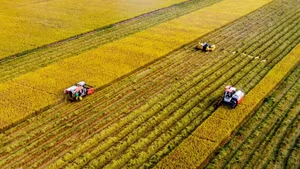
As a locality with a well-developed agricultural sector, Bac Ninh has favourable conditions for developing ecological, green, and circular agriculture. Nguyen Hong Quang, Deputy Director of the Department of Agriculture and Environment, said that circular agriculture had been put into practice across the city through various models suited to local conditions. For example, crop residues are used as animal feed, as raw materials for mushroom cultivation, or are treated and returned to the soil to replenish organic matter. Rice–fish farming, integrated crop and livestock production, and the use of livestock waste to produce organic fertiliser have begun to establish systems in which materials are reused multiple times. This reduces input costs and waste generation, helping to protect the environment while increasing farmers' incomes.
Aligning policies and effectively implementing green credit
Practical models in localities demonstrate that the green transition begins with reorganising the entire value chain, from raw material growing areas and processing technologies to markets and livelihoods. This approach will also need to be scaled up as agricultural transformation expands.
However, according to the Ministry of Agriculture and Environment, the transition to ecological, green, and circular agriculture still faces numerous challenges. Many models deliver technical and environmental benefits but are difficult to replicate because of inadequate infrastructure and raw material growing areas, as well as limitations in mechanisation, cooperative capacity, business partnerships, and access to capital. Meanwhile, the country still lacks a comprehensive system of indicators to measure the ecological, green, and circular performance of different agricultural commodities and ecological regions.
Credit policies need to be better aligned with the investment cycles of circular agriculture, agroforestry and land restoration models, while encouraging lending based on environmental outcomes. In addition, agricultural insurance should be expanded, green credit mechanisms established, and ways of mobilising social resources explored through green bonds, green transition funds, and climate risk-sharing instruments. These measures would encourage farming households to invest in new technologies and production processes.
Dr. Ha Cong Tuan
Chairman of the Viet Nam Association of Agricultural Economics and Rural Development
Against this backdrop, Dr. Ha Cong Tuan, Chairman of the Viet Nam Association of Agricultural Economics and Rural Development, said that existing policies on ecological, green, and circular agriculture should be further synchronised into a unified programme framework extending to 2030, with a vision to 2050. This framework should clearly define objectives, targets, resources, responsible agencies, and monitoring mechanisms. Alongside productivity and production value, indicators should gradually be introduced to measure the efficiency of land and water use, greenhouse gas emissions per unit of product, the proportion of by-products reused, soil quality, biodiversity, farm household incomes, and resilience.
Access to capital remains one of the decisive factors determining whether these models can be replicated on a wider scale. Credit policies therefore need to be better aligned with the investment cycles of circular agriculture, agroforestry, and land restoration models, while encouraging lending based on environmental outcomes. In addition, agricultural insurance should be expanded, green credit mechanisms established, and ways of mobilising social resources explored through green bonds, green transition funds, and climate risk-sharing instruments to encourage farming households to invest in new technologies and production processes.
As market demands, production methods and policies converge around the goals of using resources efficiently, reducing emissions, and increasing product value, ecological, green, and circular agriculture will have a stronger foundation for evolving from isolated initiatives into a broader development pathway.