Circular agriculture not only helps reduce costs and minimise waste, but also opens up opportunities for developing multi-value agriculture by linking production with processing, the One Commune One Product (OCOP) programme, tourism and environmental protection.
Turning by-products into resources
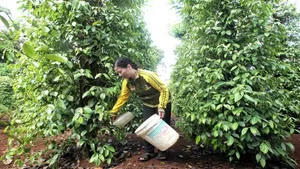
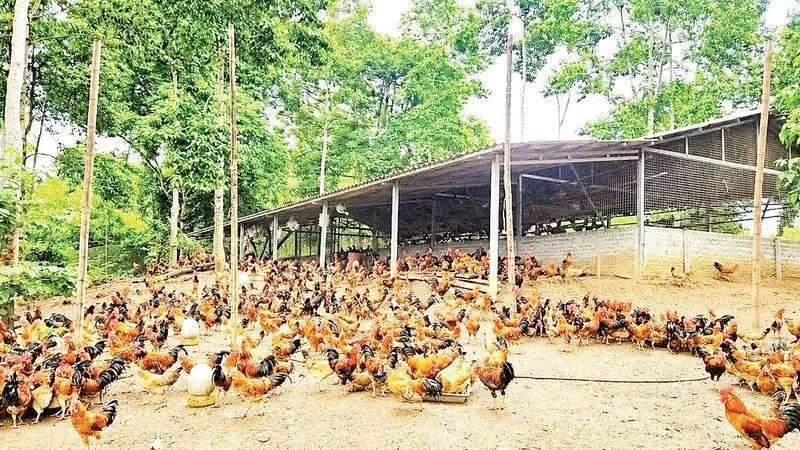
After more than five years of persistent efforts to improve the land, the three-hectare rocky, barren hillside owned by the family of Bui Van Lanh in Thong Nhat Ward, Phu Tho Province has gradually been revived, becoming a productive area that generates economic value. Pomelo, incense-cedar and yellow camphora trees are interplanted on the hillside.
Under the tree canopy are areas for raising chickens and pigs, while the water surface is used to raise fish and apple snails. Elephant grass, bananas and cassava are grown to provide part of the feed needed for livestock. Under the model, livestock waste is collected, treated and composted into fertiliser for crops, while by-products from crop production are used as animal feed.
From crops and livestock to water surfaces and organic fertiliser, the components of the model support one another, creating a relatively closed production cycle. This approach demonstrates that when production mindsets change, things once regarded as waste can become inputs for a new production process.
The story of Lanh’s family clearly reflects the nature of circular agriculture: putting resources at the centre, minimising waste and extending the life cycle of materials in production. This is not merely a technical solution but, first and foremost, a change in the way producers think and work.
Instead of the linear model of extraction, use and disposal, farmers are gradually shifting towards reuse and recycling while generating multiple values from the same resources.
Practical experience in post-merger Phu Tho Province shows that there is considerable room for developing circular agriculture, thanks to its diverse land resources, numerous ecological sub-regions and rich range of agricultural products and specialities.
However, traditional production methods still account for a large proportion of production. In crop production alone, an estimated 2-3 million tonnes of crop residues and by-products are generated each year, while around 25-30% of livestock waste is not thoroughly treated.
At present, expanding these models still faces many difficulties. A survey of 68 communes and wards found that around 48.53% had no formal circular agriculture model. Waste treatment solutions remain mainly limited to biogas digesters and biological products in livestock production.
Links between the circular economy, OCOP and tourism remain weak due to small-scale production, loose value-chain linkages and limitations in the application of science and technology, digital transformation, logistics and preservation.
These shortcomings require a shift from spontaneous models to an organised strategy based on planning and linkages, with the market serving as the guiding principle.
Towards sustainable economic value
To establish an overarching framework, the province has approved a project on developing circular agriculture and integrating multiple values for key and speciality agricultural products, linked with the development of OCOP products and agricultural and rural tourism for the 2026-2030 period.
The focus is on turning by-products and waste into inputs for production, while linking circular agriculture with OCOP brand building, the promotion of local cultural values and tourism development.
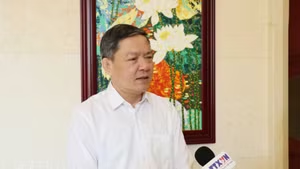
Nguyen Huy Nhuan, Director of the Phu Tho Department of Agriculture and Environment, said that shifting to a model of circular agriculture integrating multiple values is an inevitable trend aimed at moving from a production-oriented mindset to an agricultural-economy mindset.
This is an important solution for implementing the national target programme on new-style rural development, sustainable poverty reduction and socio-economic development in ethnic minority and mountainous areas.
The ultimate goal is not to limit circularity to an individual farm or household, but to expand it into value chains on a larger scale. A production area can simultaneously supply agricultural products and processing materials, produce OCOP products and create spaces for visitors to experience and discover distinctive local cultural stories.
Concentrated tea-growing areas such as Long Coc, Shan Tuyet tea associated with eco-tourism at Xuan Son National Park and Pa Co; pomelo-growing areas in Tan Lac, Yen Thuy, Chi Dam and Bang Luan; Cao Phong orange-growing areas; and craft villages producing banh chung, noodles, rice vermicelli, straw liquor, woodwork, ornamental stone and brocade products can all become spaces where multiple values are integrated.
The value of agriculture, therefore, will no longer lie solely in the volume of products harvested, but also in brands, quality, product stories, landscapes, culture, experiences and marketability.
To realise this orientation, Phu Tho Province is determined that by 2030, at least 70% of by-products from key crops will be collected and reused, while 60% of livestock households and 100% of livestock farms will treat and reuse waste.
At the same time, the province will develop three to four circular crop-production models that reduce greenhouse-gas emissions and are linked to growing-area codes and traceability; pilot at least 15 circular farming models with measurement, reporting and verification systems, enabling them to gradually participate in the carbon-credit market; and develop several circular agriculture village models, in which closed-loop solutions are fully applied alongside smart agricultural management, with a view to regenerating resources and protecting rural ecosystems.
In addition, the province will strengthen waste collection, sorting and reuse at source; replicate garden-pond-livestock, rice-fish, biogas, earthworm farming, black soldier fly farming, organic fertiliser production and bioenergy models; invest in production infrastructure; develop stable raw-material areas; and improve the quality and branding of OCOP products.
When organised systematically in this way, areas of difficult land can become significant development resources; by-products can become raw materials; and agricultural products can not only be sold on the market but also tell stories about the local culture and people.
Phu Tho Vice Chairman Dinh Cong Su said that shifting to a model of circular agriculture integrating multiple values and linked with tourism and OCOP is no longer merely a trend, but an urgent requirement and a key strategic solution for restructuring economic space, optimising resources and developing safe and sustainable agriculture.
In this process, farmers are at the centre, while science, technology and innovation serve as driving forces for gradually building a modern, green, sustainable and high-value agricultural sector.