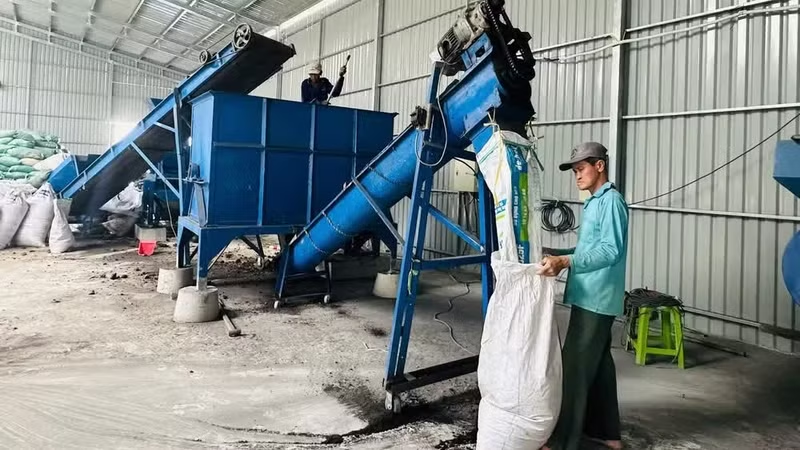
While showing us around the organic fertiliser production workshop, Le Long Ho, Director of Hoa Long Agricultural Services Cooperative based in Hoa Long Commune, Dong Thap Province, shared that since 2023, recognising the plentiful supply of agricultural by-products, the cooperative has begun researching and utilising straw, particularly waste straw from mushroom farms, to produce organic fertiliser.
On average, the cooperative uses around 1,000 tonnes of straw materials each month. Priority is given to waste straw from mushroom farms in order to optimise both time and production costs. If fresh straw collected directly from the fields is composted, the production process takes up to six months before yielding a finished product.
By contrast, straw taken from mushroom-growing substrates has already undergone a natural decomposition stage, shortening the production cycle to just four months. According to Ho, the production process is carried out systematically. After being collected, the straw is mixed with vermicompost and then thoroughly composted for around 20 days. Once the required level of decomposition is reached, the mixture is dried to achieve standard moisture levels before being fed into a grinding system and packaged as finished products.
At present, market demand is very strong. Each month, the cooperative supplies around 300 tonnes of organic fertiliser to the market. In addition to Dong Thap Province, the cooperative’s organic fertiliser products are also distributed across many other provinces and cities in the Mekong Delta region.
Phung Ha, Chairman of the Viet Nam Fertiliser Association, said that utilising agricultural by-products for fertiliser production is a core component of circular agriculture. This solution not only optimises economic efficiency and reduces pollution and greenhouse gas emissions, but also helps restore soil health, reduce dependence on imported fertilisers, and enhance the commercial value of Vietnamese agricultural products.
Organic fertiliser production in Viet Nam has seen positive progress in recent years. According to the Crop Production and Plant Protection Department under the Ministry of Agriculture and Environment, by the end of 2025 the country had more than 29,000 fertiliser products in circulation. Of these, organic fertiliser products (including biofertilisers) accounted for more than 30%, a sharp increase compared with 13.1% in 2019. Among approximately 800 fertiliser manufacturing plants nationwide, as many as 136 specialise in organic fertiliser production. Total production capacity for organic fertiliser has now reached 5 million tonnes per year, accounting for 23.8% of the industry’s overall capacity.
The Ministry of Agriculture and Environment has set a target that by 2030, organic fertiliser products approved for circulation will account for more than 30% of all fertiliser products. Industrial organic fertilisers are expected to make up at least 30% of the total volume of fertilisers used in agricultural production, while household-scale organic fertiliser production for agricultural use is targeted to reach at least 20 million tonnes annually.
According to Phung Ha, Chairman of the Viet Nam Fertiliser Association, authorities should continue creating favourable conditions for the registration and licensing of organic fertiliser products in the coming years. At the same time, efforts should focus on developing and diversifying products, particularly high-quality fertilisers. He also called for encouraging the development, production and use of household-scale organic fertilisers by making use of by-products from crop cultivation, livestock farming, agricultural processing and household waste.
The Ministry of Agriculture and Environment stated that it will prioritise and support new registrations and licence renewals for organic fertiliser factories and production facilities, especially those applying advanced production technologies and processes. The ministry will also support and encourage investment in research and development of high-quality organic fertilisers, including products containing new beneficial microorganisms that act quickly, are compact and stable in maintaining soil fertility, easy to use, and capable of utilising locally available raw materials.
In parallel, efforts will be made to promote the transfer of modern global organic fertiliser production technologies to Vietnamese manufacturers.