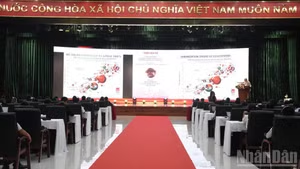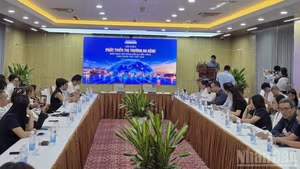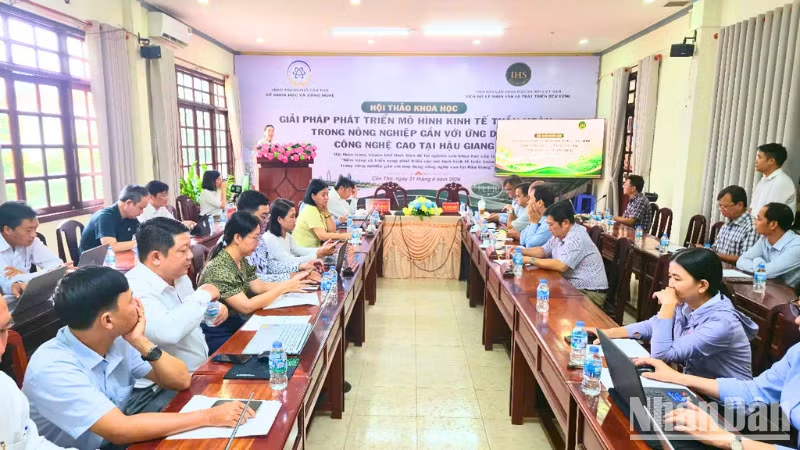
The event was jointly organised by the Institute of Human Geography and Sustainable Development under the Viet Nam Academy of Social Sciences and the Can Tho Department of Science and Technology.
The workshop explored strategies for advancing high-tech circular agriculture, the current situation and prospects for high-tech agriculture in Hau Giang, agricultural extension policies, and solutions for developing circular economy models.
Several presentations also highlighted the utilisation of rice straw and agricultural by-products to create additional value and promote sustainable production.
One model introduced at the workshop was the Ngu Thuong Mekong Cooperative in Tan Binh Commune, Can Tho City.
According to Lu Thi Nhat Hang, director of the cooperative, the Phung Hiep area yields substantial quantities of rice straw and livestock by-products after each production cycle.
To manage these materials, the cooperative has opted to develop circular agriculture through a closed-loop approach to increase value from cultivated land.
Rice straw collected after harvest is utilised as a substrate for cultivating edible and medicinal mushrooms instead of being burned.
The straw substrate from mushroom cultivation is composted to produce feed for blue worms, while cow manure is also used as material for worm farming.
The cooperative then leverages the worms to produce nutrient-rich organic fertiliser for clean vegetables and elephant grass.
Worm meat is used as a supplementary protein source for poultry and aquaculture, helping reduce feed costs.
Elephant grass provides feed for the cattle, while cow manure is returned to the worm-farming cycle, creating a circular system linking crop cultivation and livestock farming.
Wastewater from livestock facilities and fish ponds is also collected and biologically treated before being used to irrigate elephant grass fields, helping to minimise discharge into the environment.
Through the workshop, delegates expressed their aspiration to promote innovation and green growth and expand circular agriculture models, contributing to a carbon-neutral economy, environmental protection, and sustainable development.