Pooling efforts to increase value
From the idea of adding medicinal herbs to chicken feed, the research team behind the “Da Lat herbal chicken eggs” project has developed a product with a distinctive flavour. Nguyen Thuy Phuong Tram, head of the project, said: “The research team added herbs such as rosemary, turmeric, garlic and polygala to the chickens’ feed, creating a distinctive product that has attracted consumers.”
In 2025, after the project won first prize at Lam Dong Province’s Innovation and Entrepreneurship Competition, its production process was transferred to Thien Duc Phat Energy Company Limited in Lam Dong for commercialisation. The company has continued to refine the model towards a circular economy, gradually increasing the product’s value.
According to Pham Trong Tam, Director of Thien Duc Phat Energy Company Limited, with the support of the Lam Dong Department of Science and Technology, the company is working with experts from the Innovation Centre of Ho Chi Minh City University of Industry and Trade to improve the product, build its brand, develop markets and commercialise it, while gradually expanding production.
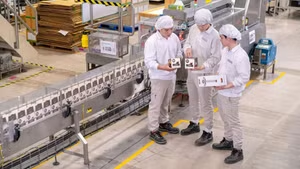
Not only new products, but also technological innovation needs to be continuously pursued throughout production and consumption processes. Vien Son Joint Stock Company, which specialises in the production, processing and export of agricultural products, exported more than 5,530 tonnes of products in 2025, including 4,752 tonnes of processed goods. In response to market demands, the company has determined that science, technology and innovation must be applied throughout the value chain, from raw material areas to processing and management.
To increase the added value and competitiveness of Vietnamese agricultural products, Nguyen Duy Da, Director of Vien Son Joint Stock Company, said that alongside businesses’ own innovation efforts, support from State management agencies, universities and research institutes is essential in research and technology transfer, as well as in effectively implementing mechanisms and policies to support businesses.
Similarly, Nguyen Duc Huy, Director of Vietponics Hydroponics Cooperative, said the cooperative had chosen to pursue technological self-reliance, gradually developing an ecosystem incorporating IoT-based control systems, traceability and e-commerce. However, to enhance production capacity and added value, the cooperative wants closer links among the “three parties”.
From the scientific community, a more proactive approach to collaboration is also being emphasised. Professor and Doctor Duong Tan Nhut, Deputy Director of the Institute of Life Sciences under the Viet Nam Academy of Science and Technology, affirmed: “We are committed to the State and businesses to focusing on research and soon delivering the best products with high efficiency.” Alongside producing results of academic value, scientists need to consider their applicability and effectiveness when research findings are put into production and developed into products and solutions serving practical needs.
Recently, Lam Dong Province commissioned Viet Nam Posts and Telecommunications Group (VNPT) to pilot an intelligent transport system (ITS) solution at several key intersections in the province. Based on practical results, the ITS solution could be deployed more widely, helping to reduce traffic congestion. Viet Nam-Germany University has also cooperated with Lam Dong Province through a project to address traffic congestion in Da Lat, commissioned by the provincial specialised department.
For “three-party” cooperation to become substantive, each party must clearly define its role: the State creates favourable mechanisms; universities, experts and scientists focus on research; and businesses play a key role in investment.
Dr. Ha Thuc Vien, Vice Rector of Viet Nam-Germany University
Dr. Ha Thuc Vien, Vice Rector of Viet Nam-Germany University, said that for “three-party” cooperation to become substantive, each party must clearly define its role: the State creates favourable mechanisms; universities, experts and scientists focus on research; and businesses play a key role in investment.
Building an innovation ecosystem
Science and technology activities in Lam Dong Province remain fragmented and scattered, with gaps still existing between policy and practical needs, between research results and their transfer potential, and between businesses’ demand for technological innovation and their access to experts and scientists.
According to Vice Chairman of the provincial People’s Committee Nguyen Ngoc Phuc, establishing a close coordination mechanism among the “three parties” is an urgent requirement. Each stakeholder has a distinct role, but all share the common goal of creating new products, technologies and production methods and generating tangible value for people, businesses and the provincial and national economies.
Under the plan, from now until 2030, Lam Dong will conduct annual surveys, select and publish a list of science, technology and innovation challenges in order to connect businesses with universities, research institutes and experts. Associate Professor and Doctor Nguyen Van Ngoc, Vice Rector of Da Lat University, suggested that Lam Dong should develop a development strategy based on science, technology and data, while establishing a closed-loop process of “commissioning-research-transfer-production-commercialisation”.
The province has identified priority areas for development, including smart agriculture, post-harvest preservation and deep processing; the green and circular economies; renewable energy; artificial intelligence, big data, GIS and digital transformation; and the digital management of cultural resources and smart tourism.
During 2026-2027, the province will support the signing and implementation of at least 20 contracts for research, development, technology transfer and the commercialisation of research results, as well as the establishment of at least three “three-party” cooperation models in priority areas. By 2030, Lam Dong aims to establish and effectively operate an innovation ecosystem, while developing several innovation centres and exemplary cooperation models among the “three parties” towards a green and sustainable economy in the new period.