Viet Nam is among Asia’s fastest-improving markets, ranking in the global top 10 for transparency improvements between 2024 and 2026. It has moved from the “Low Transparency” category before 2020 to “Semi-Transparent” today. This progress coincides with a sharp increase in foreign investment, which reached 38.1 billion USD in the first seven months of 2026, nearly matching the total for the whole of the previous year and marking the highest level in the past decade.
These figures also reaffirm Viet Nam’s position as one of the Asia-Pacific region’s leading attractive investment destinations.
Notably, comprehensive legal reforms in the 2024–2025 period have laid a solid foundation, as Viet Nam implemented far-reaching legislative changes to strengthen the basis for infrastructure development. The reforms have addressed longstanding challenges, including data shortages and complex regulations governing foreign ownership.
Furthermore, valuation gaps offer opportunities to drive market development. In this regard, JLL said that Viet Nam’s path towards greater transparency would continue to focus on six pillars: completing the digitisation of land records; establishing a unified nationwide property registration system; adopting international property measurement standards (IPMS); publishing data on the commercial real estate credit market; promoting green building certification linked to master planning and transparent databases; and strengthening disclosure requirements for listed companies.
JLL’s 2026 Global Real Estate Transparency Index report shows that Viet Nam ranks 50th among the 88 countries and territories surveyed, with a transparency score of 3.15, remaining in the “Semi-Transparent” category.
Notably, Viet Nam is among the 10 markets worldwide that recorded the strongest improvements in transparency scores in the 2024–2026 survey. GRETI is a biennial publication developed and managed by JLL and LaSalle, with 2026 marking its 14th edition since it was first launched in 1999.
The index assesses 88 markets worldwide against 256 criteria across six categories: Real Estate Performance Measurement (25%), Regulatory and Legal Environment (23.5%), Market Fundamentals (16.5%), Transaction Process (15%), Governance of Listed Vehicles (10%), and Sustainability (10%). It serves as a guide for investors, lenders, and occupiers worldwide, as a market’s level of transparency directly affects investment risks and opportunities.
According to JLL, the Asia-Pacific region recorded the strongest improvements in this year’s survey, accounting for half of the world’s top 10 most improved markets, led by India, Viet Nam, the Republic of Korea, Australia, and Thailand. These improvements have helped cross-border investment flows into the region recover strongly over the past 12 months, with direct investment transaction volumes reaching record highs in several markets, including Viet Nam.
According to data from JLL and LaSalle, Viet Nam was classified as a “Low Transparency” market before 2020, with typical limitations including scarce market data and a complex, unclear legal framework, which posed particular difficulties for foreign investors in matters of property ownership. In 2016, Viet Nam’s accession to the Trans-Pacific Partnership Agreement (TPP) and its proposal to develop a national real estate database marked the first turning point, demonstrating its commitment to international standards and reform.
Since 2020, Viet Nam has moved into the “Semi-Transparent” category, with 2024 regarded as a “foundational phase” focused on completing the legal framework. Revised versions of Land Law, Housing Law, and Law on Real Estate Business have come into force. The new Law on Prices requires valuers to hold professional practising certificates and maintain verifiable audit trails for valuations. Regulations also require real estate transactions to be conducted through the banking system.
In 2026, Decree No. 357/2025/ND-CP on the development, management, and operation of the information system and database on housing and the real estate market officially came into effect, with the aim of completing the national land database by the end of 2026. Viet Nam has also seen growing adoption of sustainable development practices in the real estate sector.
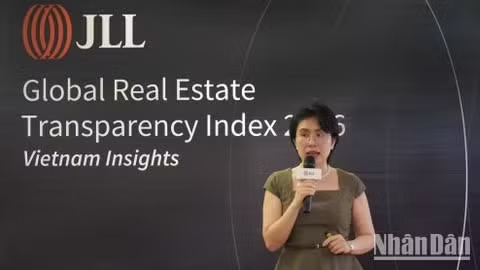
Speaking to Nhan Dan Newspaper, Le Thi Huyen Trang, Country Head of JLL Viet Nam, said that Viet Nam’s inclusion among the world’s top 10 markets with the greatest improvements in transparency in GRETI 2026 was the fruit of years of persistent effort.
“Since 2012, we have witnessed the market move beyond its early stage and establish a much stronger foundation, thanks to sustained efforts to reform the legal framework. In particular, the wave of coordinated reforms since 2025, ranging from improvements to the legal framework and the streamlining of administrative procedures to broader economic policy directions, has begun to yield tangible results, as reflected in the continuous increase in total registered foreign direct investment (FDI).
In particular, the first seven months of 2026 saw registered FDI reach 38.1 billion USD, nearly matching the total registered FDI for the whole of 2025 and marking a 10-year high. This is the clearest evidence that Viet Nam continues to maintain its position as one of the most attractive destinations in the Asia-Pacific region,” Trang said.
JLL’s report also highlights a clear link between transparency and the accuracy of real estate valuations. Examining the situation in Viet Nam in greater detail, Vo Van Huu Phuoc, Head of Value and Risk Advisory, JLL Viet Nam at JLL Viet Nam, said that when a market relies heavily on experience and surveys rather than publicly available data, then information-gathering costs, valuation times, and legal risks are all significantly higher than in highly transparent markets.
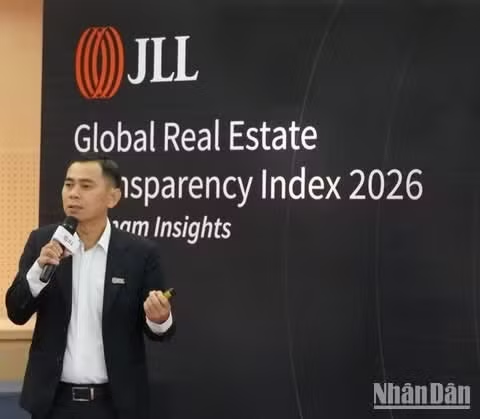
“Viet Nam’s gradual digitisation of land records, the establishment of a unified nationwide property registration system and the move towards adopting international valuation standards such as IPMS will be key factors in narrowing this gap, improving the reliability of valuation results, and strengthening international investors’ confidence in the market,” Phuoc said.
JLL noted that, amid growing global economic and geopolitical uncertainty, transparency in the real estate market has become more important than ever for investors, particularly as factors such as the application of artificial intelligence (AI), the reallocation of capital towards structurally growing segments, ensuring a stable energy supply, and transparency in credit markets are reshaping investment decision-making worldwide.