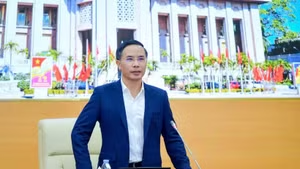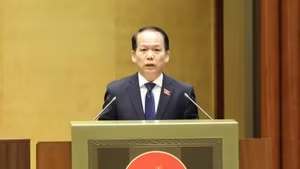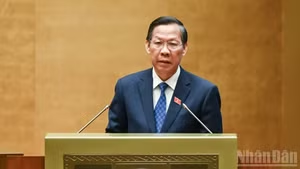
The seminar, entitled “Unlocking Capital Flows for a Sustainable Real Estate Market”, took place on the morning of July 22 in Ha Noi and was organised by Thanh Tra (Inspectorate) Newspaper. It brought together representatives from the Government Inspectorate, the State Bank of Viet Nam, the Ministry of Construction, credit institutions, real estate enterprises, economic, financial and securities experts, as well as numerous press agencies.
Featuring three thematic presentations and two policy dialogue sessions, the seminar served not only as a venue for discussing and analysing the current challenges facing the market, but also as a platform connecting regulators, the banking system, real estate businesses and the capital market to seek comprehensive solutions for increasing housing supply, improving access to housing and strengthening market confidence.
In his opening remarks, Editor-in-Chief of Thanh Tra Newspaper Nguyen Tuan Anh emphasised that the seminar aimed to create a multidimensional policy dialogue forum bringing together State management agencies, credit institutions, businesses and experts to jointly identify market bottlenecks and propose feasible solutions to unlock resources for the real estate market.

According to Nguyen Tuan Anh, real estate is a sector with wide-ranging spillover effects, directly influencing economic growth, investment, employment, the financial system and the urbanisation process. Therefore, unlocking capital is an important requirement, but it must go hand in hand with institutional improvement, the removal of legal bottlenecks and greater market transparency.
Given that bank credit remains the principal source of funding for the real estate market, sustainable development requires the gradual diversification of capital mobilisation channels while improving the efficiency of resource allocation.
Expressing confidence in the diverse perspectives contributed by regulators, experts and the business community, the Editor-in-Chief of Thanh Tra Newspaper said that the seminar would put forward practical solutions to unlock capital, make effective use of land resources and promote the transparent, healthy and sustainable development of the real estate market.

Orienting credit capital flows for real estate market
Providing information on the orientation for managing real estate credit flows, developing the financial ecosystem and ensuring that capital supports the safe and healthy development of the real estate market, Dao Van Ha, Deputy Director-General of the Forecasting and Statistics Department under the State Bank of Viet Nam, observed that the real estate market is entering a new development cycle as the relevant legal framework is gradually being amended and improved in a more comprehensive manner. At the same time, rapid urbanisation continues to sustain strong housing demand.
However, Deputy Director-General Dao Van Ha pointed out that the market still faces numerous challenges, particularly the imbalance in its product structure, with a severe shortage of housing affordable to people on average incomes. Some projects remain entangled in legal issues, while lengthy approval procedures directly affect banks’ appraisal and disbursement processes.
In addition, according to Ha, the lack of interconnected information systems creates loopholes that can be exploited to manipulate the market, while the financial capacity of a number of project developers remains limited.
Ha also noted that the underdevelopment of long-term capital mobilisation channels such as the stock market and corporate bond market means that investment capital for the real estate sector continues to rely excessively on bank credit.

“The current issue is not simply about ‘unlocking’ capital flows for the real estate sector. More importantly, capital must be allocated to areas that generate real value, enabling businesses to develop sustainably while allowing more people to access housing at reasonable costs and limiting speculation,” Mr Ha remarked.
Developing a balanced housing supply that meets actual demand and prioritising credit for social housing
At present, the State Bank of Viet Nam has been implementing a wide range of policies through proactive and flexible monetary management, closely coordinated with fiscal policy and other macroeconomic policies, thereby stabilising the money and foreign exchange markets and helping maintain lending interest rates at stable levels.
In recent years, the State Bank of Viet Nam has kept its policy interest rates unchanged while requiring credit institutions to publish lending interest rate information on their official websites so that customers can refer to it when seeking loans, said Ha.
Notably, according to Mr Ha, the State Bank has prescribed a lower risk coefficient for loans used to purchase social housing than for conventional commercial real estate, thereby creating favourable conditions and encouraging banks to expand lending to this segment.
For 2026, the State Bank has set overall credit growth at around 15%. Banks are required to ensure that credit growth in the real estate sector does not exceed overall credit growth.
Nevertheless, in order to create additional room for priority segments, from May 29, 2026, the State Bank has allowed the increase in outstanding credit for social housing and industrial parks/export processing zones compared with the end of 2025 to be excluded from the credit growth control quota.
At the same time, to meet the medium- and long-term borrowing needs of major projects, the State Bank has raised the maximum ratio of short-term funds permitted for medium- and long-term lending from 30% to 40%, with the regulation officially taking effect from July 1, 2026.

Deputy Director-General Dao Van Ha also said that inspection activities have been reformed through thematic inspections focusing resources on high-risk credit exposures, such as loans for projects lacking complete legal documentation or loans extended to major customer groups.
Real estate is a sector requiring medium- and long-term capital. Therefore, according to Mr Ha, excessive dependence on bank credit could increase pressure on the financial system and reduce the efficiency of resource allocation within the economy. To ensure that capital is channelled to areas generating genuine value, the State Bank has proposed that the Ministry of Construction accelerate research on issuing a Decree on the Housing Development Fund, establish a State-managed Real Estate and Land Use Rights Trading Centre, and improve housing, real estate market and land databases and information systems so that banks have a reliable basis for valuations reflecting actual market value and can limit speculative lending.
At the same time, the State Bank has recommended that the Ministry of Finance continue improving regulations governing the securities market and the corporate bond market. Provincial and municipal People's Committees have also been urged to expedite administrative procedures and publish lists of eligible projects so that credit institutions can promptly appraise, approve and disburse loans.
“In this new stage of development, the objective is not merely to unlock capital for the real estate market but also to ensure that capital is allocated efficiently towards genuine demand and projects that create added value for the economy,” said Ha.

Sharing the same view, Ha Quang Hung, Deputy Director of the Department of Housing and Real Estate Market Management under the Ministry of Construction, analysed solutions for promoting a balanced housing supply that meets actual market demand and lays the foundation for sustainable development. He noted that, alongside the development of commercial housing under market mechanisms, the Party and the State have strongly promoted the development of social housing and workers’ housing to support low-income groups.
“We have established a relatively comprehensive, coherent and open institutional and legal framework to support and encourage businesses to participate,” said Hung.
Citing policies such as exemptions from land-use fees, reductions in VAT and corporate income tax, support for technical infrastructure investment both inside and outside projects, and concessional low-interest loans, Mr Hung affirmed that, as a result, more than 103,000 social housing units were completed nationwide in 2025, reaching 103% of the annual target. In the first six months of 2026, construction commenced on 270 projects with a total scale of 269,409 units, including 62 newly launched social housing and rental housing projects providing 65,065 units.
“By 2026, the number of completed projects, projects under construction and projects approved in principle has reached 77% of the target set under the programme to build one million social housing apartments,” said Hung.

However, Mr Hung noted that the residential real estate market still faces a number of persistent problems, including a mismatch between supply and demand, with an oversupply of high-end housing and a shortage of reasonably priced homes. The product structure also remains heavily skewed towards housing for sale, while there is an insufficient supply of long-term rental housing that meets actual demand.
Furthermore, housing prices remain excessively high, several times higher than average incomes, making home ownership increasingly unattainable for workers in major urban areas. Incentive mechanisms are also not yet sufficiently attractive to encourage private-sector investment in rental housing.
Against this backdrop, Mr Hung said that General Secretary and State President To Lam and Prime Minister Le Minh Hung have issued new directions and orientations for housing development, with a particularly significant shift in thinking—from focusing primarily on commercial housing to simultaneously developing commercial housing, social housing and rental housing, with rental housing identified as a long-term strategic segment.

Hung added that the Ministry of Construction is currently working with ministries, sectors and localities to conduct a preliminary review of the implementation of Secretariat Directive No. 34 on strengthening the Party’s leadership over social housing development under the new circumstances.
The Ministry will also propose an appropriate document to the Politburo as the basis for improving the legal framework governing housing development and the real estate market, while researching and formulating standards and technical regulations for each housing category under the new model.
In addition, the Ministry of Construction is leading amendments and supplements to the Housing Law, the Law on Real Estate Business and other relevant legislation, which are expected to be submitted to the National Assembly for comments at the extraordinary session in August and for approval at the October 2026 session.
According to Hung, future policy will prioritise the development of reasonably priced rental housing using State resources while introducing stronger incentives relating to land, finance, taxation and credit to attract private capital and long-term investment funds.

He also said that the Ministry of Construction has requested local authorities to urgently review and comprehensively assess housing demand, particularly demand for rental housing, official residences and housing models suited to local conditions.
At the same time, local authorities should review land funds in urban areas, economic zones, industrial parks, high-tech parks and rapidly urbanising areas in order to proactively clear sites, prepare clean land banks and ensure synchronised infrastructure connections for the development of rental housing.
Local authorities have also been encouraged to take the initiative in investing in rental housing using local budget resources and to make effective use of local National Housing Funds to finance the construction and establishment of rental housing stock.
Sharing the perspective of a credit institution on financial solutions that support businesses and the public in housing development and help unlock capital for the market, Tran Hoai Phuong, Director of Corporate Banking at HDBank, proposed stronger coordination among government agencies at all levels and the business community to unlock capital flows more effectively, thereby providing greater support for businesses and citizens.
Within the framework of the programme, two policy dialogue sessions entitled “Building Institutions - Directing Capital Flows - Strengthening Market Confidence” and “Building a Capital and Market Ecosystem - Towards Easier Access to Housing for the Public” offered both comprehensive and detailed perspectives on the policy credit landscape, while proposing groups of solutions to ensure that credit capital genuinely contributes to the sustainable and effective development of the real estate market.
The two policy dialogue sessions also highlighted numerous issues of concern regarding current real estate credit flows. In particular, the first dialogue session, under the theme “Building Institutions – Directing Capital Flows – Strengthening Market Confidence”, focused on improving the legal framework, managing credit, removing institutional bottlenecks and strengthening coordination among regulatory authorities to build a transparent and stable investment environment.
It can be seen that, through the presentations and policy dialogues, the seminar clarified the core issues of the real estate market from the perspectives of institutions, credit, the capital market and operational practice. The exchanges and recommendations put forward by regulators, experts, credit institutions and businesses are expected to contribute to improving mechanisms and policies, developing medium- and long-term capital mobilisation channels, enhancing the efficiency of resource allocation, boosting housing supply and strengthening market confidence.