Expanding medicinal plant cultivation
The three border communes of Tay Giang, A Vuong and Hung Son have an estimated combined medicinal plant area of more than 1,000 hectares, with such key crops as purple 'ba kich' (scientific name: Morinda officinalis) and 'dang sam' (codonopsis javanica). Medicinal plants have long been closely associated with the Co Tu ethnic community and have been identified as a sustainable pathway out of poverty for local residents.
Nguyen Van Sao from Tay Giang Commune was among the pioneers in converting acacia-growing land to purple ba kich cultivation. With a loan of 150 million VND from the Viet Nam Bank for Social Policies, he invested in planting more than 10,000 ‘ba kich’ plants on one hectare.
“Purple ‘ba kich’ is easy to grow and well suited to the local climate. It can be harvested after just five to six years, and traders come directly to the farm to buy it for between 200,000 and 300,000 VND per kilogramme. Compared with acacia, medicinal plants deliver greater economic returns. I plan to expand the cultivation area and grow additional medicinal plants such as ‘rau hum’ (Tacca chantrieri André) and ‘that diep nhat chi hoa’ (Paris polyphylla),” Sao said.
In Tay Giang Commune, medicinal plant-based economic models are also encouraging local young people to start businesses and prosper in their homeland. C’lau Thai Ngoc, born in 1992 and residing in Po’ning Hamlet, is one of the ethnic minority youths who have successfully built a business around medicinal plants. After 10 years of perseverance, he now owns a seedling nursery covering about 500 square metres, nearly four hectares of mature ‘ba kich’ plants, and a processing workshop of more than 100 square metres equipped with machinery for production.
“Each year, I harvest between 150 and 200 kilogrammes of ‘ba kich’ roots, generating revenue of around 75-100 million VND. The nursery also supplies approximately 35,000 seedlings to the market annually, helping expand the medicinal plant cultivation area in the locality. Income from ba kich has gradually helped my family stabilise our livelihood,” Ngoc said.
Arat Blui, Chairman of the Tay Giang Commune People’s Committee, said that in 2025 the locality developed more than 290 hectares of new medicinal plant cultivation under the forest canopy, combining economic development with more effective forest protection. In 2026, the commune is focusing investment and support on medicinal crops, particularly ‘ba kich’, cinnamon and ‘che day’ (ampelopsis cantoniensis planch), in association with production, processing and product consumption linkages. At the same time, it is stepping up implementation of the One Commune One Product (OCOP) programme in a more focused manner, linked with raw material areas and OCOP product value chains.
Statistics show that Da Nang is home to more than 830 medicinal plant species, including 36 listed in the Red Data Book, with rare and valuable species such as Ngoc Linh ginseng, ‘dang sam’, purple ‘ba kich’, ‘sa nhan tim’ (purple cardamom), ‘che day’ and Tra My cinnamon. For Ngoc Linh ginseng alone, the city has planned more than 15,000 hectares of cultivation area, of which around 1,200 hectares are currently under cultivation. Other key medicinal crops, including Tra My cinnamon, ‘dinh lang’ (ming aralia), purple cardamom and purple ‘ba kich’, are also being expanded, with the total cultivation area targeted to reach 10,000 hectares by 2030.
Forests as the foundation for development
Da Nang currently has more than 745,000 hectares of forest and planted forest area, comprising over 503,000 hectares of natural forest and nearly 242,000 hectares of planted forest. Forest coverage stands at 58.25%.
In recent years, forest-based tourism models in Da Nang’s mountainous localities have generated dual benefits: creating sustainable livelihoods for local communities while improving forest protection, conserving ecosystems and preserving natural landscapes.
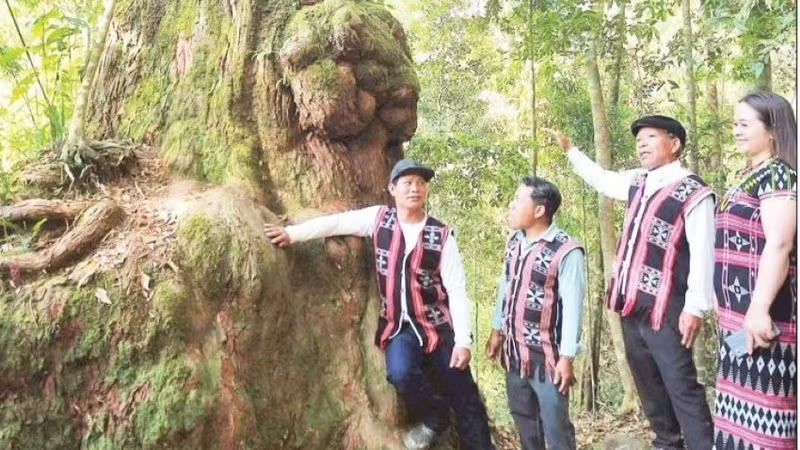
Located in the city’s western mountainous area, Hung Son Commune is home to more than 450 hectares of primeval po mu forest. It is one of the few remaining primeval po mu populations in the Truong Son Range, with thousands of trees growing naturally. Of these, 725 ancient trees were recognised as Viet Nam Heritage Trees by the Viet Nam Association for Conservation of Nature and Environment in 2015.
The locality also boasts more than 251 hectares of rhododendron forest, with 435 ancient trees recognised as Viet Nam Heritage Trees in 2018. Beyond its magnificent natural landscapes, Hung Son possesses rich biodiversity and the distinctive indigenous culture of the Co Tu ethnic community, providing a strong foundation for sustainable ecotourism development.
Nguyen An, Secretary of the Hung Son Commune Party Committee, said the locality considers forest-based ecotourism an important development direction, but conservation must remain the top priority. All activities designed to harness the value of forest resources are carefully planned to balance ecosystem conservation and protection of pristine landscapes with the creation of sustainable livelihoods for mountainous communities.
“Our position is that we will not trade natural resources for short-term growth. Hung Son’s forests are an exceptionally valuable asset, not only for the locality but also for Da Nang as the city pursues ecotourism and nature- and indigenous culture-based experiential tourism,” Nguyen An affirmed.
Following the merger, Da Nang’s ethnic minority and mountainous areas cover approximately 7,761 square kilometres, equivalent to 65.4% of the city’s total area. The city has 37 communes classified as ethnic minority and mountainous areas, along with four communes containing villages in such areas, comprising a total of 420 villages, including 230 facing particularly difficult conditions.
The area is home to around 164,000 people from more than 39 ethnic groups. At the beginning of 2026, the multidimensional poverty rate stood at 27.85%.
Therefore, improving living standards in mountainous communities, ensuring social welfare, strengthening great national unity and laying a solid foundation for achieving socio-economic development goals remain among the city’s foremost strategic tasks.
At a working session with western mountainous communes, Secretary of Da Nang City Party Committee Le Ngoc Quang stressed: “The communes need to focus on developing a sustainable forest economy and identify medicinal plants as a strategic development direction for the region. It is necessary to foster a development mindset of ‘conservation for development and development for forest protection’; put people at the centre; regard forest and medicinal plant resources as distinctive competitive advantages; and gradually establish an economic space centred on medicinal plants, the ecological economy and community-based tourism that reflects the unique identity of the mountainous region.”