Expanding resources through forest value
The legal framework for this sector is gradually being finalised. Government Decree No. 112/2026/ND-CP, dated April 1, 2026 — which took effect on May 19, 2026 — regulates the international exchange of greenhouse gas emission reduction outcomes and carbon credits, establishing a legal basis for recognising, managing, and transferring Viet Nam's emission reduction results to international partners.
Government Decree No. 180/2026/ND-CP, dated May 21, 2026 — effective July 15, 2026 — regulates forest carbon sequestration and storage services. It establishes a specialised legal framework for identifying service providers and users, determining payment methods and rates, and managing the revenue generated from these services.
The decree creates a foundation for measuring and recording the carbon sequestered and stored by forests, converting it into financial resources to support forest protection, restoration, and development. Consequently, the responsibility for forest protection is increasingly linked to the economic interests of forest owners, local communities, and other stakeholders.
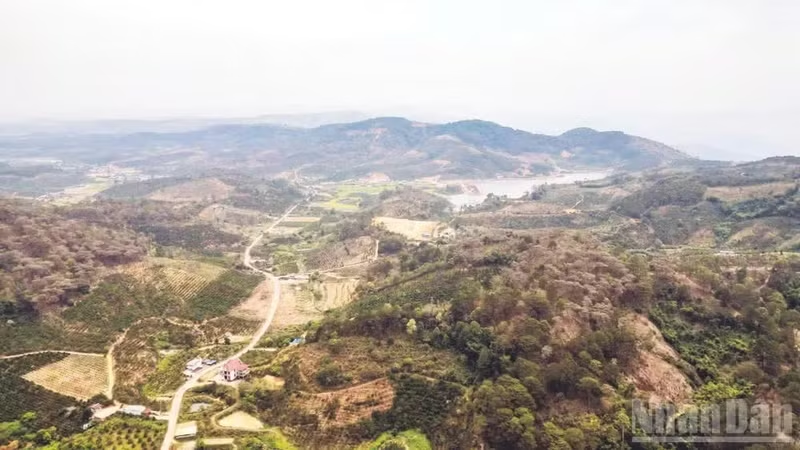
According to Le Thanh Son, Deputy Director of the Lam Dong Department of Agriculture and Environment, following administrative boundary consolidation, the province now possesses over 1.1 million hectares of forest, nearly 1 million hectares of which are natural forest. Son noted that Lam Dong is currently engaging with both domestic and international markets.
Regarding the domestic market, the province is collaborating with the Ministry of Agriculture and Environment and relevant ministries and agencies to finalise the legal framework, national registration system, forest carbon standards, emission quotas, and the trading exchange.
On the international stage, Lam Dong is one of five provinces participating in the emission reduction payment agreement signed by the South Central Coast and Central Highlands with the LEAF/Emergent coalition.
The programme aims to transfer approximately 5.15 million tonnes of CO2 equivalent between 2021 and 2025. Negotiations regarding the price — ranging from 10 to 15 USD per tonne of CO2 equivalent under ART-TREES standards — are ongoing, with projected revenue estimated at 300 to 500 billion VND.
However, as the program remains in the negotiation and legal documentation finalisation phase, no actual revenue has yet been generated. The measurement, reporting, and verification (MRV) system relies heavily on data and guidelines from central authorities, and local technical capacity requires further training and enhancement. Notably, the benefit-sharing mechanism involving the state, forest owners, communities, and other stakeholders still requires more specific regulation.
Ensuring the sustainability of forest carbon credits
In reality, forest carbon credits cannot be generated simply by the mere existence of forests. To gain market recognition, localities must demonstrate emission reductions or increased sequestration relative to a baseline, maintain systems for monitoring forest dynamics and independent verification, ensure the avoidance of double-counting, and fully meet environmental and social requirements.
Prof, Dr Tran Thi Thuy Duong, Dean of the Faculty of International Law at the University of Law, Ho Chi Minh City, notes that forest carbon credits are increasingly viewed not only as a climate policy tool but also as an asset with economic value.
Therefore, the distribution of benefits among the state, forest owners, and local communities must be designed in a transparent and equitable manner. Local communities are the force directly involved in forest protection; however, under many current mechanisms, they are often viewed merely as task implementers rather than as entities with rights to the carbon value generated.
Forest carbon credits are increasingly viewed not merely as a climate policy tool but also as an asset class with economic value. Consequently, the distribution of benefits among the state, forest owners, and local communities must be designed transparently and equitably. Local communities are the primary force directly involved in forest protection; however, under many current mechanisms, they are often regarded merely as task implementers rather than stakeholders with rights to the generated carbon value.
Prof, Dr Tran Thi Thuy Duong, Dean of the Faculty of International Law, University of Law, Ho Chi Minh City.
According to Nguyen Song Ngoc Chung from Saigon University, the sustainability of "blue" carbon credits can be compromised by various climate change-related risks — such as sea-level rise, storms, and floods — which reduce forest cover, destroy ecosystems, or cause previously sequestered carbon to be released back into the atmosphere.
This phenomenon, known as "carbon reversal," is a common risk for nature-based projects. Beyond natural disasters, stored carbon can also be lost due to wildfires, pest infestations, illegal logging, or changes in land use. Legal and policy risks are particularly noteworthy; overlapping regulations, changes in zoning plans, and adjustments to land-use purposes can undermine the long-term maintenance of carbon stocks. Furthermore, the transfer of land-use rights or changes in forest management entities can trigger disputes and compromise the credibility of issued credits.
Additionally, experts note that the current legal framework lacks mandatory requirements regarding the minimum duration for maintaining carbon stocks for specific project types, nor does it provide for a national-level carbon reserve fund to address potential carbon losses caused by natural disasters or unforeseen factors.
To address the aforementioned gaps, experts propose establishing binding legal regulations regarding carbon retention periods tailored to specific forest types and ecosystems. Simultaneously, they recommend exploring the creation of a national "green carbon reserve fund" to mitigate risks of carbon loss caused by natural disasters, climate change, or events beyond the project owner's control.
Furthermore, mechanisms must be established to ensure the continuity of carbon obligations when forest management entities change, alongside clear regulations regarding credit replacement, damage compensation, and dispute resolution within emission reduction purchase agreements. Requirements for protecting carbon stocks should also be integrated into land-use, forestry, and coastal development planning.
At the same time, the state needs to enhance support — covering finance, technology, and workforce training — for localities, forest owners, and communities; refine systems for data management, registration, measurement, reporting, and verification; and establish mechanisms for the transparent disclosure of revenues, costs, and benefit-sharing arrangements.
Emission reduction purchase agreements must include clear risk-allocation clauses that specify compensation liabilities, insurance mechanisms, reserve funds, and dispute resolution procedures in the event of carbon stock depletion or loss.
With proper preparation, forest carbon credits can provide not only supplementary financial resources but also a long-term driving force for forest protection and restoration, ecosystem conservation, livelihood improvements, and enhanced climate change resilience.

![[In Pictures] Bridge columns and underpasses in Ha Noi begin to turn green](https://en-cdn.nhandan.vn/images/nyM650OGFWrOVWc-xajqN-rTZ68Rlmc1fiGJOhBRYHH_N-Xs0TE8Psnfce7ORTs-KVfoJaEblqjNufFrgeF3e2xFkGtLQVaXm04VcmMKBEkANUyiOkpz4zAuIKgydVrrfBxmGez0E_YJIag0u_Uil0E7jpuJXsIxeMmGjoY1-W4/1791863309074-2994714492692222878-2994714492692222878-adb9ff3f4175c70066ed8bb80cfbead9.jpg.avif)