From by-products to new materials
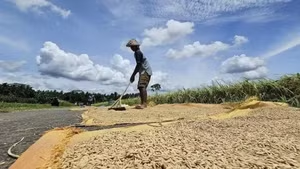
Viet Nam generates more than 45 million tonnes of agricultural by-products each year, including straw, rice husks, sugarcane bagasse, coconut fibre, and coffee husks.
Professor Dang Thi Kim Chi and her team at the Viet Nam Association for Conservation of Nature and Environment have developed a biodegradable plastic film from cassava starch.
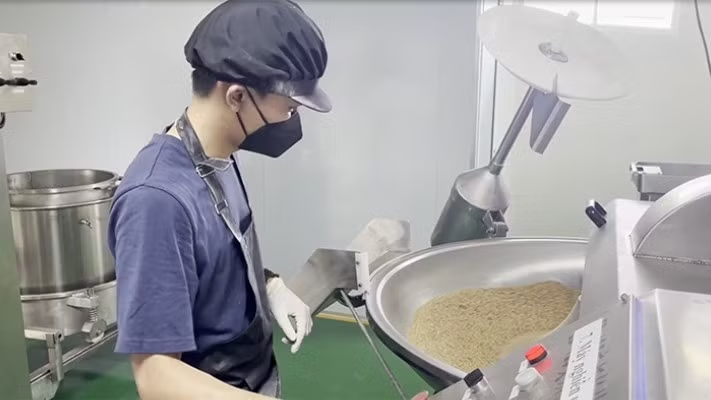
The team blended modified thermoplastic starch with PBAT and PLA to produce the film. The resulting material has a tensile strength of 17.4 MPa and an elongation at break of 220%. Under controlled composting conditions, 96% of the material degraded within 53 days.
Using Booth avocado seeds and cassava pulp, a group of students from Ho Chi Minh City University of Technology and Education developed a biofilm for use in packaging and agriculture.
Starch extracted from avocado seeds was combined with cellulose from cassava pulp to reinforce the material matrix. Initial results showed that the film was biodegradable and exhibited solid tensile strength. The team is continuing to refine the product to expand its potential applications.
Marine biomass is also being explored for the production of biomaterials. In March, the Ho Chi Minh City Department of Science and Technology approved a project to develop bioplastic film from Ninh Thuan sea moss.
The research team produced a transparent film that is biodegradable and water-resistant. The team plans to partner with businesses to conduct practical assessments and move towards scaling up production.
Do Hong Hanh, Director of BUYO Bioplastics, noted that bio-based materials should be prioritised for products that are thin and lightweight, difficult to collect, used in large quantities, or require a high level of safety when in contact with food.
Conversely, recycled plastic is more suitable for reusable products that require high mechanical strength and already have collection systems in place. Clearly defining these areas of application will help avoid treating a new material as a panacea for every type of plastic waste.
Costs also remains a major obstacle for green materials. Dr Nguyen Sy Linh of the Institute of Policy and Strategy for Agriculture and Environment explained that businesses have to invest in research, equipment, testing, and certification, while small-scale production makes it difficult for such materials to compete on price.
The effectiveness of materials also needs to be assessed throughout their entire life cycle — from raw materials, production, and use, to post-consumer treatment — to avoid simply shifting environmental pressures from one stage to another.

Standards and markets
Not all bio-based materials are completely biodegradable in every environment.
It is necessary to distinguish between products that require industrial composting, those that can degrade under natural conditions, and materials that contain only a proportion of bio-based feedstock.
There must also be greater clarity regarding degradation times, safety, the risk of microplastics, and treatment methods.
Nguyen Thi Hong Lieu of the Waste Management Division under the Department of Environment, Ministry of Agriculture and Environment, argued that national standards and technical regulations should be developed to control the quality of recycled materials, gradually increase mandatory collection and recycling rates for plastic packaging, and encourage eco-friendly design and reusable and easily recyclable packaging.
In Ha Noi, the Department of Agriculture and Environment plans to survey plastic production and recycling facilities to assess demand for raw materials, technology, and environmental impacts.
The findings will help identify opportunities for technological improvements and promote bio-based products.
Ha Noi has also proposed the swift issuance of national standards and technical regulations for alternative materials.
Products also need to be tested in real-world conditions and gain consumer acceptance. State agencies, schools, hospitals, hotels, and tourist destinations could place orders for certain single-use plastic alternatives.
The selection of products should take into account safety, recoverability, treatment costs, and impacts throughout their entire life cycle, rather than simply comparing purchase prices.
One pioneering example is Saigon Co.op, which switched to certified biodegradable bags in 2012, discontinued plastic straws in 2019, and has gradually reduced the use of single-use plastic cups and plates.
Many experts note that businesses that meet environmental and traceability requirements still face difficulties accessing distribution systems because of high costs, intense competition, and limited brand recognition.
Retailers need to create opportunities for certified products to reach consumers while supporting suppliers in improving their production processes.
Alongside market expansion, innovation support programmes are helping bring research results into commercial practice.
The 2025 Plastic Innovation Programme, organised by the Ministry of Agriculture and Environment in cooperation with the UNDP, received 116 proposals and selected 25 teams for intensive incubation.
Tourism is one of the sectors with a clear demand for testing alternative products.
A study conducted by the UNDP in cooperation with the Viet Nam National Authority of Tourism found that 95% of tourism businesses surveyed in Ninh Binh and 81.6% in Da Nang still provide single-use plastic products to tourists.
Therefore, accommodation establishments and tourist destinations could serve as testing grounds, gradually creating markets for alternative products in line with an appropriate roadmap.