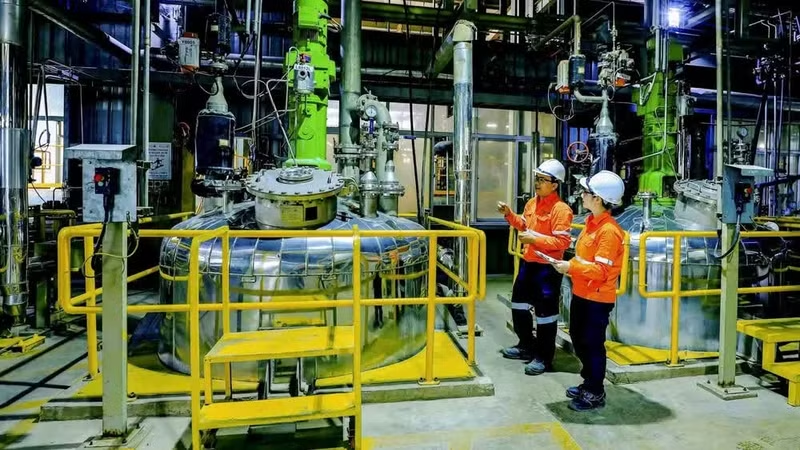
Thai Nguyen possesses significant reserves of various minerals, including tungsten, lead, zinc, iron, titanium, coal, and construction materials. In recent times, local entities and authorities have implemented advanced extraction and processing technologies to increase the value-added of these mineral resources, create employment opportunities, and boost the province’s budget revenue.
Integrating mineral extraction with processing
Thai Nguyen province possesses significant estimated reserves of various minerals, including tungsten ore (nearly 200 million tonnes), coal (over 100 million tonnes), iron ore (over 44 million tonnes), lead-zinc ore (23 million tonnes), titanium ore (over 13 million tonnes), and quartzite (19 million tonnes—used for producing engineered quartz and ferrosilicon).
The province is also home to hundreds of limestone quarries and sources of fill material. In recent years, Thai Nguyen province and local enterprises have integrated mineral extraction with processing and manufacturing, creating products that serve both the domestic economy and export markets.
Transforming raw minerals extracted from the earth into finished products requires a series of rigorous and precise processes. Thai Nguyen Iron and Steel Joint Stock Corporation (Tisco), for instance, extracts iron ore from the Tien Bo mine (in Linh Son Ward). The ore undergoes beneficiation to increase its mineral content before being smelted into pig iron, which is then converted into steel billets and rolled into construction steel and structural steel shapes.
The company produces 600,000 to 700,000 tonnes of steel annually under the Tisco brand—a name well-regarded in the market. Furthermore, the company extracts coking coal locally to produce coke, which is essential for the smelting of pig iron and the production of steel billets and rolled steel products.
Through a closed-loop production process—spanning from ore extraction to the manufacturing of construction steel—Tisco provides direct employment for over 3,000 workers, supports tens of thousands of additional jobs in auxiliary and related sectors, and contributes approximately 300 billion VND to the local budget annually.
In line with the policy against the export of raw ore, Thai Nguyen province has recently focused on integrating mineral extraction with deep processing to increase value-added. In the northern part of the province, 15 mines are currently in operation, yielding nearly 300,000 tonnes of lead-zinc ore annually.
This ore is processed at mineral dressing plants to produce lead concentrates, which serve as raw material for five facilities that manufacture over 26,000 tonnes of lead ingots (metallic lead) per year—supplying both the domestic manufacturing sector and export markets.
Cong Minh Tien, Director of Hoang Nam Co., Ltd. in Cho Don Commune, stated that the company has invested in a lead ore beneficiation line and a lead smelting plant with an annual capacity of 10,000 tonnes, contributing 30 billion VND to the state budget each year.
Similarly, Thai Nguyen Non-Ferrous Metals Joint Stock Company extracts lead-zinc ore from three mines, processing it into lead, zinc, copper, and tin concentrates. The zinc concentrate is transported to the Song Cong Zinc Plant, which produces 12,500 tonnes of metallic zinc annually for domestic manufacturing—helping to reduce imports.
The company provides employment for 1,200 workers with an average monthly income of 16 million VND per person and is projected to contribute 170 billion VND to the local budget in 2025.
In addition to operating the Nui Phao polymetallic mine, Masan Group has partnered with foreign entities to build the Nui Phao Tungsten Refinery in Dai Tu Commune. The facility produces four types of products—tungsten, fluorspar, bismuth, and copper concentrate—with the tungsten reaching high levels of purity for export.
The Nui Phao mineral extraction and processing complex provides direct employment for over 1,000 workers, generates annual revenues in the tens of billions of VND, and contributes more than 100 billion VND to the provincial budget.
Furthermore, local coal extraction and processing operations supply fuel to two thermal power plants in the area, which have a combined capacity of over 200 MW and maintain stable operations. The extraction of common minerals is also prioritised to meet the demands of transport and civil construction, as well as site leveling for industrial zones, industrial clusters, residential areas, and urban developments.
Expanding deep processing
In recent times, the mineral extraction and processing sector has made a positive contribution to the socio-economic development of Thai Nguyen province. Building on this solid foundation—and with the aim of enhancing resource-use efficiency and driving greater local economic growth—mineral extraction and processing enterprises are continuing to restructure their production operations. They are also intensifying the application of science and technology to expand the deep processing of minerals.
To move up the value chain and move away from the practice of selling semi-processed lead ore, the Thai Nguyen Non-Ferrous Metals Joint Stock Company is investing approximately 300 billion VND in a modern lead-production plant with an annual capacity of 5,000 tonnes.
Meanwhile, the Bac Kan Minerals Joint Stock Company is developing the 50-hectare Thanh Thinh Industrial Cluster, which will house three integrated plants for the production of lead and zinc, with a combined annual output reaching hundreds of thousands of tonnes.
Dinh Van Hien, General Director of the Bac Kan Minerals Joint Stock Company, stated: “These deep-processing plants are expected to begin production by the end of 2027. Once fully operational, they are projected to generate an annual revenue of over 18 trillion VND.”
At a recent conference on solutions for the deep processing of minerals in the province, Thai Nguyen set a strategic direction for the 2026–2030 period—with a vision extending to 2050—to focus on the deep processing of metallic minerals. Priority will be given to refining four key minerals for which the province holds a competitive advantage in terms of reserves, existing infrastructure, and extraction and processing capacity: tungsten, lead, zinc, and titanium.
According to Trinh Xuan Truong, Secretary of the Thai Nguyen Provincial Party Committee, the province intends to fundamentally shift its approach—moving away from traditional extraction and basic processing toward deep processing.
This transition aims to foster deeper integration into both domestic and global supply chains, particularly regarding strategic materials, thereby enhancing the value of these minerals and the province’s standing within the supply chain.
In addition to encouraging and facilitating the construction of deep-processing plants, the province will engage with relevant ministries and central agencies to develop appropriate mechanisms to promote the establishment of high-tech mineral-refining facilities.
Thai Nguyen has issued a development plan for the deep processing of specific metallic minerals, spanning through 2030 with a vision toward 2050. Furthermore, the province has established an association for mineral extraction and processing enterprises to strengthen collaboration and mobilise resources for the development of the sector.
To address the impacts of current mineral extraction and processing activities, the province has introduced a regulation requiring a contribution equivalent to 1% of the taxable value of extracted minerals—calculated based on the specific category and type—to be reinvested into the local communes where such extraction and processing operations take place.
Utilising waste soil and rock from mineral extraction as fill material or construction material helps reduce environmental pollution and limits the need for land to be used as waste disposal sites.