Using energy more efficiently through technology
Within a production line, energy waste often stems not from the equipment itself, but from how it is operated. This is where science and technology can play a pivotal role in addressing the challenge of using energy economically and efficiently.
According to a representative of Daikin Viet Nam, energy efficiency is no longer merely an option but has become a prerequisite for maintaining competitiveness.
Currently, around 65% of the total energy consumed by buildings and factories is used by central systems, of which 78% goes towards cooling and heating.
Whereas businesses previously relied mainly on electricity bills to monitor consumption, sensors, smart meters, and energy management systems now enable data to be collected by area, equipment, production line, and time of use.
Once analysed, this data helps businesses identify malfunctioning equipment, determine which processes consume the most energy, and adjust operating methods. “For some cooling systems, after data is collected and analysed, an optimal operating plan can be developed, resulting in energy savings of 10–30%,” the Daikin Viet Nam representative emphasised.
Technology is being applied not only to large systems but also incorporated into everyday energy-consuming appliances.
Ariston is one example, combining heat pump technology, smart connectivity, and energy management in hot-water systems.
Unlike conventional hot-water systems, which use electricity directly to generate heat, this technology draws heat from the surrounding environment to heat the water, thereby reducing electricity consumption.
When the smart energy-saving function is activated, the system can operate according to actual usage needs, limiting unnecessary electricity consumption. The system has proved particularly effective for businesses with high hot-water demand.
Pham Ngoc Son, head of the pre-sales consulting team for Ariston’s northern region, said that for major customers such as hotels, hospitals, and schools, heat pump solutions can maintain hot-water temperatures at 60 or 75°C, saving up to 75% of electricity consumption.
In addition, when combined with solar energy systems, cost savings can reach as much as 90%, with a typical payback period of around two to three years.
These applications have demonstrated that saving electricity does not mean simply switching off the power. Rather, it means switching off equipment when it is not in use, changing operating methods, and making use of technological support.
According to energy expert Ha Dang Son, energy efficiency requires not merely changing usage habits, but also intervening in existing technologies and processes, and adopting new and breakthrough technologies.
From a business perspective, this challenge also requires a balance between immediate economic efficiency and investment in sustainable development.
Truong Cong Phong, General Director of Tan A Dai Thanh, said businesses need to strike a balance between profit targets and the requirements of green production, especially given that the initial costs of technology, research, and training are often substantial.
Energy efficiency is therefore gradually becoming a data-driven issue. By knowing how much electricity a production line consumes it, when and under what conditions it consumes, and how efficiently it operates, businesses can quantify, verify, and continuously optimise their energy use.
Creating space for new energy sources
While technology enables businesses to use electricity more efficiently, generating electricity on-site creates additional opportunities for efficient energy management.
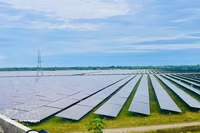
Many businesses have invested in rooftop solar power to reduce their dependence on externally purchased electricity, meet part of their energy needs, and cut production costs.
The experience of Song La Xanh Packaging Company in Ha Tinh clearly demonstrates this approach. The company produces around 6,000 tonnes of packaging a year, with monthly electricity bills averaging around 1 billion VND.
Since June 2025, the company has invested in a 2.7 MWp rooftop solar power system, covering around 90% of its factory roof area, to reduce costs. Of this capacity, 1.2 MWp is used by the company itself, while the remainder is run under an energy service company (ESCO) model, whereby the ESCO leases the factory roof to install the system and sells electricity to the grid.
Phan Chi Tam, deputy director of the company, said the 1.2 MWp rooftop solar system helps the company reduce its monthly electricity costs by 20–25%, with the investment expected to pay back after seven years.
Investing in on-site power generation not only helps businesses reduce costs but also enhances their energy autonomy. However, solar power creates a new challenge: electricity is generated only at certain times, while demand occurs continuously.
When the timing of generation and consumption does not coincide, businesses need additional solutions to manage loads and make use of surplus electricity. This is where storage technologies, including battery energy storage systems (BESS), can play a supporting role.
BESS does not generate additional electricity but helps improve the efficient use of renewable electricity by shifting the timing of consumption. This process also creates a need to master the underlying technologies.
Associate Professor Nguyen Ngoc Trung, Deputy Head of the Research Management Division at the Ha Noi University of Science and Technology, said that addressing energy challenges, including the development of solar power, wind power, and energy storage, requires research into appropriate technologies while ensuring sufficiently competitive costs.
The effective models implemented by the businesses mentioned above provide vivid evidence of the strategic vision set out in a Politburo resolution issued in August last year on ensuring national energy security through 2030, with a vision to 2045.
At the same time, they reflect the Prime Minister’s close, timely direction on implementing electricity-saving measures and developing rooftop solar power, which emphasises the need to pair rooftop solar development with the installation of BESS.
This is a key solution for both expanding clean energy sources and optimising load regulation on the power grid.
In reality, energy efficiency and the energy transition are not two separate stories. One is about how to use less energy to achieve the same production value; the other is about how to develop and use clean and new energy sources more efficiently.
This is also the overarching spirit of a Politburo resolution issued in 2024 on science, technology, and innovation, which makes digital transformation and science and technology capabilities key drivers.
It is helping businesses shift from saving through awareness to saving through technological capability, improving productivity and competitiveness, and promoting sustainable development across the economy.