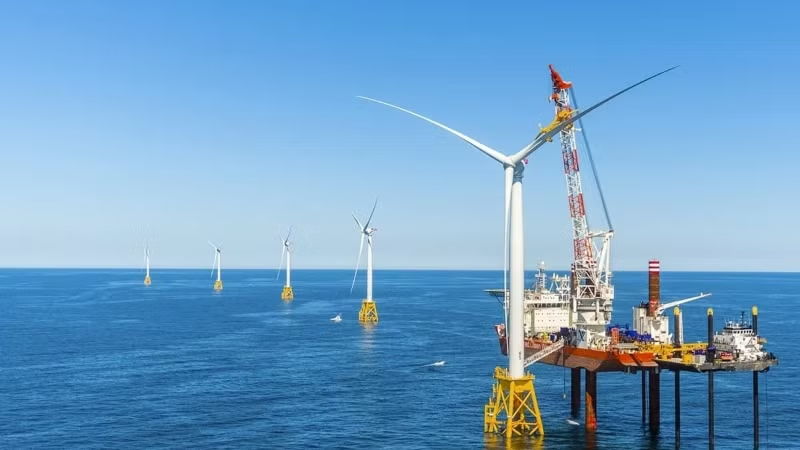
According to experts, enhancing institutions and dismantling barriers in mechanisms and policies will be key to opening up new development space, forming a modern energy value chain, contributing to national energy security and generating growth momentum in the new era.
Opening up development space from a new energy value chain
The world is entering an energy transition phase at an unprecedented pace. Geopolitical fluctuations, supply chain disruptions, carbon neutrality targets and the rapid advancement of clean energy technologies are profoundly reshaping the global energy industry.
For Viet Nam, ensuring energy security is no longer simply about maintaining supply. It must also be linked to transforming the growth model, improving competitiveness and fulfilling the commitment to net-zero emissions by 2050.
According to Dr Nguyen Quoc Thap, Chairman of the Viet Nam Petroleum Association, the oil and gas-energy sector is under simultaneous pressure from many forces. Alongside geopolitical fluctuations and emission-reduction requirements, many key oil and gas fields have entered their natural decline phase, while new projects are becoming increasingly difficult in terms of engineering, technology and capital.
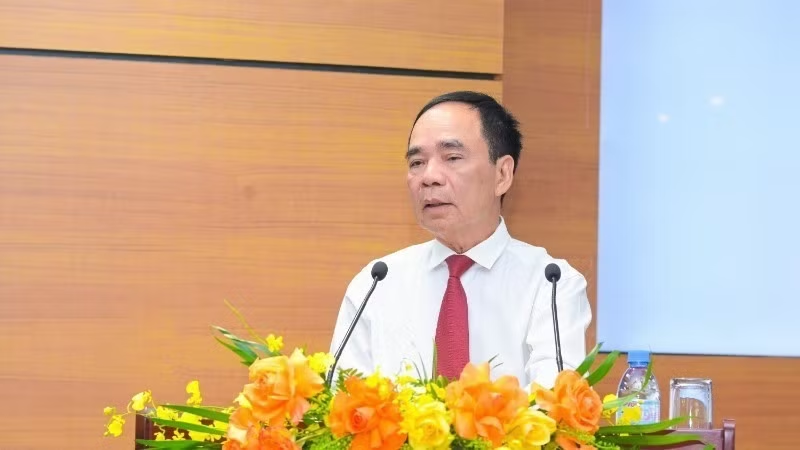
However, challenges also present opportunities for the sector to restructure towards expansion into areas with strong potential such as liquefied natural gas (LNG); gas-fired power; offshore wind power; hydrogen, carbon capture and storage (CCS); and carbon capture, utilisation and storage (CCUS), as well as high-quality technical services. In his view, these are no longer long-term orientations but urgent development requirements in order to maintain the role of the oil and gas industry in the new context.
Sharing the same perspective, Trinh Quoc Tuy, senior officer at the Party Central Committee's Commission for Policies and Strategies, stated that the oil and gas sector needs to shift from a mindset based mainly on resource exploitation to the development of an integrated energy ecosystem.
Accordingly, together with the task of ensuring energy security, the Viet Nam National Industry – Energy Group (Petrovietnam) needs to focus on six strategic issues: responding to geopolitical volatility; developing offshore wind, green hydrogen and carbon capture technologies; seeking growth drivers to replace declining traditional fields; developing infrastructure to serve the digital economy; and renewing governance and strengthening technological capacity.
To achieve these goals, the prerequisite is to continue improving institutions, synchronising legal regulations and building mechanisms flexible enough for new energy fields.
Policy reform as the key to unlocking growth momentum
According to experts, the biggest bottleneck at present does not lie in resource potential or corporate capacity, but in a legal framework that has not kept pace with development requirements.
Tran Thanh Tung, Deputy Head of the Oil, Gas and Coal Department under the Ministry of Industry and Trade, said the oil and gas-energy sector is facing dual pressure as it must both meet the target of double-digit GDP growth in the 2026–2030 period and implement the commitment to net-zero emissions by 2050.
Petrovietnam aims to join the Fortune Global 500 by 2030; by 2050, it targets revenue of 80–100 billion USD, with more than half of output coming from low-emission energy sources.
Meanwhile, Viet Nam has become a net energy importer, consumption demand continues to rise rapidly, but all major oil and gas fields are seeing declining output. New discoveries are mainly small, marginal fields located in deep water and offshore areas, with high investment costs and high risk.
In addition, energy infrastructure remains unsynchronised; the legal framework for new fields such as offshore wind, hydrogen, ammonia and CCS is not yet complete; and mobilising the very large amount of capital needed for energy transition also poses many challenges.
According to Tung, amending the Law on Petroleum and the Electricity Law in the direction of simplifying procedures, creating special mechanisms for marginal fields, promoting decentralisation and delegation of authority, and making use of existing oil and gas infrastructure to develop green energy will help unlock resources, enhance competitiveness and ensure national energy security.

At the same time, it is necessary to develop energy infrastructure in a coordinated manner, promote digital transformation, improve the quality of human resources and create favourable conditions for enterprises to implement new energy projects.
From the business perspective, Vu Dao Minh, Deputy General Director of Petrovietnam, said the group is aiming to become a competitive industrial-energy enterprise in the region and internationally, playing a core role in ensuring energy security and leading Viet Nam’s energy transition.
At present, Petrovietnam has total assets of nearly 1.2 quadrillion VND, with revenue equivalent to around 9–10% of GDP. The group aims to join the Fortune Global 500 by 2030; by 2050, it targets revenue of 80–100 billion USD, with more than half of output coming from low-emission energy sources.
To realise this ambition, Petrovietnam has identified two key groups of solutions. First is internal renewal through maintaining production output, accelerating key projects such as the Block B – O Mon gas-to-power value chain; promoting digital transformation in line with an “AI-First” orientation; increasing investment in research and development (R&D); and building integrated industrial-energy centres to optimise infrastructure and the value chain.
In the context of the global energy transition gaining momentum, Viet Nam’s oil and gas industry is not only facing challenges but also has opportunities to create new growth drivers.
At the same time, it will continue to improve the Petroleum Law in a more flexible direction for small and marginal fields; establish a “green lane” mechanism for strategic energy projects; and implement a sandbox mechanism for hydrogen, offshore wind and the carbon market.
In the context of the global energy transition gaining momentum, Viet Nam’s oil and gas industry is not only facing challenges but also has opportunities to create new growth drivers.
Unblocking institutions, improving policies and building a favourable investment environment will be an important foundation for developing a modern oil and gas-energy value chain, promoting fields such as LNG, offshore wind, hydrogen and carbon capture technologies, thereby helping ensure energy security, improve national competitiveness and realise sustainable development goals.