Proposing five major policy groups
According to the Ministry of Industry and Trade – the agency in charge of drafting the amended Law on Oil and Gas, petroleum activities in recent times have faced a number of difficulties and inadequacies that need to be addressed. These include: Some principle-based framework issues specific to oil and gas operations have arisen but are not specifically regulated in the Law on Oil and Gas 2022; some frequently changing issues stipulated in the current law that are no longer relevant to current practices; together with the continuous development of scientific and technological achievements, energy transition trends, and mechanisms for developing and promoting the value chain of oil, gas, and offshore energy, in association with high-tech oil and gas services need to be supplemented and completed.
In the context where oil and gas exploration and production are becoming increasingly difficult, in order to create more favourable conditions for the Viet Nam National Industry–Energy Group and contractors to increase output and investment efficiency, create new growth momentum, unlock resources, contribute to national growth and State budget revenues in the coming years, and helping to safeguard maritime sovereignty and national energy security, it is necessary to continue improving mechanisms and policies for the oil and gas sector.
The amended Law on Oil and Gas is built to ensure that basic oil and gas surveys and oil and gas activities are safe for people and assets, improve the efficiency of resource exploitation in association with environmental protection, climate change response, and biodiversity conservation, and bring about effectiveness and benefits for both the nation and investors, on the basis of respect for Viet Nam’s independence, sovereignty, territorial integrity and national security, and compliance with Vietnamese law; while minimising difficulties, obstacles, ambiguities, overlaps, and inadequacies in the legal system.
At the same time, it aims to strengthen the attraction of foreign and private investment in oil and gas exploration and production in an increasingly difficult and complex oil and gas operating situation; promote science and technology development and innovation in the oil and gas sector, with a spearhead focus on self-reliant high-tech oil and gas services, and expand oil and gas services abroad.
Accordingly, the Ministry of Industry and Trade proposes five major policy groups:
Policy 1: Perfect and simplify procedures, and strengthen decentralisation in the appraisal and approval of steps for implementing basic oil and gas surveys and oil and gas activities.
Policy 2: Supplement and improve regulations on petroleum contracts.
Policy 3: Supplement and perfect regulations on investment incentives in oil and gas activities.
Policy 4: Stipulate mechanisms and policies for developing the oil and gas value chain, including high-tech oil and gas services and offshore energy.
Policy 5: Provide a framework regulation for greenhouse gas emission reduction, carbon capture, and storage in oil and gas activities.
Clarifying incentive mechanisms and responsibilities of subjects in oil and gas activity chain
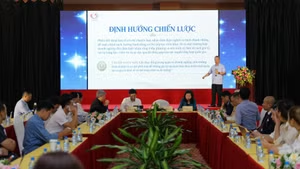
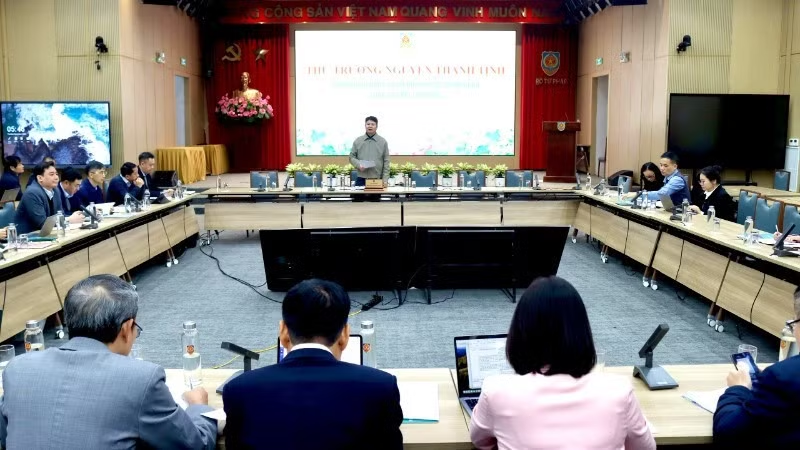
At the meeting of the Policy Appraisal Council for the amended Law on Oil and Gas, held on January 26, council members unanimously agreed on the necessity of promulgating the law.
Emphasising that oil and gas issues affect not only socio-economic issues but also national defence and security, the council members requested the drafting agency to continue researching and completing the legal framework for oil and gas activities, ensuring consistency with related legislation; and to further clarify incentive mechanisms and the responsibilities of subjects in the oil and gas activity chain. At the same time, it is necessary to establish a mechanism to assess economic efficiency in association with field development profiles; stipulate in detail the profiles and necessary documents for each project phase; establish transparent and clear management mechanisms for special incentives for fields; and design incentive policies in line with the Law on Investment and tax policies.
In addition, members also mentioned issues on adjusting the boundary between the oil and gas sector and environmental protection, as well as mechanisms for management, supervision, and cost recovery for carbon storage and utilisation projects.
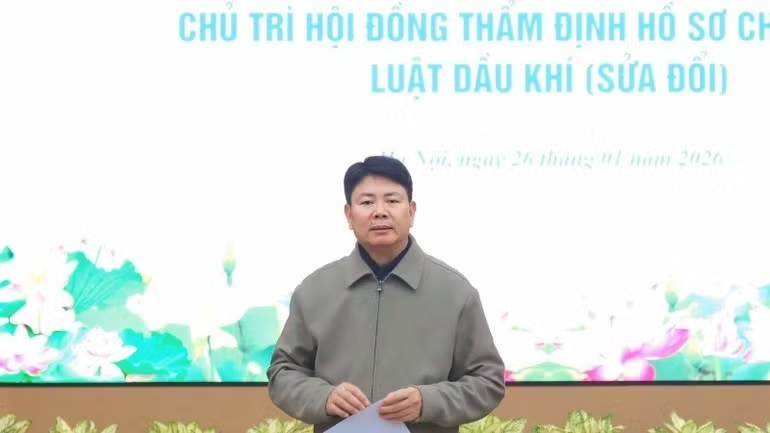
Speaking at the meeting, Deputy Minister of Justice Nguyen Thanh Tinh emphasised that the five draft policy groups play an important role in the development of the oil and gas industry. He therefore requested the drafting agency to assess the results and difficulties in implementing the current Law on Oil and Gas; focusing on consulting relevant experts and subjects; and concentrating resources to further perfect the policies based on the council’s comments.
The Deputy Minister noted that in recent times, the Politburo has issued important resolutions in association to the development of the oil and gas sector, such as the Politburo’s Resolution No. 57-NQ/TW dated December 22, 2024 on breakthroughs in the development of science, technology, innovation, and national digital transformation; and the Politburo’s Resolution No. 59-NQ/TW dated January 24, 2025 on international integration in the new situation. Therefore, the drafting agency needs to study and apply these orientations, creating special mechanisms to develop the oil and gas industry into a spearhead sector with international competitiveness.
He also emphasised a regulation on investment incentives to mobilise private resources to participate in oil and gas activities, meeting the target of strong petroleum development; ensure connectivity between high-tech oil and gas services and offshore energy; and study international experience in providing a framework regulation for greenhouse gas emission reduction, carbon capture, and storage in oil and gas activities, ensuring suitability to Viet Nam’s practical conditions.