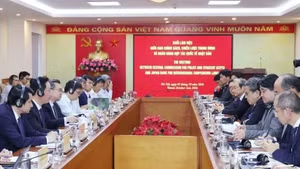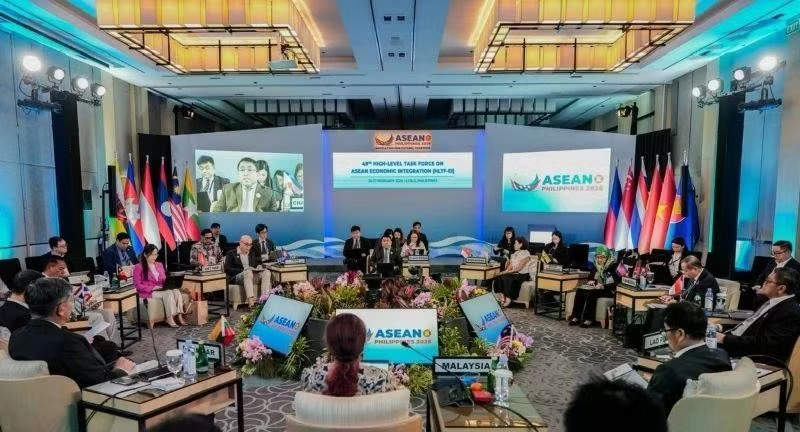
The meeting was attended by representatives of the 11 ASEAN member states, the ASEAN Secretariat, and regional research and advisory organisations.
The 49th HLTF-EI meeting focused on several key issues, including non-tariff barriers within the region; economic security in light of global economic developments; progress in formulating the Philippines’ Priority Economic Deliverables (PEDs) for 2026; consideration of revisions and additions to the mandate and operations of the HLTF-EI; reform of the ASEAN Economic Community (AEC) meeting calendar; monitoring and evaluation mechanisms for the implementation of the AEC Strategic Plan beyond 2025; the sustainable development agenda (circular economy, carbon neutrality, and blue economy); and a Memorandum of Understanding between ASEAN and the Asian Development Bank (ADB) for the 2026–2030 period.
At the meeting, ASEAN members noted that the bloc’s economic growth in 2025 is estimated at 4.5% (compared with 4.8% in 2024), with inflation projected at 2.4%. Total merchandise trade in the first three quarters of 2025 reached 3.2 trillion USD.
ASEAN countries reaffirmed the bloc’s central role in regional economic and trade cooperation, acknowledged progress in advancing economic integration within ASEAN, and outlined orientations to further deepen intra-regional trade and investment.
The meeting reaffirmed its commitment to an open, transparent, and rules-based multilateral trading system, while underscoring the need to closely monitor global trade policy developments, coordinate positions at the World Trade Organisation (WTO), and safeguard ASEAN members’ interests.
Participants also took note of adjustments to the operational mechanism of the HLTF-EI and agreed to maintain Track 1.5 dialogues on geoeconomics. Discussions further addressed strengthening ASEAN’s economic security amid a rapidly evolving geoeconomic environment, emphasising the importance of promoting economic security on the basis of openness, diversification, and deeper integration, and considering the potential development of an ASEAN Economic Security Framework.
During the discussions, Viet Nam expressed its support for the Philippines’ priority economic cooperation initiatives in its capacity as ASEAN Chair in 2025 and actively contributed views on relevant agenda items, helping to ensure the success of the meeting.
On the sidelines, ASEAN members participated in a workshop on ASEAN Economic Security, focusing on policy recommendations for a common approach, such as enhancing cross-pillar coordination mechanisms; strengthening cooperation in priority areas including strategic trade management, strategic supply chains, the digital economy, and energy and food security; and improving timeliness, flexibility, and stakeholder engagement through dialogue and early warning mechanisms.
The 49th HLTF-EI meeting concluded successfully, putting forward recommendations on ASEAN economic integration to be submitted to the ASEAN Economic Ministers’ Retreat, scheduled for March 2026.
The High-Level Task Force on ASEAN Economic Integration (HLTF-EI) was established in 2002 by decision of the ASEAN Economic Ministers, in the context of the bloc’s push for deeper liberalisation following the Asian financial crisis.
Since then, the HLTF-EI has played a central role in developing the Roadmap for the establishment of the ASEAN Economic Community (AEC); the AEC Blueprint 2015 and AEC Blueprint 2025; and the strategic orientation for the AEC 2026–2030 period. It can be said that the HLTF-EI serves as the “policy architect” behind the major strides of ASEAN economic integration.