For many workers, the early days of the year are often a time to reflect on income, spending, and plans for the months ahead. More than a month since implementing the new regional minimum wage, even modest changes have become visible in daily life.
Positive changes
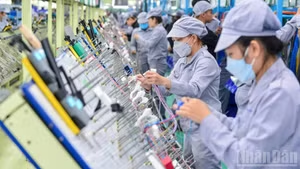
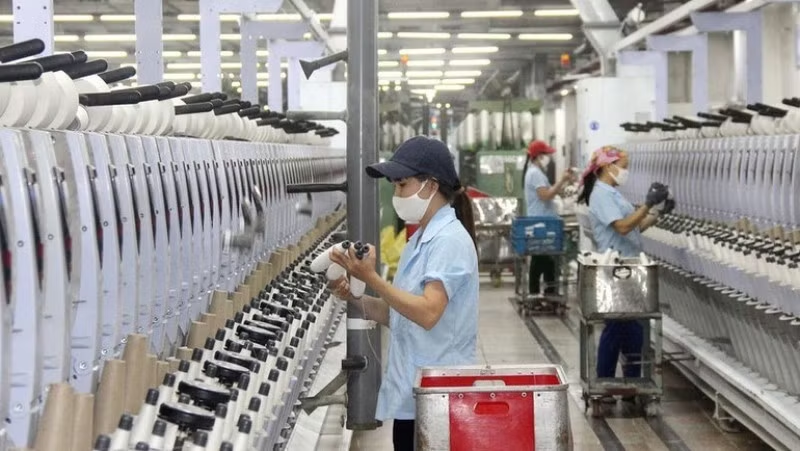
Ho Thi Dan Tam (born in 1990), a worker at Nam Dan Garment Factory (Nghe An), has clearly felt the impact while reviewing her family’s budget. Her five-member household — with her mother, husband, and two young children — relies mainly on wages, overtime pay, and statutory allowances. Since the new regional minimum wage took effect, her monthly income has increased by more than 1 million VND. “This increase eases the pressure on spending, especially household expenses and my children’s schooling at the start of the year.”
According to her, the timely adjustment creates a sense of being supported, helping workers feel more secure and committed to their jobs in the long term.
Working at the same factory, Nguyen Thi Tuyet (born in 1974), a packaging team worker with nearly nine years in the garment industry, said her previous income covered essential needs but required careful budgeting.
After more than a month under the new minimum wage, she has noticed clear improvements. “Monthly expenses are less strained, especially regarding costs of living and caring for my children. With stable employment and improved income, I feel more confident entering the new year,” she shared, expressing hope that the company will continue to maintain a stable working environment so employees can remain committed.
Truong Nhat Tan, 28, a worker at Anpha Mechanical Manufacturing Trading Company Limited in Dong Nam Industrial Park, Binh My Commune, Ho Chi Minh City, said the adjustment in line with the new regional minimum wage has helped his family feel more secure in spending and preparing for Tet. “When the family is stable, I can focus better on my work and contribute more effectively to the company,” he said, expressing confidence in the company’s development orientation and welfare policies.
At S68 Door Viet Nam Joint Stock Company, which manufactures roller doors in Thoi An Ward, Ho Chi Minh City, Tran Dinh Lam, a 40-year-old production worker, said that following the adjustment, his income and that of many colleagues has improved. “Some household expenses are now more balanced, and we feel more at ease welcoming the new spring. I hope the company maintains stable operations so workers can have long-term employment,” he noted.
Nguyen Ba Khanh Tung, Deputy General Director of Ha Noi Textile and Garment Joint Stock Corporation (Hanosimex), said that after the Government issued Decree No. 293/2025/ND-CP on regional minimum wages, the corporation proactively reviewed and adjusted its salary scales and payment schemes to ensure workers’ rights in accordance with regulations. At the same time, it has implemented cost-saving measures and improved productivity to maintain stable production and business amid rising input costs. In the new year, Hanosimex continues to place workers at the centre, focusing on income, welfare, and strengthened dialogue through trade unions to foster reassurance and long-term commitment.
Pham Ngoc Hoa, Director of Anpha Mechanical Manufacturing Trading Company Limited, affirmed that although it is a young enterprise, the company always regards people as its core value. “Adjusting wages in line with the new minimum level provides staff and workers with greater motivation, and productivity has improved noticeably,” he said. The company is committed to continuing to improve income, working conditions, and development opportunities for employees.
Similarly, Tran Manh Tuan, General Director of S68 Door Viet Nam Joint Stock Company, said that an appropriate wage policy forms the foundation for retaining personnel and building long-term development strategies. “We are committed to ensuring income, working conditions and career advancement opportunities so that employees can enter the new year with high expectations,” he stated.
Workers’ confidence and hope
Deputy Minister of Home Affairs Nguyen Manh Khuong assessed that the 7.2% increase in the regional minimum wage under Decree No. 293/2025/ND-CP was formulated based on a comprehensive evaluation of the socio-economic situation, ensuring a harmonious sharing of interests between workers and enterprises. The new wage levels are around 0.6% higher than the minimum living standard calculated through to the end of 2026 and already factor in part of the consumer price index so that workers benefit from the beginning of the year.
According to Nguyen Manh Khuong, immediately after the decree was issued, the Ministry of Home Affairs strengthened communication, guidance, and supervision of implementation. Official documents were sent to 34 centrally governed provinces and cities to ensure timely and consistent application from January 1, 2026. In the more than a month since implementation, workers’ living conditions have shown positive changes despite ongoing pressure from living costs. The increase helps ensure a minimum living standard, improve wages, and allow workers to manage their lives more proactively, particularly at the start of the new year and the Lunar New Year period.
Improved income also creates a positive psychological effect, helping workers feel secure and more motivated to remain committed to their jobs. Beyond immediate impacts, Nguyen Manh Khuong noted that minimum wage policy also affects social security, labour relations, and the labour market. Adjusting the wage floor provides a basis for enterprises to review salary scales, allowances, and benefits, thereby forming a clearer wage framework. This facilitates dialogue and collective bargaining, contributing to more stable labour relations and reducing disputes.
At the beginning of the year, labour demand typically rises, especially in industrial parks. The new minimum wage helps enterprises refine remuneration policies, attract and retain workers, and encourage employees to return after the Tet holiday, contributing to a balance between labour supply and demand. More importantly, when workers clearly see economic growth translated into tangible benefits, confidence in the Party and State’s policies is strengthened. “That confidence is the driving force enabling workers to work with peace of mind, make long-term contributions, and accompany enterprises in their development,” Nguyen Manh Khuong affirmed.
As the colours of spring spread across factories and workshops, January wages alone may not resolve all difficulties, but they are enough to kindle confidence and hope. For workers, it means a warmer Tet. For enterprises, it provides a foundation for a stable year ahead. For society, it marks a necessary step in aligning social security with development.