The policy has been issued with a clear roadmap, creating conditions for enterprises to proactively develop production and business plans while giving workers greater expectations of improved income.
As living costs continue to exert pressure and labour productivity still has ample room for improvement, there is a need to implement social welfare policies, training, and enterprise support in a coordinated manner. Only when wages are closely linked to productivity and social welfare is expanded can wage increases truly become a foundation for sustainable development.
Seeking a stable foundation
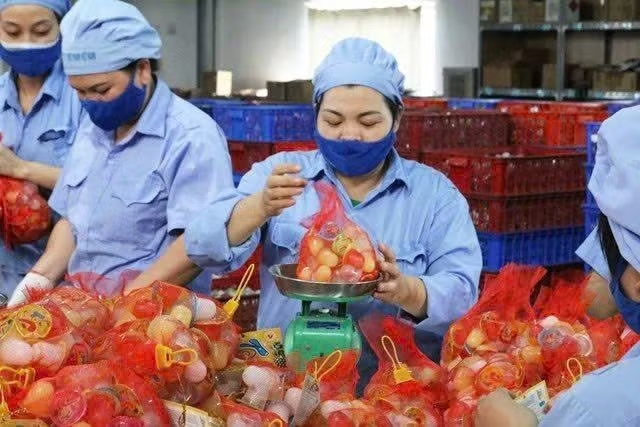
With an average income of around 8 million VND per month, Nguyen Thi Xuan, a worker at Vietfoods Factory (Hapro Industrial Park, Thuan An Commune, Ha Noi), shared that her current income is just enough to cover her family’s basic living expenses. When additional costs arise, especially as food and commodity prices rise, it becomes increasingly difficult to balance income. Wages at present only maintain daily life but do not provide long-term security. The minimum wage adjustment from early 2026 brings a certain level of expectation, but employees still face considerable pressure from living costs when real income has not kept pace with price increases. For those who participate in direct production, the wage increase is first and foremost an opportunity to stabilise life, reduce worries, and build some savings.
Xuan’s case reflects the common sentiment among many workers in industrial zones, whose income depends largely on wages while living costs continue to rise. This reality underscores the need for wage policies to closely reflect actual conditions to ensure a minimum living standard for workers.
According to Le Hau Phuong, Director of Viet Nam Food Joint Stock Company, adjusting the minimum wage and the base for social insurance contributions from 2026 will create significant cost pressure on manufacturing enterprises, especially small and medium-sized businesses with limited profit margins. Labour costs will rise simultaneously in wages and wage-based contributions, forcing enterprises to carefully calculate how to maintain competitiveness. Wage increases are an inevitable trend associated with economic development and improved living standards. The key issue lies in a stable and synchronised adjustment roadmap that helps enterprises proactively allocate resources and adjust financial plans and human resource strategies.
Phuong said that a sustainable path for enterprises is to enhance productivity through process improvements, technology application, and skills training for workers, while fully maintaining welfare regimes as required. Open and frank dialogue between employers and employees is seen as a crucial factor in ensuring smooth wage adjustments, fostering engagement and long-term stability.
Stabilising the labour market and long-term social welfare
According to Nguyen Manh Khuong, Deputy Minister of Home Affairs, the Government’s issuance of Decree No. 293/2025/ND-CP, which stipulates minimum wages for employees working under labour contracts, at the end of 2025 carries particular significance. This is the period when enterprises develop financial plans, estimate labour costs, and set human resource strategies for the following year. Early issuance of the policy, with a clear roadmap, helps enterprises proactively prepare resources and minimise disruptions when entering the new year.
For workers, the minimum wage is a floor level to protect vulnerable groups of employees in the labour market. As living costs tend to rise, adjusting the minimum wage helps ensure minimum living standards and improve income and living conditions, in line with the spirit of the Labour Code.
The 7.2% adjustment was built based on a comprehensive assessment of socio-economic conditions, considering the harmony of the interests of workers and enterprises. According to Nguyen Manh Khuong, the new minimum wage levels are about 0.6% higher than the projected minimum living standard until the end of 2026, with part of the consumer price index already factored in so that workers can benefit from the start of the year.
The Ministry of Home Affairs recommends that management agencies, enterprises and workers all uphold their responsibilities during the implementation process. Management agencies should strengthen guidance, monitoring, and timely support. Enterprises should proactively review wage scales, labour contracts, and allocate appropriate resources. Workers should understand their rights while also sharing responsibility with enterprises to maintain a stable and harmonious labour environment.
Ngo Duy Hieu, Vice President of the Viet Nam General Confederation of Labour, said that compared with the minimum living standard, the adjusted regional minimum wages from 2026 still have a certain gap. Nevertheless, amid the impacts of global economic volatility, supply chain and tariff policies, this increase is considered acceptable. The Viet Nam General Confederation of Labour shares workers’ concerns about price pressures. During negotiations at the National Wage Council, living costs and inflation control were always emphasised. At the same time, trade unions have proposed that the State continues implementing price control measures and expanding social welfare policies. At the grassroots level, trade unions are directed to strengthen dialogue and negotiations with employers to enhance benefits for trade union members, while also carrying out programmes to support workers’ livelihoods during Tet and for those affected by natural disasters and risks.
According to Ngo Duy Hieu, enterprises operating effectively will create the foundation for workers to increase their incomes. Therefore, besides protecting rights, trade unions also encourage workers to improve their skills and work with higher productivity and quality, sharing responsibilities and developing together.
Dr Lam Van Doan, Deputy Head of the National Assembly’s Committee on Culture and Social Affairs, said that low income forces many workers to work prolonged overtime, directly affecting health and quality of life. Increasing income by extending working hours is not a sustainable solution. The fundamental goal is to raise labour productivity through technological innovation, vocational training, and the development of high-quality human resources. When productivity increases, wages rise accordingly, while working hours can be reduced, creating conditions for workers to restore their labour capacity and care for their families. Apart from wage policies, social welfare policies are helping reduce workers’ expenditure burdens, such as tuition exemptions up to high school level and moves towards expanding health insurance coverage. When spending on education and healthcare decrease, workers’ real income improves in a more sustainable way.
Dr. Doan emphasised that minimum wage adjustments should be maintained regularly, but it must be considered in the broader framework of macroeconomic management and enterprise capacity. International experience shows that when wage increases are linked with training, technological innovation, and social welfare, the economy will shift from quantity-based growth to quality-based growth.
Increasing the minimum wage from 2026 opens expectations of improved income for workers, but the effectiveness of the policy depends largely on the degree of synchronous implementation. When wages are linked to productivity, social welfare is expanded, and enterprises are supported in adaptation, the labour market will operate more stably, creating a solid foundation for sustainable economic growth in the coming period.