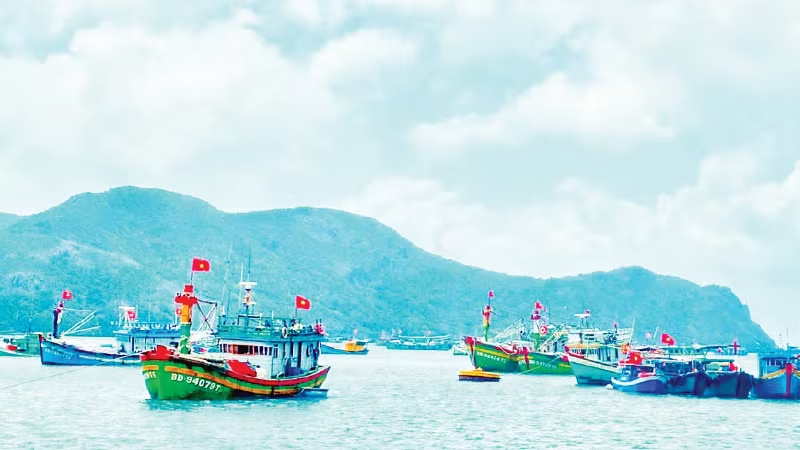
After many historical ups and downs, Con Dao is changing day by day, rising and developing to become a highlight of ecological, historical, and spiritual tourism in the nation’s seas and skies.
A heroic land
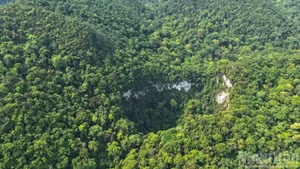
The aircraft descends and lands at Con Dao Airport. From here, we take a car and travel for about 20–25 minutes along the 14 km coastal road to reach the island’s centre. The road is truly beautiful, with forested mountains belonging to Con Dao National Park on one side and the East Sea/South China Sea stretching to the horizon on the other. Curving sections that hug the mountainside open wide views where sea waves crash against dark rocky shores, creating a sound both powerful and peaceful.
The Con Dao special administrative zone lies about 230 km from the mainland and consists of 16 islands of various sizes with a total natural area of around 76 km2. The archipelago is famous for its pristine beauty and rich forest–marine ecosystem, with more than 20,000 hectares of protected area within Con Dao National Park.
Con Dao is not merely a tourist destination. It is also sacred ground in the history of the Vietnamese nation. For 113 years (1862–1975), the Con Dao prison system was used to detain patriots and revolutionary fighters. Tens of thousands of people were brought to this remote island and endured brutal forms of torture. Many of them lay here forever.
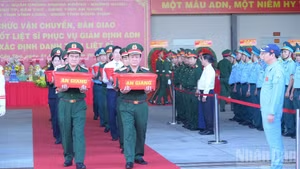
We visited Hang Duong Cemetery and Hang Keo Cemetery, the resting places of heroic martyrs. These are sacred destinations for tens of thousands of people and visitors every year. Each day at Hang Duong Cemetery, where nearly 2,000 martyrs are laid to rest — including former General Secretary Le Hong Phong, patriot Nguyen An Ninh, and Hero Vo Thi Sau — streams of people from all over quietly return to pay their respects.
In the shimmering candlelight and the scent of incense carried by the sea breeze, each visitor respectfully joins their hands in remembrance, creating a sacred, solemn, and deeply moving atmosphere. Mot, a security guard working here, told us: “Hang Duong Cemetery is always crowded with people coming to burn incense, especially at Ms Sau’s grave. Some told me that before coming they felt afraid, but once they arrived they only felt moved and sensed its sacredness.”
Perhaps it is precisely this special history that makes every visitor’s footsteps slow down on the island. Those who choose to come to Con Dao do not simply come for sightseeing, but also to listen to the stories of the past — stories that contribute to the sacred value of this land.
Rising from hardship
After the country’s reunification in 1975, Con Dao embarked on an entirely different journey. From a land associated with prisons and war, the island began building a new life almost from scratch. The liberation soldiers who took over Con Dao that year became the first residents of peacetime. They built houses, cleared land, and opened roads, gradually forming the first residential areas on the island.
Loan, who has worked at Hang Duong for many years, guided us around Con Dao. She said that in the early years after liberation, life on the island was extremely difficult. Being far from the mainland, the transport of food, construction materials, and essential goods depended entirely on sea vessels. Electricity, water, and transport infrastructure were very limited, and people’s lives were filled with shortages. To reach the island, residents had to travel on cargo ships, taking 16 hours to arrive, which was extremely arduous. Yet with persistence and the efforts of both authorities and residents, Con Dao gradually transformed.
Member of the Standing Board of the Ho Chi Minh City Party Committee and Secretary of the Party Committee of the Con Dao Special Administrative Zone, Le Hoang Hai, said that although many difficulties and challenges remain, with the attention and direction of the Ho Chi Minh City authorities, along with the unity and determination of the Party organisation, armed forces, and people in the area, the Con Dao Special Administrative Zone has achieved many positive results across various sectors.
Total revenue from trade, services, and tourism exceeded 4.7 trillion VND (178.8 million USD), an increase of 20.03% compared with 2024, of which tourism revenue reached more than 3.06 trillion VND (about 116.4 million USD).
Party building and the political system have continued to be strengthened, and the first Party Congress of the special administrative zone for the 2025–2030 term was successfully organised. Inspection, supervision, grassroots Party organisation building, and Party membership development have been carried out seriously, contributing to improving the leadership capacity and combat strength of Party organisations.
“Entering 2026 — a pivotal year in implementing the Resolution of the Party Congress of the special administrative zone for the 2025–2030 term — the Con Dao Party Committee will continue to build upon achieved results, overcome limitations, and focus on implementing tasks and solutions to promote socio-economic development associated with ensuring national defence and security, protecting the environment, preserving the values of historical relics, and improving people’s living standards, thereby creating a solid foundation for the sustainable development of the special administrative zone in the coming period,” Le Hoang Hai affirmed.
Where nature and history intertwine
Beyond its landscapes, Con Dao also possesses a unique natural ecosystem. Con Dao National Park has been recognised as the world’s 2,203rd Ramsar site and the sixth of Viet Nam — an internationally important wetland with a rich marine–island ecosystem.
The island’s primary forests are home to many rare species of flora and fauna, while beneath the crystal-clear waters surrounding the islands lies a vibrant world of multi-layered coral reefs where schools of fish, shrimp, and squid swim among brilliant colours.
In addition, the waters of Con Dao are among the few places in Viet Nam that still preserve rare marine species such as dugongs, dolphins, and various sea turtles. Vast seagrass beds beneath the ocean form the home of the dugong — one of the rarest marine mammals in the world today.
Taxi driver Pham Van Mong, who was taking us around the island, said that tours to watch sea turtles lay eggs in Con Dao, particularly on Hon Bay Canh Island, take place from April to November (with peak season from June to October) and are a distinctive ecotourism activity loved by many visitors.
According to the locality’s socio-economic development report, Con Dao welcomes about 612,000 visitors each year, including more than 25,600 international tourists. These figures show that tourism is becoming a key economic sector of the island.
In the morning, visitors can walk along pristine beaches, dive to see coral reefs, or explore the primary forest of Con Dao National Park. In the afternoon, they may visit historical relics such as the Con Dao prison system and the French and American tiger cages — remnants of a fierce period in history.
In recent years, Con Dao has entered a new stage of development with many changes, particularly since the implementation of the two-tier local government model. The special administrative zone’s Public Administrative Service Centre has received 2,715 administrative procedure dossiers, with an on-time and early settlement rate of 99.11%, demonstrating the clear effectiveness of administrative reform and improvements in public service quality. Alongside this are important infrastructure investment projects.
In recent years Con Dao has entered a new phase of development with many changes, especially since the implementation of the two-tier local government model. The Public Administrative Service Centre has received 2,715 administrative dossiers, with a 99.11% rate of timely and early resolution, demonstrating the effectiveness of administrative reform and service quality improvements. Alongside this are key infrastructure projects.
Deputy Chief of Office of the Party Committee of the Con Dao Special Administrative Zone, Vu Thi Ngan
Deputy Chief of Office of the Party Committee of the Con Dao Special Administrative Zone, Vu Thi Ngan, shared that in recent years Con Dao has entered a new phase of development with many changes, especially since the implementation of the two-tier local government model. The Public Administrative Service Centre has received 2,715 administrative dossiers, with a 99.11% rate of timely and early resolution, demonstrating the effectiveness of administrative reform and service quality improvements.
Alongside this are key infrastructure projects. The Con Dao Civil–Military Medical Centre with a capacity of 60 beds officially came into operation in August 2025, allowing island residents better access to healthcare services.
The island now has 60 electric taxis serving passenger transport, together with seven electric charging stations and an electric bus route connecting the airport with the town centre. These steps not only help reduce emissions but also create the image of an environmentally friendly tourist destination.
“These changes are helping shape a new image for Con Dao — more modern and convenient, yet still preserving its inherent tranquillity,” Le Hoang Hai added.
Every day, Hang Duong and Hang Keo cemeteries continue to glow with memorial candles. Perhaps it is precisely the harmony between historical memory and the vitality of today that has created such a distinctive Con Dao — a sacred land amid the seas and skies of the nation.