This orientation has continued to be concretised through Decision No. 2371/QD-TTg dated October 27, 2025 by the Prime Minister approving the project “Making English a second language in schools for the 2025–2035 period, with a vision to 2045.”
Expanding English-language academic environments
Many higher education institutions have proactively developed strategies to make English a core competency, gradually creating academic and training environments aligned with international standards. At Ha Noi University of Science and Technology, Associate Professor Nguyen Xuan Quyen, Deputy Head of the Training Department, said that English training had been prioritised at the university since 1975, though more visible progress has only emerged in recent years.
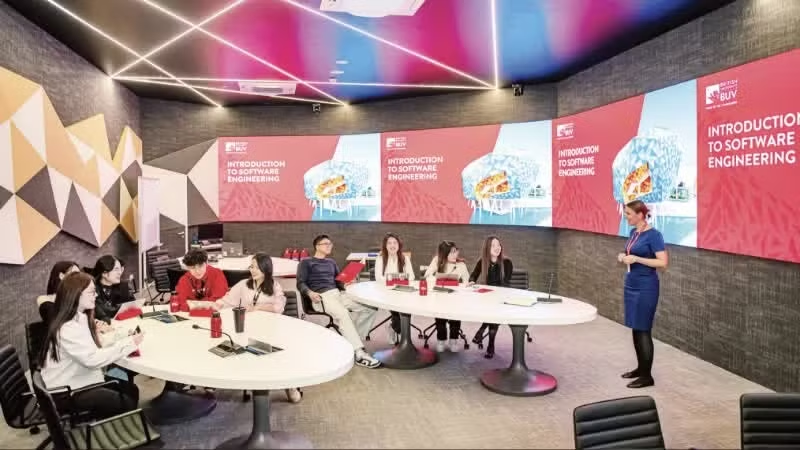
Since 2022, 100% of the university’s foundational English classes have been taught on digital platforms. Students are supported by modern learning materials and online tools, enabling them to experience high-quality education and study specialised subjects in English from an early stage.
Recent admission results at Ha Noi University of Science and Technology have shown many positive signs. The proportion of students holding international foreign language certificates increased from 16.8% in cohort K67 to 24.6% in K68, reaching 33.7% in K69 and continuing to rise to 44% in K70. IELTS scores have also improved significantly, with the number of students achieving 7.5 or higher increasing rapidly.
This advantage allows many students to be exempt from foundational English courses and more easily access full English-medium training programmes. The project “Developing English as a second language at Ha Noi University of Science and Technology for the 2025–2035 period, with a vision to 2045” is currently being developed with the goal of creating an environment in which English becomes a daily academic and communication tool for students and lecturers.
Associate Professor and Doctor Nguyen To Chung, Rector of the School of Languages and Social Sciences under Phenikaa University, said that the use of English in teaching has been implemented at various levels and is gradually becoming an important component of the university’s development strategy.
In engineering, medicine and pharmacy, economics, and information technology programmes, foreign language graduation standards are generally designed at Level 3/6 of Viet Nam’s six-level foreign language proficiency framework, while some specialised programmes aim for Level 4/6 or higher. In the English Language programme, more than 80% of courses are taught in English, while over 90% of courses in the master’s programme in English Language are delivered entirely in English.
In addition, policies encouraging students with international English certificates such as IELTS 6.0 or above through bonus admission points or entrance scholarships (applied during 2019–2024) have contributed to a sharp rise in the number of applicants holding international certificates each year. According to university statistics, the number of first-year students with international English certificates increased by 180% in 2023 compared with 2022 and continued to rise by 395% in 2025 compared with 2024.
According to Dang Van Huan, Deputy Director General of the Higher Education Department under the Ministry of Education and Training, the ministry surveyed 92 institutions, including 84 universities and eight pedagogical colleges. The results showed that for English Language programmes, the number of training programmes increased from 70 in the 2022–2023 academic year to 75 in the 2024–2025 academic year, while student enrolment rose from 40,981 to 45,440.
For programmes in other disciplines taught in English, the number of programmes increased from 324 to 399, with student enrolment rising from 78,267 to 82,413 students. Programmes with enhanced English instruction recorded the strongest growth, increasing from 117 to 224 programmes. These figures demonstrate that higher education institutions are accelerating internationalisation efforts and focusing on developing English-medium programmes.
Addressing bottlenecks in implementation
According to the Ministry of Education and Training, the process of making English a second language in higher education still faces numerous challenges, including issues related to lecturers, teachers, facilities, learning environments, and management, requiring suitable approaches, cautious roadmaps, and synchronised solutions.
Associate Professor and Doctor Vu Thi Thanh Nha of the University of Languages and International Studies under Viet Nam National University, Ha Noi, believes that the English proficiency of both teachers and learners remains one of the biggest challenges. In addition, shortages of teaching and learning materials, assessment tools, and regional disparities also create significant barriers.
Nguyen Thi Mai Huu, Head of the National Foreign Languages Project Management Board, stressed that implementing English as a second language in schools must be properly understood in nature, follow an appropriate roadmap, and focus on improving education quality rather than merely pursuing bilingual forms.
The project “Making English a second language in schools for the 2025–2035 period, with a vision to 2045” does not require all schools to immediately adopt bilingual teaching. Instead, it aims to support educational institutions in gradually building English-speaking environments suited to their actual conditions.
The project will focus on three main tasks: continuing to improve the quality of English teaching and learning as a subject; gradually teaching some other subjects in English; and building English communication and working environments within schools.
“Not all subjects need to be taught entirely in English. Even implementing certain content, activities, or academic exchanges in English can be considered an important first step in creating a regular and effective English-using educational environment,” Doctor Nguyen Thi Mai Huu said.
Vu Thanh Mai, Deputy Head of the Party Central Committee’s Commission for Information, Education, and Mass Mobilisation, affirmed that Resolution No. 71 has created a fundamental shift from teaching and learning English as a subject to using English as a tool for knowledge development and working in a global environment. This is regarded as an important orientation for improving the quality of human resources and meeting the demands of international integration in the new period.