Forming an ecosystem for using English
In recent years, in Lang Son province, the quality of English teaching and learning has been improved in a comprehensive manner across listening, speaking, reading, writing, grammar and language knowledge. In the 2025–2026 academic year, the whole province has 79 preschools, more than 12,800 pupils in Grades 1 and 2 at 92 schools introduced to English; more than 43,000 primary school pupils, more than 56,000 lower secondary students and more than 25,000 upper secondary students study compulsory English under the 2018 General Education Programme.
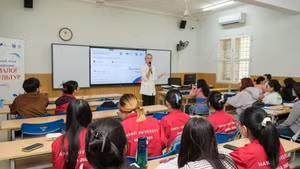
Deputy Director of the Department of Education and Training Phan My Hanh said: “We require educational institutions to organise diverse experiential activities and build an environment for using foreign languages in schools so that students have opportunities to demonstrate their abilities through school-level clubs, foreign language festivals, English exchanges or connected lessons both within and outside the province.”
In addition, English teaching has been innovated in terms of content, curriculum, teaching methods, assessment and evaluation through digital transformation, the use of technology, artificial intelligence and digital learning materials. Pilot models have been developed with the role of “core units”, creating a premise for expansion across the province.
As one of six pilot units implementing the project, Vinh Trai Lower Secondary School organised a model Chemistry lesson taught in English in a very lively manner. “Because we communicate and interact entirely in English with the teacher, the lesson becomes very interesting. Through that, we both acquire knowledge and practise listening, speaking and thinking in English,” said Tran Nam Trung, a student of class 8A10.
According to Meritorious Teacher Dang Tuan Cuong, Principal of Vinh Trai Lower Secondary School, from the beginning of the 2025–2026 academic year, the school has trained 100% of teachers in all subjects to build a foundation of English knowledge, especially specialised English. Mathematics, Informatics and Natural Sciences subjects will integrate English teaching content at 10% of lesson time per week. By 2030, each Mathematics, Informatics and Natural Sciences teacher will teach 30% of lessons each year that are prepared and delivered entirely in English.
In addition, the school has implemented the “English Radio – Vinh Trai Voice” project entirely in English, broadcasting for 10 minutes every Monday, Wednesday and Friday morning, with content introducing local scenic spots compiled by students themselves. During break times, students also participate in activities and games using English to improve listening and speaking skills or present STEM products bilingually to develop thinking skills.
Teachers are the key factor
The overall objective of the project is for English to be widely, regularly and effectively used in teaching, communication, management and educational activities in schools. Improving English proficiency does not only come from training and refresher courses of the sector, but each teacher needs to proactively self-study and enhance their own language skills.
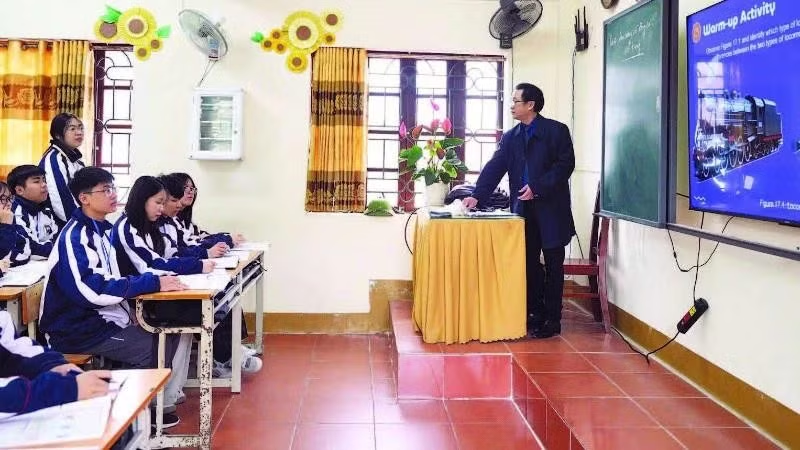
With a proactive and confident mindset, joining in with students, Cao Son Bac, a Technology teacher at Viet Bac High School, actively designs lessons in English. Bac shared that the teaching method is not to “force” students to immediately understand all complex vocabulary. Before the lesson, the teacher and students learn basic technical terms together. According to Bac, the greatest advantage is that students today have a good English foundation, so they are ready to help correct the teacher’s pronunciation and grammar.
Nong Gia Huy, a student of class 11A10 at Viet Bac High School, said: “At first, we were quite worried because this is a technical subject with many specialised terms, so it is difficult to teach in English. In fact, the teacher applies artificial intelligence and information technology to design electronic lessons with visual images, diagrams and vivid comparison tables, helping us absorb knowledge more effectively.”
The project has also helped many teachers in Lang Son remove their hesitation, bravely step out of their “comfort zone” and gradually master English proficiency in teaching. With a spirit of willingness to learn, many teachers have actively sought learning materials and practised communication with students and colleagues with foreign language expertise, thereby significantly improving their English usage skills.