Building and refining digital data systems
Where lessons once revolved around teachers delivering lectures and students taking notes, today’s classrooms have changed significantly. Nguyen Thi Thuy An, a teacher at Quang Trung Secondary School, said that the use of software such as Plickers and Wordwall has created new forms of interaction. In the opening minutes of a lesson, instead of orally questioning a few students, the entire class can participate in answering multiple-choice questions. Results are displayed instantly, enabling teachers to gauge each student’s level of understanding. “Students are very enthusiastic. They get involved and can express themselves, making lessons far more dynamic,” An shared.
Beyond enhancing interaction, technology also provides teachers with data to adjust their teaching methods. Rather than relying on general impressions, teachers can clearly see how many students selected the correct answers and how many still have misconceptions.
However, not all tools are easy to access. Applications requiring flexible operation across multiple devices remain challenging for some teachers. As a result, schools have adopted a flexible approach, offering multiple options so that each teacher can choose tools suited to their abilities.
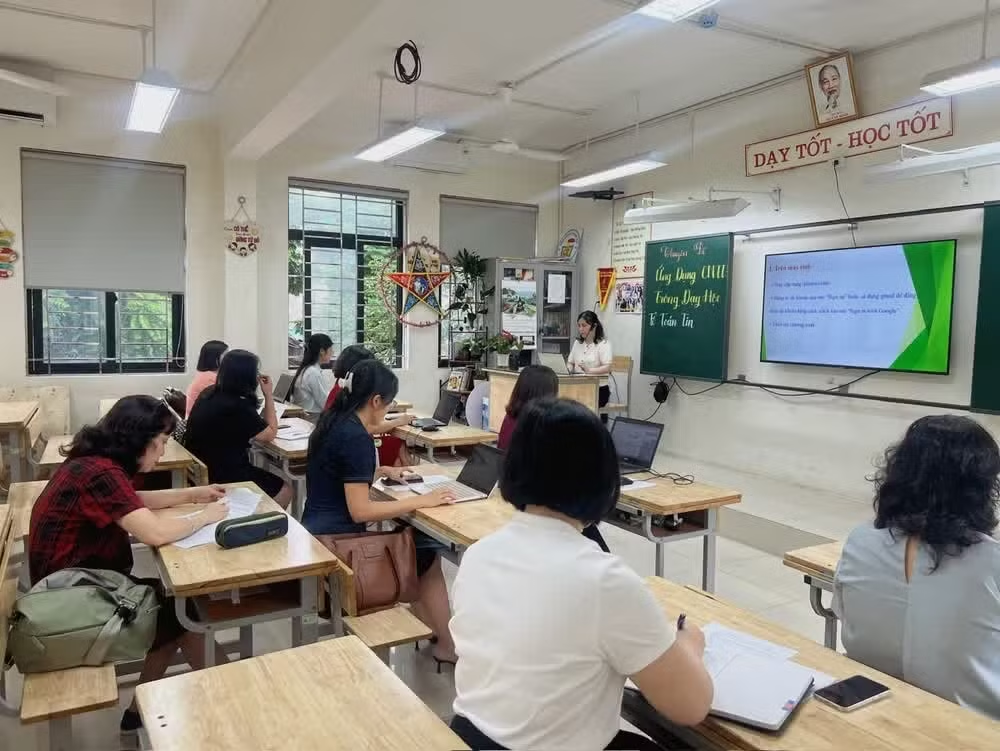
From a broader perspective, digital transformation is placing students at the centre of the learning process. They are no longer passive recipients but active participants who engage, interact, and provide feedback in every lesson. Nguyen Minh Hoai, Vice Principal of Quang Trung Secondary School, said the process is being implemented in a coordinated yet cautious manner, following clear, step-by-step measures. The first step is training: teachers not only receive theoretical instruction but are also given hands-on guidance so they can apply the tools immediately.
“The school considers digital transformation a mandatory requirement. However, we are not implementing it hastily; instead, we are following a roadmap step by step to ensure effectiveness,” Hoai said.
Teacher records and documentation, once paper-based, have been moved to digital platforms. From teaching schedules and lesson plans to instructional content, everything is digitised, encrypted, and centrally stored. With a single action, administrators can review all information instead of searching through individual record books as before.
Notably, the introduction of an “academic administration” model as a focal point responsible for data systems highlights that digital transformation is not merely about technology, but also about organisational change and operational methods.
Infrastructure challenges and adaptive capacity
According to Ha Tien Vien, Head of Informatics at Quang Trung Secondary School, the school has implemented management software that enables real-time monitoring of students’ learning and activities. From attendance tracking via cards or facial recognition to automatic notifications sent to parents’ phones, all information is updated promptly.
“Whenever students arrive at or leave school, parents receive instant notifications. This makes management far more transparent and accurate,” Vien said. Administrative procedures such as leave requests and communication between teachers and parents are also conducted online. Tasks that previously required face-to-face meetings can now be handled quickly through applications.
In special situations — such as switching to online learning due to weather conditions or disease outbreaks — these systems continue to prove effective. Students adapt quickly, and learning is not disrupted.
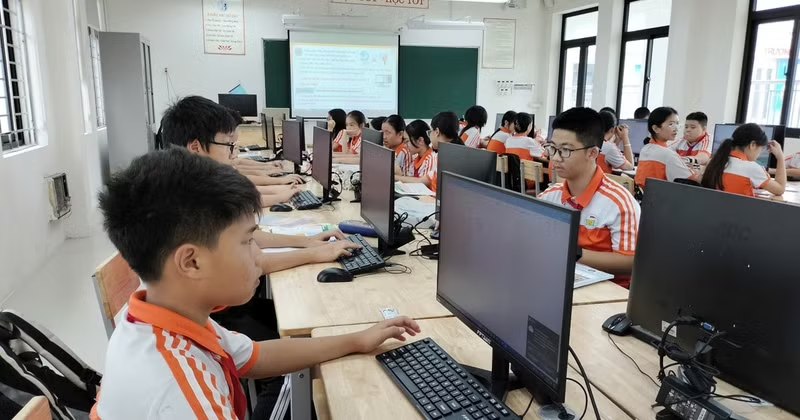
Despite positive results, digital transformation in education still faces considerable challenges. In practice, the most significant limitation remains infrastructure. The number of computer labs is still limited, and equipment does not yet meet requirements, particularly for subjects requiring hands-on practice. Sharing computers between two students reduces individual learning time.
In addition, the rapid pace of technological change places pressure on educational institutions. Vu Chi Thanh, Principal of FPT Polytechnic College, noted that the challenge lies not only in teaching tools but, more importantly, in cultivating an adaptive mindset among learners. In a constantly evolving technological landscape, students need to develop self-learning abilities, flexibility, and readiness to adapt to labour market changes. This, he emphasised, is the sustainable value that digital education aims to achieve.
From a ground-level perspective, it is clear that when used appropriately, technology does not diminish the role of teachers; rather, it enables them to better understand their students and teach more effectively. In this way, classrooms become not merely places for knowledge transmission but spaces for interaction, creativity, and development.
For digital transformation in education to succeed, it is essential to first change mindsets and implementation methods, ensuring synchronisation at every stage — from management to practical deployment — in order to generate real impact. Ultimately, digital transformation in education is not simply about applying technology, but about fundamentally reshaping thinking, teaching approaches, and management practices towards a modern, flexible education system suited to the new context.