Elite education: From scale to quality
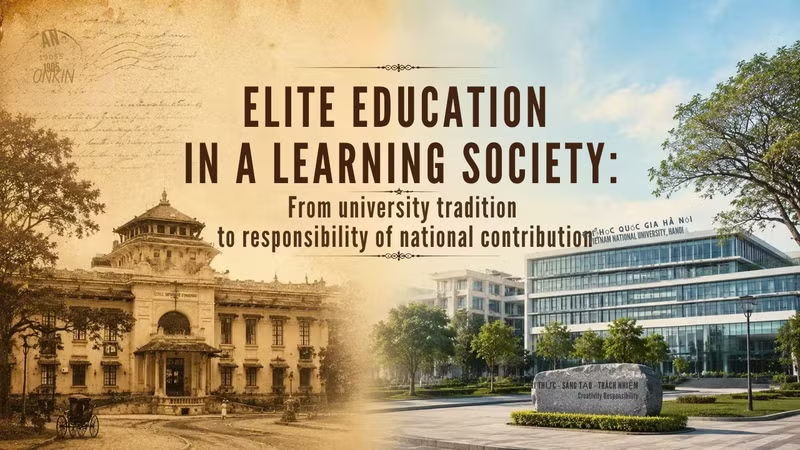
The 120th anniversary of the Indochina University - the predecessor of Viet Nam National University, Ha Noi - is not only a milestone in Vietnamese higher education but also an opportunity to revisit a fundamental question: what is the ultimate purpose of educating people? Since the establishment of the Indochina University on May 16, 1906, higher education has always been associated with the requirements of each stage of national development. During wartime, it was about training cadres and intellectuals to serve the resistance; in peacetime, it was about training human resources for development; and today, as competition increasingly centres on knowledge, technology, and innovation, the requirements have become more direct and concrete.
The scale of the current education system has expanded significantly. By 2024, the country had more than 240 higher education institutions with over 2.35 million students. This marks major progress in terms of access to opportunities. However, in the new stage of development, the benchmark no longer lies in scale but in the quality of human resources after graduation.
Reality shows that there remains a rather clear gap between academic achievement and practical capability. A person who studies well may not necessarily perform well at work; someone with high academic qualifications may not necessarily create commensurate value. Once outside the classroom, learners are no longer assessed by grades but by their ability to solve real-life problems.
This requires a strong shift from education focused mainly on transmitting knowledge to education linked with practical competence.
In this context, the trend among research universities has become increasingly clear: elite education must be associated with research and innovation. In its development strategy for 2026–2035, with a vision towards 2045, Viet Nam National University, Ha Noi, identifies “excellent research associated with elite education” as a strategic pillar. Strong research groups and modern laboratories not only generate new knowledge but also serve as training environments where learners develop independent thinking, experimental capability, and problem-solving skills.
In recent years, the quality of higher education has gradually improved. By 2024, around 86% of higher education institutions had met quality accreditation standards; the proportion of lecturers holding doctoral degrees increased from around 11% in 2011 to nearly 39%. This indicates that Vietnamese higher education is gradually shifting from the stage of expanding scale to improving quality and research capacity.
From this, it can clearly be seen that elite education cannot stop at producing talented individuals but must aim towards the capacity for genuine contribution to society.
Education cannot be closed off: From schools to a learning society
An important transformation in modern educational thinking is the shift from “education within schools” to “education throughout society.”
Party Resolution No. 29-NQ/TW in 2013 on “fundamental and comprehensive reform of education and training to meet the requirements of industrialisation and modernisation under a socialist-oriented market economy and international integration” identified the goal of building a learning society. The prime minister’s issuance of Decision No. 1373/QD-TTg in 2021 concretised the policy of lifelong learning. Politburo Resolution No. 71-NQ/TW in 2025 on breakthroughs in education and training development further emphasised the requirement of linking education with reality and developing high-quality human resources. This orientation was reaffirmed in the documents of the 14th National Party Congress with the requirement to rapidly develop human resources, especially high-quality human resources.
In the current development orientation, the requirement to build a learning society continued to be emphasised by General Secretary To Lam at the ceremony commemorating the 80th anniversary of the education and training sector and the opening of the 2025-2026 academic year: “Learning is not only a personal need, it must first be viewed as a political responsibility, a constant revolutionary action of every citizen.” At the same time, people must “learn to master knowledge and technology, learn to develop themselves and contribute to building a strong and prosperous nation.”
These orientations clearly show that education cannot be confined within schools. Knowledge may be acquired in classrooms, but capability is formed only through practice. A degree obtained after graduation cannot guarantee effective working ability.
According to international studies, the gap between training and labour market demand remains a notable issue. The Viet Nam Development Report by the World Bank shows that employers increasingly demand higher cognitive, behavioural, and technical skills from workers. Meanwhile, according to data from the General Statistics Office in 2024, the proportion of workers holding formal qualifications or certificates reached only around 28%, reflecting limitations in the quality of human resources compared with development requirements.
On the other hand, the private economic sector currently has more than 940,000 active enterprises, contributing around 50% of GDP and creating more than 80% of jobs in the economy (according to Politburo Resolution No. 68-NQ/TW on Private Sector Economic Development). This places enormous demands on human resources capable of working immediately, adapting quickly, and generating practical value. The gap between training and utilisation is therefore no longer solely an issue of education but one affecting the entire development system.
Reality also shows that when education is linked with enterprises and real working environments, the transformation of knowledge into capability occurs more quickly and substantively. This confirms that education does not end when students leave university but continues throughout social life.
In journalism, this is particularly evident. No training institution can fully “complete” journalism education within classrooms. A reporter only truly matures when entering a newsroom, participating in the daily flow of information and facing pressure related to time, accuracy, and social responsibility. Newspaper headquarters therefore serve both as places of employment and as training environment. Editors, editorial secretaries, readers’ feedback, and public opinion all participate in the process of “professional training.” Journalism is one of the fields in which society directly and continuously participates in educating individuals.
Another example is the TechLab model at the University of Technology Sydney, where enterprises, universities, and government jointly participate in research and education. Students work with real equipment, real data, and real-world problems throughout their studies.
In Viet Nam, similar cooperative models are gradually taking shape but are not yet strong enough to create a large-scale ecosystem for transforming knowledge.
The environment also determines the speed of human development. People develop more quickly in places that value capability, transparency, and creativity. Conversely, if motivation and clear standards are lacking, capability can easily deteriorate.
It can be said briefly: schools lay the foundation, while society determines the real value of individuals.
Elite individuals must be proven through contribution
“Elite” cannot be measured solely by academic achievement. In the current context, where development increasingly relies on creativity and problem-solving capability, the criteria for evaluating people must also change. Learners who excel academically but fail to create practical value still have limited social impact.
Resolution No. 29 sets the goal of comprehensive human development. Resolution No. 71 emphasises the development of high-quality human resources capable of mastering technology. Therefore, the ultimate measure of education must be the ability to contribute.
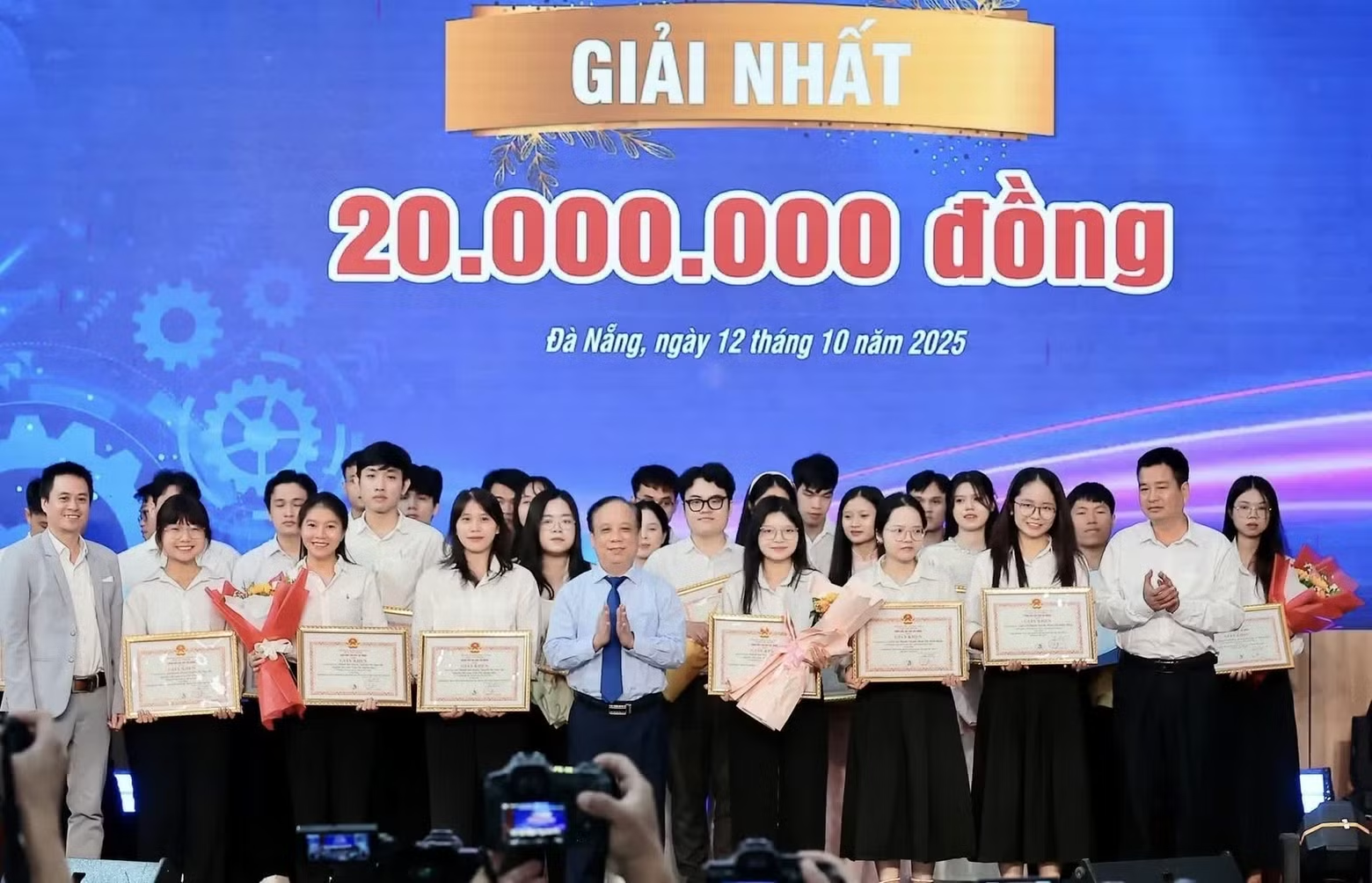
The reality of renovation has demonstrated the particularly important role of elite intellectuals, those making concrete contributions to national development. Their prestige is established not through titles but through achievements and dedication.
The country’s development during the renewal period has also shown another important aspect of elite intellectuals: they are not only creators of knowledge but also force direct participation in policy formulation and leadership. During many periods, groups of experts, scientists, and managers formed policy advisory groups (think tanks), contributing scientific arguments, criticism, and policy recommendations to the Party and the State. This is a concrete manifestation of knowledge entering real life and transforming into governance and national development capability.
From this perspective, the requirements for elite education also become clearer: it must not only form professionally outstanding individuals but also build a team of intellectuals capable of helping solve the country’s major challenges.
Therefore, the issue no longer stops at education but shifts towards utilisation and promotion. Without environments where intellectuals can maximise their abilities, and without mechanisms to recognise and utilise talent, even the most systematic training process will struggle to generate substantive results.
Current realities also raise many concerns, such as shortages of leading experts, gaps in successor generations, limited investment in science and education, and insufficiently strong mechanisms for utilising talent. According to education sector data, by 2024 Viet Nam had an average of only around 6.27 professors and associate professors per 10,000 people — a figure illustrating the enormous pressure in building a highly qualified intellectual workforce for the new stage of development.
In every field, the ultimate measure of value returns to practical effectiveness. In journalism, that means journalistic works and their social impact. Many reporters mature rapidly not because they were the best students but because they were placed in real working environments, assigned difficult tasks, and required to take responsibility before the public.
President Ho Chi Minh once taught to study to work, to be a good person, to be a cadre. Study to serve organisations, to serve the class and the people, and to serve the Fatherland and humanity. In the current context, this requirement has become even clearer: study in order to act. In new technological fields, this gap is even more apparent. Many technology enterprises today face difficulties recruiting personnel with suitable skills in fields such as artificial intelligence, big data and semiconductors. These realities all point to one common fact: knowledge is only the starting point, while value lies in the capacity for action.
In the country’s development process, higher education not only transmits knowledge but also prepares people for major responsibilities. Yet that preparation is only truly complete when it continues throughout social life.
Looking back at the 120-year development of the Indochina University — Viet Nam National University, Ha Noi — one can see a consistent principle: education only truly has meaning when linked to the destiny of the nation. Education must not stop at knowledge but must move towards action; education must not stop at producing talented people but must aim at producing useful people.
Elite individuals are not those standing above society but those making significant contributions to society.