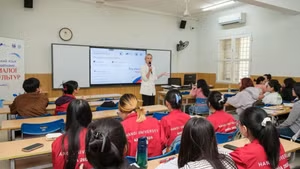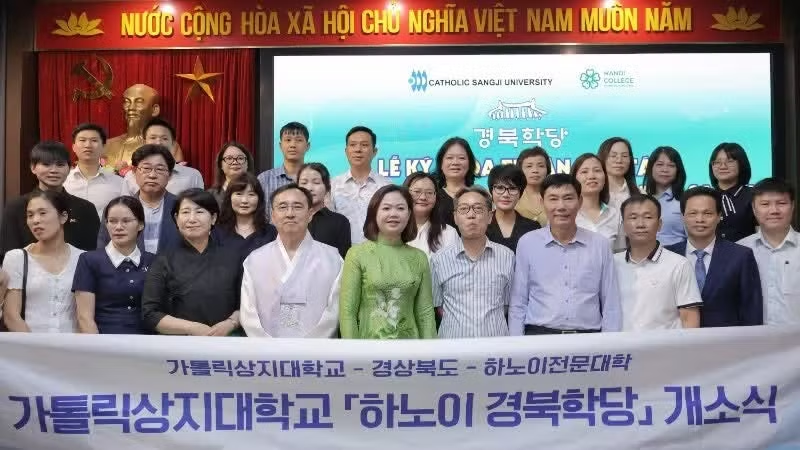
This strategic vision has now been realised through the launch of the Gyeongbuk Academy model. The programme is a training cooperation initiative between Ha Noi College (HNC) and Catholic Sangji University of the RoK.
With the advantage of having thousands of students currently studying at its Korean Language Faculty, together with its application-oriented and career-focused training approach, HNC fully meets the stringent criteria required to become the pioneering partner for this new-generation “public study abroad” model directly sponsored by the Gyeongsangbuk-do provincial government.
What distinguishes this model is that students not only receive completely free language training, but are also equipped with adaptation skills for life in the RoK through the “Gyeongbuk Studies” programme, which provides in-depth understanding of local culture, lifestyle and industrial ecosystems. The training pathway is designed as a launch pad helping learners smoothly transition to the regional special visa (F-2-R) and skilled worker visa (E-7), thereby opening up employment opportunities with remuneration equivalent to that of local workers.
Through this closed-loop training model, Gyeongbuk Academy aims at three core objectives: providing high-standard vocational training; creating a safe study-abroad pathway; and supporting long-term settlement linked to employment. In particular, learners participating in the programme will have access to scholarship funds and training sponsorship programmes provided by Gyeongsangbuk-do Province.
Professor Kim Yang-hee, Head of the Global Korean Language Department at Catholic Sangji University, said this was the first time the RoK had implemented such a public study-abroad model. The programme will comprehensively address shortcomings currently seen at private study-abroad centres, notably information asymmetry, inflated costs and, in particular, the disconnect between training and actual labour market demand in the RoK.
The Gyeongbuk Academy initiative not only marks the beginning of a long-term educational cooperation strategy, but also serves as vivid evidence of a new trend in the Viet Nam–RoK Comprehensive Strategic Partnership. That relationship is now extending far beyond trade cooperation and investment attraction, shifting strongly towards human development and contributing sustainable value to both countries.