Creating “pockets of excellence”
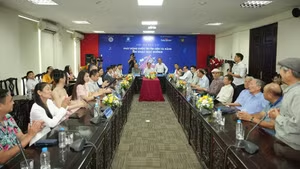
At the seminar “Developing elite and excellent university models in Viet Nam in the context of implementing Resolution No. 71-NQ/TW, the higher education development strategy, and the higher education institution network plan”, Deputy Minister of Education and Training Le Quan emphasised that, in the period ahead, “quality” must become an inherent value of higher education. Quality cannot simply be determined independently by individual universities, but must move towards standards that meet Viet Nam’s development requirements and international expectations.
This requirement stems from a compelling reality: although the proportion of students graduating with good academic results is high, some graduates remain unemployed, work outside their field of study, or fail to realise their full potential. Degrees can therefore no longer serve as a sufficient measure of the quality of education. What matters more is what learners are able to do after entering the labour market.
For elite, excellent, and key institutions, this requirement is even more pronounced. Admission and graduation standards, curricula, and quality assurance conditions must be established from the outset, in line with the mission and fields each university chooses to pursue.
The Ministry of Education and Training plans to develop a set of criteria for screening and selecting higher education institutions by group. Universities will be able to proactively register and choose areas of strength for development, while the State will assign tasks to institutions with a leading role based on their missions, strategies, and planning. Notably, the Ministry does not envision a rigid set of criteria applied uniformly to all institutions, but is taking into account the 2026–2030 period, during which each institution can identify its areas of strength and develop “pockets of excellence” within the system.
This represents a shift from a model of uniform development towards one centred on strategic priorities. Under the Higher Education Development Strategy for 2026–2035, with a vision to 2045, the system will move from fragmented and dispersed development towards a national higher education ecosystem linking educational institutions with research institutes, businesses, local authorities, and international partners.
Under the proposed model, the elite group would comprise around three to five institutions, focusing on cutting-edge research, international competition, and core innovation; the key group would include around 25–30 institutions responsible for training high-quality human resources and leading development in regions and sectors; while other institutions would focus on vocational and practice-oriented training. The tiered system would be linked to missions, objectives, KPIs, resources, and outputs, based on the principle that greater autonomy must be accompanied by greater accountability.
Deputy Minister Le Quan also noted that developing elite universities is not a matter confined to the two Viet Nam national universities. Many institutions can rise to the challenge if they identify their strengths correctly. The issue is to concentrate resources on strategic priorities rather than distribute them evenly, thereby creating centres of excellence and key fields of expertise. The State’s assignment of tasks must also be accompanied by corresponding mechanisms, policies, and resources.
Measured by quality and impact
Vietnam National University, Ha Noi (VNU) is gradually transforming itself towards an elite university model, building on a talent-development foundation established over many years. According to Dao Thanh Truong, Deputy Director of VNU, the university is formulating a scheme to nurture talented human resources from upper secondary school, including studying the introduction of selected university-level modules into secondary education to create greater continuity between the two levels.
At undergraduate level, numerous talent, advanced, international-standard, and high-quality programmes, as well as interdisciplinary programmes in core technologies and semiconductor technology, have been implemented. At postgraduate level, training is linked to cutting-edge research through 48 strong research groups. Since 2021, VNU has offered annual scholarships of 100–120 million VND to outstanding PhD candidates and research interns, later expanding the scheme to 12 training units.
According to Dao Thanh Truong, moving towards an elite university represents a qualitative transformation: from fragmentation to integrating the strength of the entire system; from expanding scale to prioritising quality and talent development; and from academic outcomes to social impact. The “One VNU” model, with shared resources at Hoa Lac, has been recognised as an important foundation for this process.
Accordingly, an elite university must generate new knowledge, develop strategic technologies, and help to establish new standards for society. Quality must become part of academic culture, built on the values of integrity, collaboration, autonomy, and excellence. More importantly, such universities should not become privileged “islands”, but should act as leading institutions, experiment with new models, share knowledge infrastructure, and spread their values throughout the wider system.
To achieve this, Prof., PhD Chu Duc Trinh stated a “new compact” was needed: the State should grant universities autonomy, trust, and targeted investment resources, while universities should commit to achieving international standards of quality and take responsibility for their performance.
Concentrating resources and removing bottlenecks
Resources are among the critical factors determining whether elite universities can be established. The higher education system has expanded rapidly in scale, but resources for research, talent attraction, laboratories, and innovation remain fragmented.
Assoc Prof., PhD Vo Van Minh, Rector of the University of Education under the University of Danang, asserted building elite universities was a necessary direction amid increasingly knowledge-, science- and technology-, and innovation-driven competition between countries. This is not merely a task for the education sector, but is directly linked to national competitiveness and standing.
Viet Nam has advantageous foundations for achieving this goal, from strong political commitment to science, technology, innovation, and high-quality human resources, to an increasingly dynamic pool of lecturers and young scientists, and strong capacity for international integration. Vietnamese students are also able to adapt quickly to new technologies.
However, according to Assoc Prof., PhD Vo Van Minh, major bottlenecks remain in the institutional framework and mechanisms for university development. University autonomy is not yet fully aligned, investment in research and innovation remains fragmented, and mechanisms for attracting and rewarding talent are not strong enough to create an academic environment of international standing. Many universities still have to allocate most of their resources to student recruitment and teaching, while lacking adequate conditions for investment in research and innovation ecosystems.
Internationalisation is another important measure. Dr Le Mai Lan, Chairwoman of the Council of VinUniversity, noted Viet Nam currently has around 250,000 Vietnamese studying overseas, while only about 22,000 international students come to study in Viet Nam. The cost of sending Vietnamese students abroad is estimated at 4–5 billion USD a year. She emphasised internationalisation should focus on attracting talent, co-training, joint research, and generating knowledge capable of having an international impact.
These figures demonstrate that the challenge facing elite universities goes beyond rankings. It is also about retaining talent, attracting international scientists and students, and creating an environment attractive enough for knowledge to be generated, connected, and transformed into value.
Innovation must therefore be placed at the centre. The Ministry of Education and Training has requested universities to review their capabilities, identify development directions, and proactively register to join the elite university or key/excellent university groups, or develop centres of excellence. Universities must also restructure their curricula, integrate AI and core technologies, and reform teaching methods towards practical, project-based learning and research.
Assoc Prof., PhD Vo Van Minh proposed that the State provide targeted, long-term investment to universities with the potential to lead, while granting them genuine autonomy in academic, organisational, financial, and human-resource matters. Universities, for their part, need to change their development mindset, cultivate an academic culture, promote interdisciplinary research, strengthen links with businesses, attract talent, and create an environment that encourages innovation.