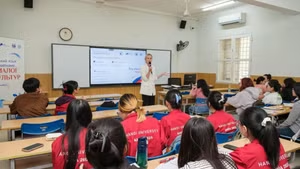
In response to actual workforce needs, the University of Da Nang works with businesses to develop and adjust training programmes and learning outcomes. Deputy Head in charge of Student Affairs, Business Relations, and Communications at the University of Da Nang Dr Huynh Minh Son said the university was proactively introducing new degree programmes, with a focus on the digital industry. It also consults businesses and experts to assess workforce supply and demand, refining curricula and academic benchmarks.
In the first six months of 2026, the University of Da Nang signed and implemented a further 132 memoranda of understanding and co-operation agreements with businesses, including 42 domestic and international engineering and technology enterprises. To date, the university has established partnerships with more than 350 organisations and businesses, encompassing nearly 170 domestic and foreign technology firms.
Member universities are increasing the time allocated to practical training and internships at businesses, inviting industry experts to supervise graduation projects, and aligning some training programmes with workforce needs in high-tech parks, commercial zones, and foreign-invested enterprises in Viet Nam.
One notable example is the “Learn and Work” programme jointly run by the University of Da Nang, CT Group, and the Management Board of Da Nang Hi-Tech Park and Industrial Zones. The programme aims to bridge the gap between university education and practical experience, enabling students to gain exposure to modern industrial production environments while studying.
This is not an isolated example. Several commissioned training models have demonstrated their potential to link education with employment and workforce demand. Nha Trang University and Minh Phu Group operate a five-year commissioned training programme worth approximately 50 billion VND. Meanwhile, the Co-op model at Tra Vinh University has attracted 2,188 students, who alternate between academic study and eight to 12 months of work at businesses.
According to Deputy Director General of the Department of Science, Technology and Information under the Ministry of Education and Training Tran Nam Tu, co-operation between the State, universities, and businesses is no longer optional but a prerequisite for improving the quality of education, research, and innovation. Training must closely reflect labour market demand, research must address practical challenges, and research outputs must be geared towards application and commercialisation. The approach needs to shift from focusing on “what we have” to “what the country and businesses need”.
While businesses at the University of Da Nang are visibly involved in workforce training, at the Banking Academy this relationship extends to entrepreneurship and innovation. Director of the Centre for Entrepreneurship and Innovation Support at the Banking Academy Dr Le Thi Minh Ngoc said businesses should not merely serve as employers for graduates but should become active participants in managing the process through which learners develop their capabilities. The effectiveness of partnerships should therefore be measured not simply by the number of agreements signed or events held, but by the extent of business involvement and the tangible results achieved. However, Dr Ngoc noted that entrepreneurship and innovation activities remained fragmented. Many programmes were still limited to competitions and events, without fully developed links between research, education, businesses, and investors.
One major bottleneck is the difference in priorities and operating methods. Universities tend to pursue long-term academic activities, while businesses need practical results in a shorter timeframe. The University of Da Nang has proposed improving mechanisms to give businesses greater incentives to invest in training, research, laboratories, and scholarships, while enabling universities and businesses to share facilities and exchange experts and lecturers. More importantly, businesses need to be involved from the outset, including in forecasting workforce demand, commissioning training, developing curricula, conducting research, and transferring technology. Universities must connect education and research with practical challenges, thereby producing graduates and research outputs that meet market needs.
This requirement is becoming increasingly pressing as new technology sectors develop rapidly. According to Deputy Minister of Education and Training Le Quan, amid digital transformation and accelerating technological change, graduates must possess the capabilities needed to meet businesses’ evolving requirements. Businesses, meanwhile, are no longer relying solely on traditional recruitment methods but are actively partnering with educational institutions to secure a highly skilled workforce.
Artificial intelligence, digital transformation, quantum technology, and materials science are creating demand for personnel in research, innovation, organisation, and operations. At the same time, universities must address a range of challenges when launching new degree programmes and organising training, including curriculum development, technical infrastructure, intellectual property, practical training equipment, and teaching staff. Training programmes should be designed in modules so that learners master specific technological skills and competencies after each stage. Businesses can work with universities to design curricula, share technology, train lecturers, and organise practical learning, while students gain experience through real-world projects and assignments.
The challenge, therefore, is not simply to increase the number of partnership programmes, but to change how universities and businesses collaborate to create value. Universities need to understand what businesses require, businesses must become more deeply involved in education and training, and the State must establish the framework and mechanisms needed to bring these resources together.