Inevitable shifts
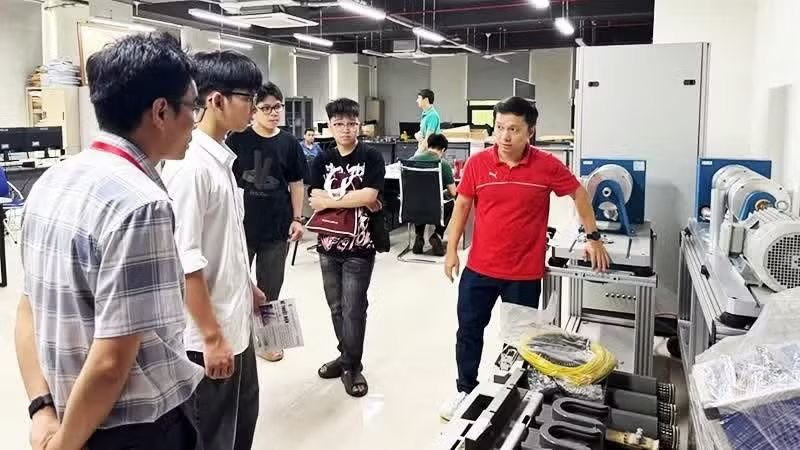
At Ha Noi University of Science and Technology, the research university model has been promoted more vigorously following the implementation of autonomy. The university has continuously introduced new disciplines such as artificial intelligence, data science, semiconductor engineering, and cyber security, while also investing heavily in laboratories and innovation centres. Under its development strategy towards 2030, the university plans to establish 30 new teaching laboratories and 30 research laboratories in strategic technology sectors.
Scientific research and technology transfer activities have also recorded notable progress. In recent years, Ha Noi University of Science and Technology has maintained around 1,500–1,600 international publications annually, placing it among the higher education institutions with the highest number of international publications nationwide. Revenue from science and technology activities in 2024 (announced at the end of 2025) exceeded 101 billion VND (3.8 million USD), while the university’s total revenue surpassed 1.5 trillion VND (57 million USD). Student enrolment reached nearly 44,000, the highest level in the past five years.
Associate Professor Dr Huynh Quyet Thang, Director of Ha Noi University of Science and Technology, said that the core value of autonomy lies in creating momentum for comprehensive institutional reform, enabling lecturers to maximise their research and technology transfer capabilities.
Meanwhile, National Economics University has utilised the autonomy mechanism to reform its training programmes in line with labour market demands. Courses such as digital business, fintech, e-commerce, and business data analytics were introduced relatively early. The university has also expanded English-language programmes, strengthened international cooperation, and enhanced partnerships with businesses in practical training.
At Foreign Trade University, autonomy has enabled greater flexibility in recruiting high-quality personnel, developing international joint programmes, and fostering a start-up ecosystem among students. In recent years, the university has focused on emerging fields such as international logistics, the digital economy, and sustainable business, with numerous student start-up groups winning awards both domestically and internationally.
Beyond major universities, cooperation models between universities and businesses are also becoming increasingly common. Some companies are participating in curriculum development, sending specialists to teach, or collaborating on research projects. From a governance perspective, many universities are also shifting towards management models based on data and digital technology. Although these developments have yet to create uniform changes across the entire system, they demonstrate that autonomy is generating clear pressure for reform.
From 2026 onwards, university autonomy will enter a new phase as academic, organisational, and financial autonomy is further expanded under the amended Law on Higher Education. This indicates that university autonomy is gradually moving from a pilot mechanism to becoming a mainstream operational model across the system.
Turning universities into centres of innovation
Alongside positive developments, many obstacles in the autonomy process have also become increasingly apparent. In many institutions, autonomy remains largely confined to financial matters, while decision-making powers regarding organisational structures and personnel are still constrained by inconsistencies between various laws. Some universities granted autonomy continue to be bound by regulations applied to ordinary public administrative units in areas such as public investment, asset management, and recruitment.
Some universities are required to become “financially self-sufficient for recurrent expenditure”, yet tuition fees remain capped, while mechanisms to mobilise social investment or develop university endowment funds remain insufficiently robust. As a result, many institutions struggle considerably to secure revenue sources. Autonomy has also widened disparities between universities. Institutions with strong reputations and locations in major cities generally find it easier to attract students, lecturers, and business partnerships. In contrast, many local universities face difficulties in student recruitment and retaining high-quality personnel.
Another issue is that university governance capacity has not kept pace with new requirements. Many educational institutions still operate under an administrative mindset, whereas autonomy requires strategic governance capabilities, financial management, data governance, and academic brand development. Reality has shown that granting autonomy alone is insufficient. Without transparent oversight mechanisms and professional management teams, autonomy can easily be misunderstood as merely increasing tuition fees or chasing “trending” disciplines to generate revenue.
According to Dr Le Viet Khuyen, former Deputy Director General of the Higher Education Department under the Ministry of Education and Training, one of the current shortcomings is that many universities have been granted autonomy without corresponding reforms in public investment, public asset management, and personnel mechanisms. This has left numerous institutions trapped in a state of being “half autonomous, half administrative”, making it difficult to fully realise their reform potential.
Minister of Education and Training Hoang Minh Son has repeatedly stressed that autonomy does not mean “leaving universities entirely to fend for themselves”, but rather aims to create momentum for improving training quality, research, and international competitiveness. According to him, autonomy must go hand in hand with accountability, quality accreditation, and transparent governance, avoiding the simplistic view that autonomy merely means financial autonomy.
Under the orientation of the 14th National Party Congress, university autonomy is closely linked with the modernisation of higher education. This demonstrates that reform is not only about operational mechanisms, but also about training models and the capacity to generate knowledge and innovation.
Many lecturers acknowledge that the current pace of technological change means that textbooks can become outdated within just a few years, or even a few months in certain digital technology fields. Minister Hoang Minh Son once remarked that Viet Nam’s higher education system must transition decisively towards digital universities, innovation-driven universities, and interdisciplinary training.
According to him, universities can no longer continue teaching through a “one-way transmission” model, as much of today’s knowledge may quickly become obsolete within only a few years. This requires training programmes to become more flexible, updated more rapidly, and more closely integrated with science and technology.
However, genuine modernisation requires substantial investment in digital infrastructure, laboratories, academic databases, and research-oriented teaching staff. If universities merely stop at transmitting knowledge, they will struggle to compete in an era of rapidly changing technology. This remains a major gap between many Vietnamese universities and the world’s leading institutions today.
One of the notable goals in the orientation of the 14th National Party Congress is the development of several universities to international standards. This is not simply a matter of rankings or branding. The deeper objective is to establish research centres capable of competing regionally. According to Minister Hoang Minh Son, internationally recognised universities cannot be developed through fragmented investment. What is needed instead are focused investment mechanisms, sufficiently strong policies to attract talented scientists, and a genuinely open academic environment.
Reality shows that a world-class university is not measured solely by physical infrastructure, but by research quality, international publication capacity, the ability to attract global lecturers and students, and contributions to national innovation. To achieve this, many experts believe that multiple bottlenecks must be addressed simultaneously, from financial mechanisms and commissioned research policies to measures aimed at retaining talented scientists.
Drawing on practical experience in implementing autonomy, Associate Professor Dr Huynh Quyet Thang, Director of Ha Noi University of Science and Technology, argued that if universities are to innovate strongly, they must be granted sufficiently flexible mechanisms to proactively invest in strategic technology sectors, attract leading scientists, and deepen cooperation with businesses. According to him, if autonomy rights continue to be fragmented across overlapping regulations, it will be extremely difficult to develop strong research universities or genuine innovation centres.
According to many experts, for the spirit of university autonomy outlined in the documents of the 14th National Party Congress to truly take root in practice, universities must not only be granted genuine authority, but also face pressure to publicly disclose training quality, research effectiveness, and competitiveness. Only then can autonomy become a genuine driver of reform rather than merely a financial challenge.