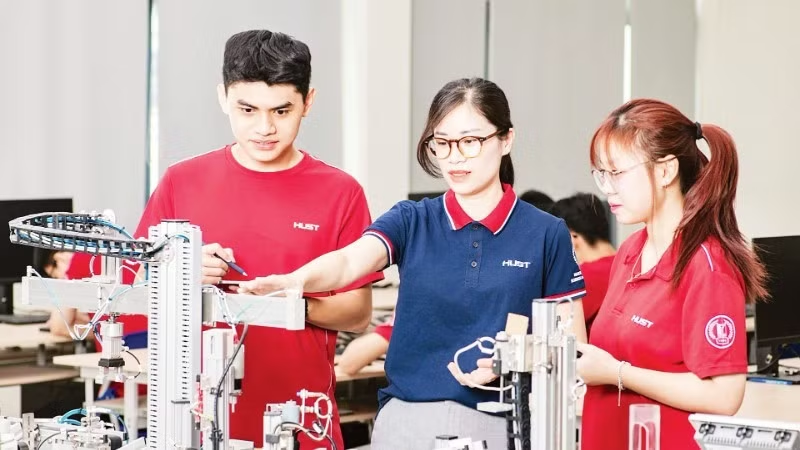
Higher education not only plays a role in training high-quality human resources but also serves as a pillar for leading knowledge and realising the country’s goals of rapid and sustainable development.
Breakthroughs in institutions and governance
The year 2025 marked a significant milestone for higher education as the Ministry of Education and Training submitted the revised Law on Higher Education to the National Assembly for approval. A key new provision of the Law is the termination of university councils and the strengthening of the leadership role of Party organisations within higher education institutions. On that basis, university autonomy is more comprehensively safeguarded, encompassing academic space, personnel, scientific research, innovation, finance and international cooperation.
Current investment policies focus on higher education institutions that meet established standards, raise benchmarks and develop outstanding universities to lead the system, while also creating a level playing field between public and private institutions. The new legal framework opens up opportunities to attract high-calibre lecturers and promotes training closely linked with scientific and technological research.
University autonomy has proven its validity in practice. A notable example is the Foreign Trade University, one of the pioneers of autonomy since 2015. According to its President, Pham Thu Huong, in 2025 the university was listed for the first time in the QS Asia University Rankings, placed 580th among more than 1,500 institutions. This achievement affirms its ambition to join the ranks of Asia’s leading universities, becoming an environment that respects academic freedom, encourages innovative research and delivers training grounded in critical thinking.
The breakthrough of Viet Nam’s higher education sector has also been recognised through the first-time inclusion of 16 higher education institutions in the THE Impact Rankings. Governance reforms have generated new momentum, driving a sharp rise in scientific research—particularly international publications—and placing many universities among the region’s and the world’s leading institutions.
The Ministry of Education and Training has submitted to the Prime Minister the Master Plan for the network of higher education and teacher-training institutions for the 2021–2030 period, with a vision to 2050. Disciplines such as data science and artificial intelligence have been strengthened at institutions including Ha Noi University of Science and Technology and the Foreign Trade University. This shift has been accompanied by strong growth in STEM fields, with the number of candidates registering these disciplines as their first choice rising by 10.5 per cent.
Notably, entry scores for teacher-training programmes, strategic technology disciplines, and science and engineering fields have increased significantly. The proportion of lecturers holding the titles of professor, associate professor or doctoral degrees has surpassed 35 per cent. Alongside rising indicators in scientific publication and technological development across the university system, the number of international scientific publications has increased markedly compared with previous periods.
Higher education as the national centre of knowledge
Reforms in higher education, coupled with strengthened autonomy, have created new momentum, contributing to improved training quality and a sharp increase in scientific research, particularly international publications. The scale and quality of higher education continue to expand, with a positive shift in the structure of training. STEM disciplines, in particular, have recorded substantial growth, exceeding the overall national increase in enrolment, especially in Mathematics and Statistics, Computer Science and Information Technology, Engineering Technology and Engineering at undergraduate, master’s and doctoral levels.
Minister of Education and Training Nguyen Kim Son emphasised that the education sector fully recognises that investment in higher education today is an investment in Viet Nam’s intellect, strength and standing in the future. This is not merely a professional task but also a political responsibility and a national development aspiration. Accordingly, the sector is focusing on enhancing the quality and stature of Viet Nam’s higher education through the standardisation of training programmes in line with international standards, benchmarking against highly ranked universities worldwide. Training is being closely aligned with the development needs of the digital economy, the green economy and strategic technology sectors. In doing so, knowledge and innovation are positioned as the key drivers of national growth.