
Harnessing AI’s potential in universities
In higher education, AI does more than support teaching and administration; it also contributes to redesigning personalised learning experiences, strengthening lecturer engagement, encouragings co-creation between institutions and learners, and drives the restructuring of higher education models towards a learner-centred approach.
According to Dr Nguyen Dang Khoa from the National Economics University, AI in education not only enhances teaching quality but also helps schools and educational organisations operate more efficiently, ensuring learners receive accurate and timely knowledge. AI can analyse learning outcomes to provide tailored recommendations, while reducing lecturers’ administrative burdens so they can focus on teaching.
AI platforms allow lecturers to gather insights and build new programmes and high-quality lectures, boosting interaction and knowledge absorption among students. Universities applying AI can also cut training costs, allowing universities to free resources for investment in teaching activities.
In the context of global competition and demands for innovation, Vietnamese universities should treat AI as a strategic pillar—one that elevates the relationship between teachers, learners, and institutions rather than replacing human roles.
Many education experts argue that in the context of global competition and demands for innovation, Vietnamese universities should treat AI as a strategic pillar—one that elevates the relationship between teachers, learners, and institutions rather than replacing human roles. Common applications include personalised learning pathways, outcome prediction, task automation, streamlined administration, and support for programme design and lecture preparation.
In practice, several Vietnamese universities are already advancing AI integration. Associate Professor Dr Bui Huy Nhuong, Director of the National Economics University, emphasised the institution’s commitment to applying scientific and technological advances in teaching, such as writing syllabuses, assessing students, making lectures more dynamic, delivering knowledge effectively, and creating interest in learning among students.
CMC University has introduced an AI Training Assistant to help students with queries on regulations, schedules, and course registration. FPT University enables students to develop AI projects such as intelligent recruitment platforms and automated image tools. Hoa Sen University, Fulbright University, and others encourage students to undertake real-world projects using popular AI platforms.
Navigating risks and responsibilities
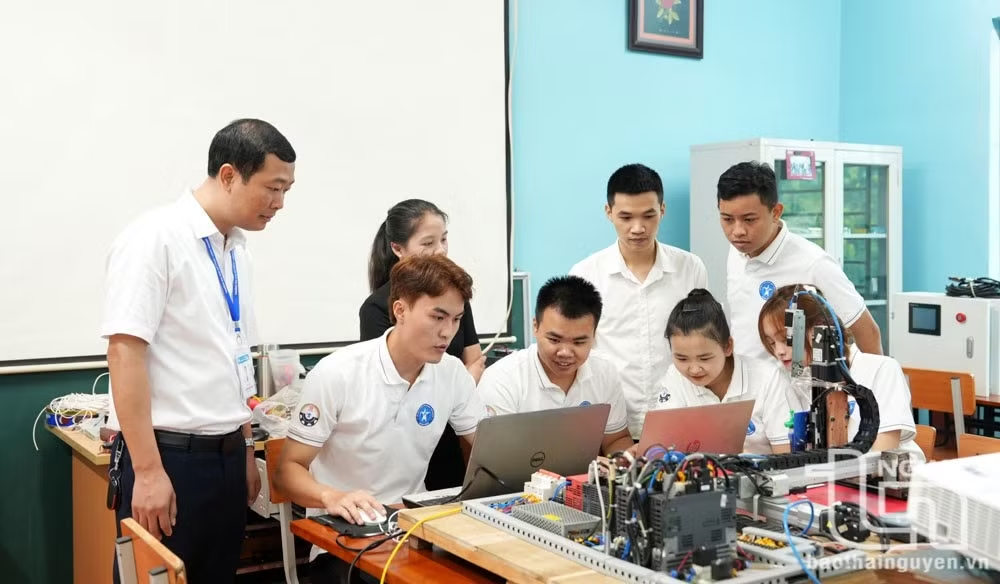
The rapid growth of AI requires lecturers to adapt quickly, improve technological skills, and effectively integrate new tools into teaching. At the same time, universities face challenges related to security, copyright, and upgrading infrastructure to support AI development.
Associate Professor Dr Nguyen Thi Cam Van from the School of Technology under the National Economics University pointed out that using AI in education gives rise to ethical and social concerns: over-reliance on AI for problem-solving and decision-making could hinder independent thinking and analytical skills.
Dr Le Quang Minh, Deputy Director of the Information Technology Institute at Viet Nam National University – Ha Noi, stressed the importance of guiding students to use AI responsibly, with the ability to evaluate outputs and uphold fairness and academic integrity.
Using AI in education gives rise to ethical and social concerns: over-reliance on AI for problem-solving and decision-making could hinder independent thinking and analytical skills.
Associate Professor Dr Le Chi Ngoc from School of Information Technology and Communications under the Ha Noi University of Science and Technology added that a clear ethical framework is essential, ensuring AI remains a support tool while learners act honestly and lecturers assess fairly. Universities, he argued, must not only train but also lead in research, technology development, ethical values, and building a national AI ecosystem.
To advance AI in teaching and learning at higher education institutions, experts recommend that state agencies establish a robust legal framework with clear objectives, technical standards, and quality benchmarks to ensure that AI implementation in educational institutions is carried out effectively, safely, and sustainably.
Strengthening partnerships with technology companies that can provide AI platforms and teaching support tools, expanding international cooperation to learn from and apply the best practices from advanced education systems, and fostering a culture of ethical AI use are seen as vital steps towards creating flexible, innovative learning environments.