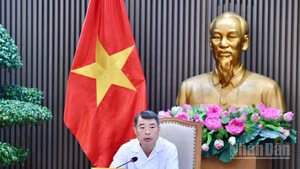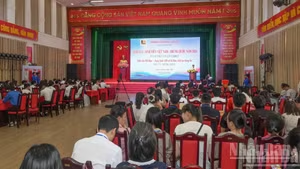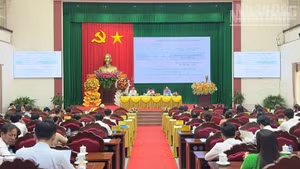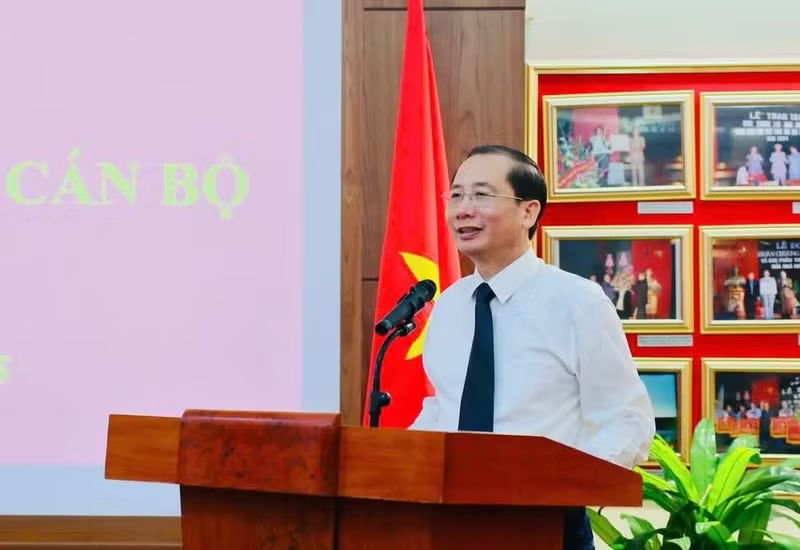
According to Associate Professor Dr Nguyen Ba Chien, Secretary of the Party Committee and Director of the Academy of Public Administration and Governance, the merger is not merely an organisational change, but also a step of strategic repositioning, expanding the academy’s development space amid the requirement to build a modern, effective and efficient national governance system. The academy both inherits a 67-year tradition and promotes closer integration between political theory training and training in governance capacity and public duty performance.
Associate Professor Dr Nguyen Ba Chien discussed the changes following the merger, the initial results of the new development model and the academy’s strategic orientations in the coming time.
Q: Associate Professor Dr Nguyen Ba Chien, after more than one year of implementing the policy of merging into the Ho Chi Minh National Academy of Politics, what are the fundamental changes that most clearly reflect the repositioning of the functions, mission and development space of the Academy of Administration and Public Governance?
A: It can be affirmed that the merger of the National Academy of Public Administration into the Ho Chi Minh National Academy of Politics and its renaming as the Academy of Public Public Administration and Governance was a decision of strategic significance. This is not merely an adjustment to the organisational model, but also a step to reposition the academy’s functions, mission and development space amid the requirement to build a modern and effective national governance system.
After one and a half years of implementation, the academy has quickly stabilised its organisation, maintained solidarity and unity, and ensured that training, retraining, scientific research and international cooperation activities have continued smoothly and effectively. The academy has not only inherited the foundational values built up over the past 67 years, but has also opened up new development space through closer integration between political theory training and training and retraining in governance capacity and public duty performance.
The academy continues to develop towards becoming a key national higher education institution with regional and international prestige in administration, state management, public governance and development governance.
As a unit under the Ho Chi Minh National Academy of Politics, the party school named after beloved President Ho Chi Minh, the academy has more favourable conditions to receive the leadership, direction and strategic guidance of the Party, the State and the leadership of the Ho Chi Minh National Academy of Politics. This is an important foundation for the academy to continue developing towards becoming a key national higher education institution with regional and international prestige in administration, state management, public governance and development governance.
Q: Looking back at the first year of operation under the new model, how do you assess the outstanding results achieved by the academy, especially in training, retraining, scientific research and the performance of assigned political tasks?
A: The first year of operation under the new model can be seen as a period of laying the foundation for a transformation of long-term significance. While having to stabilise its organisation and implement both regular tasks and new political assignments, the academy still achieved many positive results, showing that the new model is beginning to prove effective and generate new momentum for development.
At present, the academy manages more than 16,000 undergraduate students, nearly 2,000 master’s students and more than 200 doctoral candidates, while continuing to strengthen its team of lecturers and experts in both quantity and quality. Its training network is deployed in Ha Noi and three branches in Ho Chi Minh City, Da Nang City and Dak Lak Province, thereby strengthening the connection between training and retraining and governance practice in different regions.
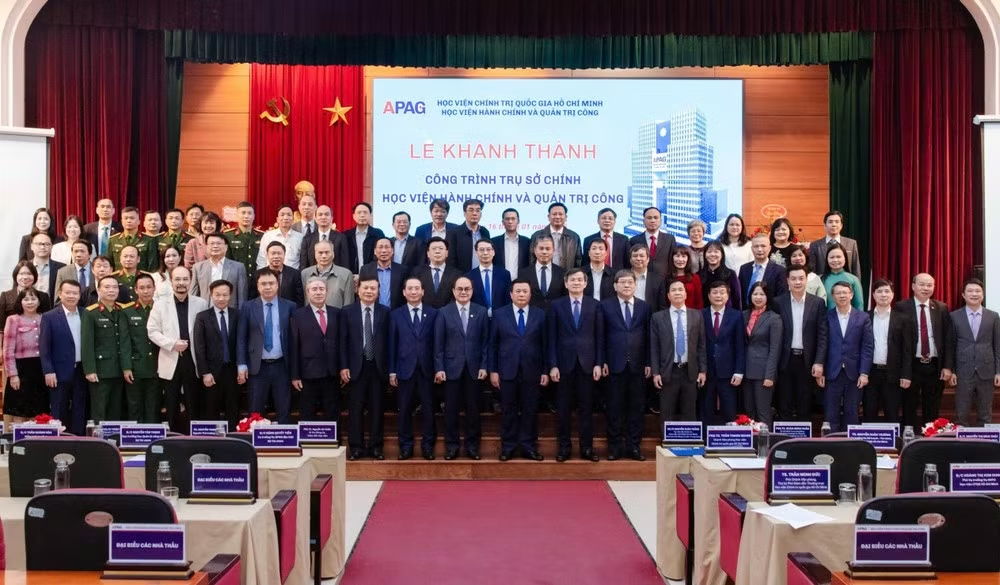
A strategically important highlight is that the academy is shifting strongly from a training model focused mainly on knowledge transmission to a capacity development model, in which lecturers and learners jointly create knowledge and values. The academy focuses on new areas such as development governance, local governance, digital governance, adaptability and innovation, with the aim of equipping learners with solid professional knowledge, systematic thinking, implementation capacity and the ability to lead renewal and development.
In 2025, as assigned and decentralised by the Ho Chi Minh National Academy of Politics, the academy directly participated in compiling materials and organising training programmes for leaders, managers, cadres and civil servants at communal and ward levels and special zone in the context of the restructuring of the organisational apparatus and the implementation of the two-tier local government model. This is an important political task, while further affirming the academy’s core role in improving public duty performance capacity and contributing to strengthening governance effectiveness and efficiency at the grassroots level.
Q: In the context of national digital transformation, the requirement to modernise the administration and improve the quality of public governance human resources is becoming increasingly urgent. What strategic orientations is the academy identifying to meet development requirements in the new stage?
A: The academy has determined that amid national digital transformation and the imperative to modernise public administration, innovation and digital transformation are no longer optional, but prerequisites for improving the quality of university governance, the effectiveness of training and retraining, and its capacity for research and policy consultancy.
At present, the academy is accelerating digital transformation in university governance, training, retraining and scientific research, with the goal of gradually building a “Digital - Green - Smart Academy” model. This is not only a technological orientation, but also a development orientation, taking data, connectivity and modern governance thinking as the foundation for improving the quality, effectiveness and adaptability of the entire system.
In the coming time, the academy continues to enhance its role in policy consultancy and criticism, and proactively participate more deeply in addressing practical issues facing the country, localities, agencies and units.
The major requirement today is to train high-quality human resources with systematic thinking, lifelong learning capacity, rapid adaptability and the courage to act in an increasingly volatile governance environment. Therefore, the academy not only equips students, trainees and doctoral candidates with professional knowledge, but also places emphasis on developing their capacity to create value, innovate, implement solutions and acquire governance skills in a digital environment.
The academy places special emphasis on closely linking training with scientific research and the practice of national governance, local governance, corporate governance and social development governance. In the coming time, the academy will continue to enhance its role in policy consultancy and criticism, and proactively participate more deeply in addressing practical issues facing the country, localities, agencies and units.

At the same time, the academy will continue to expand international cooperation in a practical, effective and in-depth manner; proactively absorb the essence of modern governance knowledge from around the world, while helping introduce Viet Nam’s knowledge and experience in renewing national governance to the region and the world. This is also a task requirement for the academy and an important way for it to gradually enhance its position, academic prestige and integration capacity in the new stage.
Q: On the occasion of the 67th anniversary of the Academy’s founding day, May 29, 1959 - 2026, what expectations and message would you like to convey to the Academy’s staff and learners?
A: The value of an educational institution is measured not only by the scale of its training or its academic achievements, but first and foremost by its capacity to serve the nation and contribute to social progress.
In that sense, the academy’s public employees and workers are the force that preserves its foundation, discipline, tradition, quality and modernity, while generations of learners are the subjects who receive, benefit from and spread those values into governance and public service.
In the new stage of development, the academy must be even more aware of its pioneering responsibility in building a modern, effective and efficient national governance system and a professional civil service.
I believe that, with its 67-year tradition and the strong determination for renewal of its entire staff and learning community, the Academy of Public Administration and Governance will continue to develop commensurately as a leading national centre for training, retraining, scientific research and policy consultancy in the fields of administration, state management, public governance and development governance.
Reporter: Thank you very much.